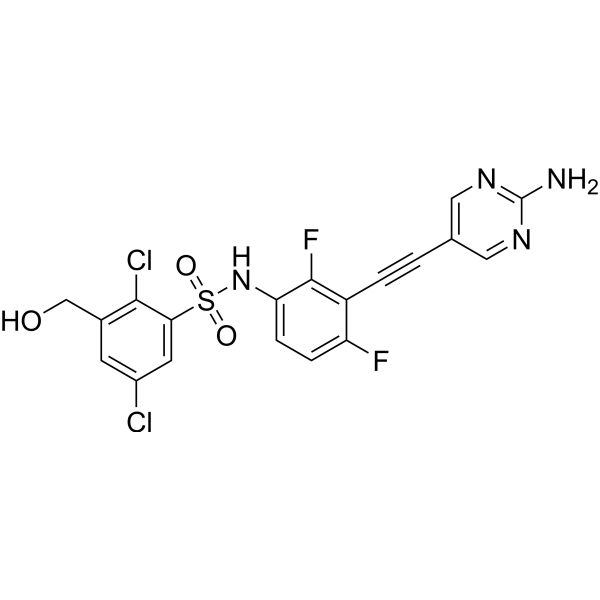
Physicochemical Properties
| Molecular Formula | C19H12CL2F2N4O3S |
| Molecular Weight | 485.291387557983 |
| Exact Mass | 483.997 |
| CAS # | 2183470-09-7 |
| PubChem CID | 137347437 |
| Appearance | Light yellow to yellow solid powder |
| LogP | 3 |
| Hydrogen Bond Donor Count | 3 |
| Hydrogen Bond Acceptor Count | 9 |
| Rotatable Bond Count | 6 |
| Heavy Atom Count | 31 |
| Complexity | 782 |
| Defined Atom Stereocenter Count | 0 |
| SMILES | ClC1C(CO)=CC(=CC=1S(NC1C=CC(=C(C#CC2=CN=C(N)N=C2)C=1F)F)(=O)=O)Cl |
| InChi Key | VJXAWOQPYMAEFQ-UHFFFAOYSA-N |
| InChi Code | InChI=1S/C19H12Cl2F2N4O3S/c20-12-5-11(9-28)17(21)16(6-12)31(29,30)27-15-4-3-14(22)13(18(15)23)2-1-10-7-25-19(24)26-8-10/h3-8,27-28H,9H2,(H2,24,25,26) |
| Chemical Name | N-[3-[2-(2-aminopyrimidin-5-yl)ethynyl]-2,4-difluorophenyl]-2,5-dichloro-3-(hydroxymethyl)benzenesulfonamide |
| HS Tariff Code | 2934.99.9001 |
| Storage |
Powder-20°C 3 years 4°C 2 years In solvent -80°C 6 months -20°C 1 month |
| Shipping Condition | Room temperature (This product is stable at ambient temperature for a few days during ordinary shipping and time spent in Customs) |
Biological Activity
| Targets | GCN2 |
| ln Vitro | In acute lymphoblastic leukemia (ALL) CCRFCEM cells, GCN2-IN-6 (compound 6d) was applied in the presence of asparaginase, an asparagine-depleting agent, to investigate the impact of GCN2 inhibition on cancer cell proliferation. The CCRF-CEM cells' sensitivity to asparaginase was significantly enhanced by treatment with GCN2-IN-6. GCN2 wild-type (WT) mouse embryonic fibroblasts (MEFs) showed a slight antiproliferative impact from combined asparaginase and GCN2-IN-6 treatment, while GCN2 knockout (KO) MEFs did not show this effect. ATF4, p-eIF2α, and GCN2-IN-6 are all inhibited by asparaginase[1]. |
| ln Vivo | GCN2-IN-6 (Compound 6d; 0.3-3 mg/kg; oral) at 3 mg/kg suppresses the autophosphorylation of GCN2 and the downstream effector ATF4 to basal levels following asparaginase pretreatment [1]. |
| Animal Protocol |
Animal/Disease Models: Mice bearing CCRF-CEM cells xenografts[1] Doses: 0.3 mg/kg, 1 mg/kg, and 3 mg/kg Route of Administration: Oral administration; for 8 hrs (hours) Experimental Results: Suppressed both self-phosphorylation of GCN2 and the downstream effector ATF4 to the basal level following pretreatment with asparaginase. |
| References |
[1]. Identification of Novel, Potent, and Orally Available GCN2 Inhibitors with Type I Half Binding Mode. ACS Med Chem Lett. 2019 Sep 19;10(10):1498-1503. |
Solubility Data
| Solubility (In Vitro) | DMSO : 250 mg/mL (515.16 mM) |
| Solubility (In Vivo) |
Solubility in Formulation 1: ≥ 2.08 mg/mL (4.29 mM) (saturation unknown) in 10% DMSO + 40% PEG300 + 5% Tween80 + 45% Saline (add these co-solvents sequentially from left to right, and one by one), clear solution. For example, if 1 mL of working solution is to be prepared, you can add 100 μL of 20.8 mg/mL clear DMSO stock solution to 400 μL PEG300 and mix evenly; then add 50 μL Tween-80 to the above solution and mix evenly; then add 450 μL normal saline to adjust the volume to 1 mL. Preparation of saline: Dissolve 0.9 g of sodium chloride in 100 mL ddH₂ O to obtain a clear solution. Solubility in Formulation 2: ≥ 2.08 mg/mL (4.29 mM) (saturation unknown) in 10% DMSO + 90% Corn Oil (add these co-solvents sequentially from left to right, and one by one), clear solution. For example, if 1 mL of working solution is to be prepared, you can add 100 μL of 20.8 mg/mL clear DMSO stock solution to 900 μL of corn oil and mix evenly. (Please use freshly prepared in vivo formulations for optimal results.) |
| Preparing Stock Solutions | 1 mg | 5 mg | 10 mg | |
| 1 mM | 2.0606 mL | 10.3031 mL | 20.6062 mL | |
| 5 mM | 0.4121 mL | 2.0606 mL | 4.1212 mL | |
| 10 mM | 0.2061 mL | 1.0303 mL | 2.0606 mL |