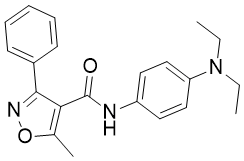
GATA4-NKX2-5-IN-1 (Compound 3) dose-dependently inhibits the GATA4–NKX2-5 transcriptional synergy with an IC50 of 3 μM. GATA4-NKX2-5-IN-1 exhibits no activity on the protein kinases involved in the regulation of GATA4 phosphorylation, and it modulates the hypertrophic agonist-induced cardiac gene expression.
Physicochemical Properties
| Molecular Formula | C21H23N3O2 |
| Molecular Weight | 349.426 |
| Exact Mass | 349.179 |
| CAS # | 544681-96-1 |
| PubChem CID | 753168 |
| Appearance | Off-white to pale purple solid powder |
| LogP | 4.1 |
| Hydrogen Bond Donor Count | 1 |
| Hydrogen Bond Acceptor Count | 4 |
| Rotatable Bond Count | 6 |
| Heavy Atom Count | 26 |
| Complexity | 441 |
| Defined Atom Stereocenter Count | 0 |
| InChi Key | UDDOZWWBHVIGDS-UHFFFAOYSA-N |
| InChi Code | InChI=1S/C21H23N3O2/c1-4-24(5-2)18-13-11-17(12-14-18)22-21(25)19-15(3)26-23-20(19)16-9-7-6-8-10-16/h6-14H,4-5H2,1-3H3,(H,22,25) |
| Chemical Name | N-[4-(diethylamino)phenyl]-5-methyl-3-phenyl-1,2-oxazole-4-carboxamide |
| HS Tariff Code | 2934.99.9001 |
| Storage |
Powder-20°C 3 years 4°C 2 years In solvent -80°C 6 months -20°C 1 month |
| Shipping Condition | Room temperature (This product is stable at ambient temperature for a few days during ordinary shipping and time spent in Customs) |
Biological Activity
| Targets |
- GATA4-NKX2-5-IN-1 targets the GATA4-NKX2-5 protein-protein interaction [1] |
| ln Vitro |
- GATA4-NKX2-5-IN-1 inhibits the synergistic transcriptional activity of GATA4 and NKX2-5 by disrupting their protein-protein interaction. This effect was assessed via luciferase reporter assays in HEK293 cells, which were transfected with GATA4 and NKX2-5 expression vectors plus a GATA4/NKX2-5-responsive luciferase reporter construct. The compound showed dose-dependent inhibition of reporter gene activity, confirming disruption of the GATA4-NKX2-5 transcription factor complex [1] |
| Enzyme Assay |
- For evaluating the effect of GATA4-NKX2-5-IN-1 on GATA4-NKX2-5 interaction, a luciferase reporter assay was performed. HEK293 cells were co-transfected with GATA4 and NKX2-5 expression plasmids, as well as a luciferase reporter plasmid containing GATA4/NKX2-5 binding sites. Cells were treated with different concentrations of GATA4-NKX2-5-IN-1 for 24 hours. After treatment, luciferase activity was measured using a luminometer, and results were normalized to protein concentration. The assay confirmed the compound’s concentration-dependent inhibition of luciferase activity, indicating its ability to disrupt GATA4-NKX2-5 interaction [1] |
| Cell Assay |
- A cell-based luciferase reporter assay was used to assess GATA4-NKX2-5-IN-1 ’s impact on GATA4-NKX2-5 transcriptional activity. HEK293 cells were co-transfected with GATA4 and NKX2-5 expression vectors, along with a GATA4/NKX2-5-responsive luciferase reporter construct. Following transfection, cells were treated with varying concentrations of GATA4-NKX2-5-IN-1 for 24 hours. Luciferase activity was then measured and normalized to protein concentration, revealing the compound’s dose-dependent inhibition of GATA4-NKX2-5-mediated transcriptional activity [1] |
| References | : Välimäki MJ, et al. Discovery of Small Molecules Targeting the Synergy of Cardiac Transcription Factors GATA4 and NKX2-5. J Med Chem. 2017 Sep 28;60(18):7781-7798. |
| Additional Infomation |
- GATA4 and NKX2-5 are key transcription factors in cardiac development and function; their synergistic interaction regulates the expression of genes involved in cardiomyocyte differentiation and heart development. GATA4-NKX2-5-IN-1 was developed to target the GATA4-NKX2-5 protein-protein interaction, which may provide a therapeutic approach for diseases linked to aberrant GATA4-NKX2-5 signaling (e.g., congenital heart defects) [1] |
Solubility Data
| Solubility (In Vitro) | DMSO : ~83.33 mg/mL (~238.47 mM) |
| Solubility (In Vivo) |
Solubility in Formulation 1: 2.08 mg/mL (5.95 mM) in 10% DMSO + 90% (20% SBE-β-CD in Saline) (add these co-solvents sequentially from left to right, and one by one), suspension solution; with sonication. For example, if 1 mL of working solution is to be prepared, you can add 100 μL of 20.8 mg/mL clear DMSO stock solution to 900 μL of 20% SBE-β-CD physiological saline solution and mix evenly. Preparation of 20% SBE-β-CD in Saline (4°C,1 week): Dissolve 2 g SBE-β-CD in 10 mL saline to obtain a clear solution. Solubility in Formulation 2: ≥ 2.08 mg/mL (5.95 mM) (saturation unknown) in 10% DMSO + 90% Corn Oil (add these co-solvents sequentially from left to right, and one by one), clear solution. For example, if 1 mL of working solution is to be prepared, you can add 100 μL of 20.8 mg/mL clear DMSO stock solution to 900 μL of corn oil and mix evenly. (Please use freshly prepared in vivo formulations for optimal results.) |
| Preparing Stock Solutions | 1 mg | 5 mg | 10 mg | |
| 1 mM | 2.8618 mL | 14.3090 mL | 28.6180 mL | |
| 5 mM | 0.5724 mL | 2.8618 mL | 5.7236 mL | |
| 10 mM | 0.2862 mL | 1.4309 mL | 2.8618 mL |