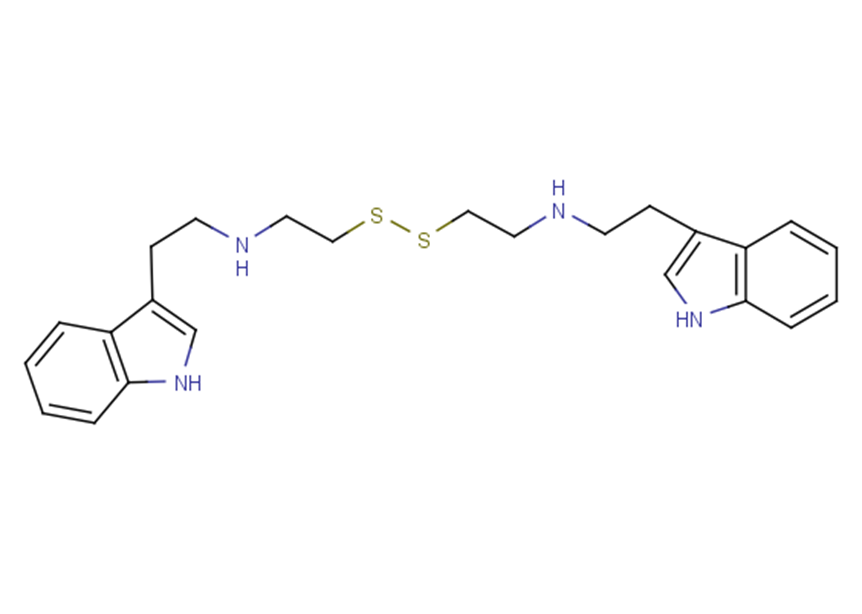
Physicochemical Properties
| Molecular Formula | C24H30N4S2 |
| Molecular Weight | 438.6518 |
| Exact Mass | 438.191 |
| CAS # | 421581-52-4 |
| PubChem CID | 6615809 |
| Appearance | Light yellow to yellow ointment |
| LogP | 4.2 |
| Hydrogen Bond Donor Count | 4 |
| Hydrogen Bond Acceptor Count | 4 |
| Rotatable Bond Count | 13 |
| Heavy Atom Count | 30 |
| Complexity | 438 |
| Defined Atom Stereocenter Count | 0 |
| InChi Key | AJBHTYKMNQDUAA-UHFFFAOYSA-N |
| InChi Code | InChI=1S/C24H30N4S2/c1-3-7-23-21(5-1)19(17-27-23)9-11-25-13-15-29-30-16-14-26-12-10-20-18-28-24-8-4-2-6-22(20)24/h1-8,17-18,25-28H,9-16H2 |
| Chemical Name | 2-(1H-indol-3-yl)-N-[2-[2-[2-(1H-indol-3-yl)ethylamino]ethyldisulfanyl]ethyl]ethanamine |
| HS Tariff Code | 2934.99.9001 |
| Storage |
Powder-20°C 3 years 4°C 2 years In solvent -80°C 6 months -20°C 1 month |
| Shipping Condition | Room temperature (This product is stable at ambient temperature for a few days during ordinary shipping and time spent in Customs) |
Biological Activity
| ln Vitro | In SH-SY5Y cells, 1μM AG1 (50, 100, 250, 500, 750, and 1000 nM) enhanced the proteolytic stability and 20% increased the activity of Canton G6PD. AG1's lack of response to siRNA-induced downregulation of G6PD supports its G6PD specificity [2]. In human red blood cell suspensions (5%) exposed to 1 mM chloroquine (CQ; 4 hours) or diamide (GSH oxidant; 4 hours), AG1 (1-5 μM; overnight preincubation) decreases hemolysis. When these medications cause oxidative stress, AG1 raises GSH and lowers ROS levels while raising G6PD activity [2]. Several other NAD- or NADP+-dependent dimerizing or tetramerizing enzymes, such as 6-phosphogluconate dehydrogenase (6PGD), glyceraldehyde 3-phosphate dehydrogenase (GAPDH), aldehyde dehydrogenase 2 (ALDH2), and aldehyde dehydrogenase 3A1 (ALDH3A1), are not affected by AG1 in terms of dimerization or activity[2]. |
| References |
[1]. https://patents.google.com/patent/WO2019023264A1/en?oq=WO2019023264A1. [2]. Current investigations on clinical pharmacology and therapeutics of Glucose-6-phosphate dehydrogenase deficiency. Pharmacol Ther. 2020 Dec 14;222:107788. |
| Additional Infomation | N,N'-[disulfanediyldi(ethane-2,1-diyl)]bis[2-(1H-indol-3-yl)ethan-1-amine] is an organic disulfide composed of two molecules of 2-{[2-(1H-indol-3-yl)ethyl]amino}ethane-1-thiol linked together via a disulfide bond. It is a glucose-6-phosphate dehydrogenase (G6PD) activator which reduces oxidative stress in cells and zebrafish. It is an organic disulfide, a member of indoles and a secondary amino compound. |
Solubility Data
| Solubility (In Vitro) | DMSO : ~20.83 mg/mL (~47.49 mM) |
| Solubility (In Vivo) |
Solubility in Formulation 1: ≥ 2.08 mg/mL (4.74 mM) (saturation unknown) in 10% DMSO + 40% PEG300 + 5% Tween80 + 45% Saline (add these co-solvents sequentially from left to right, and one by one), clear solution. For example, if 1 mL of working solution is to be prepared, you can add 100 μL of 20.8 mg/mL clear DMSO stock solution to 400 μL PEG300 and mix evenly; then add 50 μL Tween-80 to the above solution and mix evenly; then add 450 μL normal saline to adjust the volume to 1 mL. Preparation of saline: Dissolve 0.9 g of sodium chloride in 100 mL ddH₂ O to obtain a clear solution. Solubility in Formulation 2: ≥ 2.08 mg/mL (4.74 mM) (saturation unknown) in 10% DMSO + 90% Corn Oil (add these co-solvents sequentially from left to right, and one by one), clear solution. For example, if 1 mL of working solution is to be prepared, you can add 100 μL of 20.8 mg/mL clear DMSO stock solution to 900 μL of corn oil and mix evenly. (Please use freshly prepared in vivo formulations for optimal results.) |
| Preparing Stock Solutions | 1 mg | 5 mg | 10 mg | |
| 1 mM | 2.2797 mL | 11.3986 mL | 22.7972 mL | |
| 5 mM | 0.4559 mL | 2.2797 mL | 4.5594 mL | |
| 10 mM | 0.2280 mL | 1.1399 mL | 2.2797 mL |