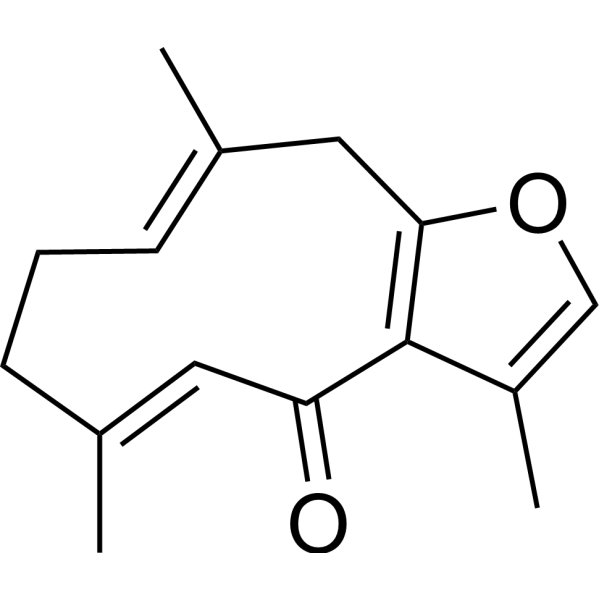
Physicochemical Properties
| Molecular Formula | C15H18O2 |
| Molecular Weight | 230.3022 |
| Exact Mass | 230.13 |
| CAS # | 24268-41-5 |
| PubChem CID | 6506548 |
| Appearance | White to off-white solid powder |
| Density | 1.0±0.1 g/cm3 |
| Boiling Point | 363.8±42.0 °C at 760 mmHg |
| Flash Point | 172.0±20.6 °C |
| Vapour Pressure | 0.0±0.8 mmHg at 25°C |
| Index of Refraction | 1.510 |
| LogP | 4.76 |
| Hydrogen Bond Donor Count | 0 |
| Hydrogen Bond Acceptor Count | 2 |
| Rotatable Bond Count | 0 |
| Heavy Atom Count | 17 |
| Complexity | 365 |
| Defined Atom Stereocenter Count | 0 |
| SMILES | C/C/1=C\C(=O)C2=C(C/C(=C/CC1)/C)OC=C2C |
| InChi Key | XVOHELPNOXGRBQ-NXAIOARDSA-N |
| InChi Code | InChI=1S/C15H18O2/c1-10-5-4-6-11(2)8-14-15(13(16)7-10)12(3)9-17-14/h6-7,9H,4-5,8H2,1-3H3/b10-7+,11-6+ |
| Chemical Name | (5E,9E)-3,6,10-trimethyl-8,11-dihydro-7H-cyclodeca[b]furan-4-one |
| HS Tariff Code | 2934.99.9001 |
| Storage |
Powder-20°C 3 years 4°C 2 years In solvent -80°C 6 months -20°C 1 month Note: Please store this product in a sealed and protected environment (e.g. under nitrogen), avoid exposure to moisture and light. |
| Shipping Condition | Room temperature (This product is stable at ambient temperature for a few days during ordinary shipping and time spent in Customs) |
Biological Activity
| Targets |
- Furanodienone targets epidermal growth factor receptor (EGFR) [1] - Furanodienone targets human epidermal growth factor receptor 2 (HER2),with IC50 values of 7.8 μM (SK-BR-3 cells), 9.2 μM (BT-474 cells), 12.5 μM (MCF-7/HER2 cells), and >50 μM (MCF-7 cells, HER2-low expression) for cell proliferation inhibition [1] |
| ln Vitro |
During a 24-hour period, furandienone (0-573.8 μM) exhibited the following IC50 values: 56.4 μM (RKO), 73.7 μM (sw480), 251.1 μM (HT-29), 412.5 μM (sw620), and 573.8 μM (LoVo); additionally, after 48 hours, the IC50 values were 51.8 μM (RKO), 44.18 μM (sw480), 168.9 μM (HT-29), 314.2 μM (sw620), and 502.1 μM (LoVo), respectively [1]. Furandienone (0-150 μM; 24 hours) caused apoptosis and elevated the activity of caspase-9 and -3 in both cells, but it had relatively little effect on caspase-8 in RKO and HT-29 cells [1]. In RKO cells at 75 and 150 μM doses, furandienone (0-150 μM; 24 h) enhanced the apoptotic rate from 2.34±0.45% to 19.45±2.37% and 27.34±0.79%. HT-29 cells exhibited apoptotic rates of 12.4±1.08 and 20.64±3.02% at doses of 75 and 150 μM, respectively, in contrast to 2.89±0.26% [1]. - In HER2-overexpressing human breast cancer cells (SK-BR-3, BT-474, MCF-7/HER2), Furanodienone (5 μM - 40 μM) dose-dependently inhibited cell proliferation, with significant inhibition at concentrations ≥10 μM compared to the control group. It showed weak inhibitory effect on HER2-low expressing MCF-7 cells (IC50 >50 μM) [1] - Furanodienone (10 μM, 20 μM) induced G2/M phase cell cycle arrest in SK-BR-3 and BT-474 cells. Flow cytometry analysis showed that the proportion of cells in G2/M phase increased from ~15% (control) to ~35% (20 μM treatment) after 24 hours [1] - Furanodienone (10 μM, 20 μM) promoted apoptosis in SK-BR-3 cells, as evidenced by increased Annexin V-positive cells (from ~3% to ~28% at 20 μM) and elevated caspase-3 activity (1.8-fold and 2.5-fold increase at 10 μM and 20 μM, respectively) [1] - Furanodienone (5 μM - 20 μM) dose-dependently suppressed the phosphorylation of EGFR (Tyr1068) and HER2 (Tyr1248) in SK-BR-3 cells, without affecting the total protein levels of EGFR and HER2. It also downregulated the phosphorylation of downstream signaling molecules AKT (Ser473) and ERK1/2 (Thr202/Tyr204) [1] - Furanodienone (20 μM) reduced the expression of cell cycle-related proteins cyclin B1 and cdc2, and increased the expression of p21 (a cyclin-dependent kinase inhibitor) in SK-BR-3 cells [1] |
| ln Vivo |
- In nude mice bearing SK-BR-3 xenograft tumors, intraperitoneal administration of Furanodienone (20 mg/kg, 40 mg/kg) once daily for 21 days significantly inhibited tumor growth. The high-dose group (40 mg/kg) showed a tumor volume inhibition rate of ~62% and a tumor weight inhibition rate of ~58% compared to the vehicle control group [1] - Immunohistochemical analysis of tumor tissues from treated mice revealed that Furanodienone (40 mg/kg) reduced the phosphorylation levels of EGFR, HER2, AKT, and ERK1/2, and decreased the Ki-67 labeling index (a proliferation marker) from ~65% (control) to ~28% [1] |
| Enzyme Assay |
- For EGFR kinase activity assay: Purified recombinant EGFR kinase domain was incubated with different concentrations of Furanodienone (1 μM - 50 μM) in reaction buffer containing ATP and a synthetic peptide substrate (corresponding to EGFR autophosphorylation site). The reaction was incubated at 37°C for 60 minutes, then terminated by adding stop buffer. The phosphorylated peptide was detected using a sandwich ELISA, and the inhibition rate of EGFR kinase activity was calculated. Furanodienone showed dose-dependent inhibition of EGFR kinase activity with an IC50 of ~12.3 μM [1] - For HER2 kinase activity assay: Purified recombinant HER2 kinase domain was treated with Furanodienone (1 μM - 50 μM) following the same protocol as EGFR kinase assay. The IC50 for HER2 kinase activity inhibition was ~10.7 μM [1] |
| Cell Assay |
Western Blot Analysis[1] Cell Types: RKO and HT-29 Cell Tested Concentrations: 0 μM; 50μM; 100μM; 150 μM Incubation Duration: 24 hrs (hours) Experimental Results: Increased caspase-9 and -3. Apoptosis analysis [1] Cell Types: RKO and HT-29 Cell Tested Concentrations: 0 μM; 75 μM; 150 μM Incubation Duration: 24 hrs (hours) Experimental Results: Induced apoptosis of colorectal cells (RKO and HT-29). - Cell proliferation assay: HER2-overexpressing (SK-BR-3, BT-474, MCF-7/HER2) and HER2-low (MCF-7) breast cancer cells were seeded in 96-well plates (5×10³ cells/well) and cultured overnight. Furanodienone at concentrations of 5 μM, 10 μM, 20 μM, 40 μM was added, and cells were cultured for 72 hours. A colorimetric assay based on tetrazolium salt reduction was used to measure cell viability, and IC50 values were calculated from dose-response curves [1] - Cell cycle analysis: SK-BR-3 and BT-474 cells were seeded in 6-well plates (2×10⁵ cells/well) and treated with Furanodienone (10 μM, 20 μM) for 24 hours. Cells were harvested, fixed with 70% ethanol at -20°C overnight, stained with propidium iodide (PI) containing RNase A, and analyzed by flow cytometry to determine cell cycle distribution [1] - Apoptosis assay: SK-BR-3 cells were treated with Furanodienone (10 μM, 20 μM) for 48 hours. Cells were collected, washed with PBS, and stained with Annexin V-FITC and PI. Apoptotic cells (Annexin V-positive/PI-negative and Annexin V-positive/PI-positive) were quantified by flow cytometry. Caspase-3 activity was measured using a colorimetric assay with a specific substrate [1] - Western blot analysis: SK-BR-3 cells were treated with Furanodienone (5 μM - 20 μM) for 24 hours. Total protein was extracted, separated by SDS-PAGE, and transferred to a polyvinylidene difluoride membrane. The membrane was incubated with primary antibodies against p-EGFR (Tyr1068), EGFR, p-HER2 (Tyr1248), HER2, p-AKT (Ser473), AKT, p-ERK1/2 (Thr202/Tyr204), ERK1/2, cyclin B1, cdc2, p21, and β-actin (loading control), followed by a horseradish peroxidase-conjugated secondary antibody. Protein bands were visualized by chemiluminescence, and band intensity was quantified using image analysis software [1] - Colony formation assay: SK-BR-3 cells were seeded in 6-well plates (1×10³ cells/well) and treated with Furanodienone (5 μM, 10 μM, 20 μM) for 14 days. Colonies were fixed with methanol, stained with crystal violet, and counted. The number of colonies in treated groups was compared to the control group to calculate the colony formation inhibition rate [1] |
| Animal Protocol |
- Animals: Female BALB/c nude mice (4-6 weeks old, 18-22 g) were housed under specific pathogen-free conditions with free access to food and water [1] - Tumor xenograft model: SK-BR-3 cells (5×10⁶ cells/mouse) suspended in Matrigel were subcutaneously injected into the right flank of nude mice. When tumors reached a volume of ~100 mm³, mice were randomly divided into three groups (n=6 per group): control group, low-dose (20 mg/kg) Furanodienone group, and high-dose (40 mg/kg) Furanodienone group [1] - Drug administration: Furanodienone was dissolved in dimethyl sulfoxide (DMSO) and diluted with normal saline (final DMSO concentration ≤5%). The drug was administered intraperitoneally once daily for 21 days. The control group received an equal volume of the vehicle (DMSO + normal saline) [1] - Sample collection and analysis: Tumor volume was measured every 3 days using a caliper (volume = length × width² / 2). At the end of the experiment, mice were euthanized, and tumors were excised, weighed, and fixed in 4% paraformaldehyde for immunohistochemical analysis. Tumor tissue sections were stained with antibodies against p-EGFR, p-HER2, p-AKT, p-ERK1/2, and Ki-67, and positive staining was quantified [1] |
| Toxicity/Toxicokinetics |
- During the 21-day in vivo experiment, Furanodienone (20 mg/kg, 40 mg/kg) did not cause significant changes in mouse body weight (no more than 10% reduction compared to control) [1] - Serum biochemical analysis showed no significant elevation of alanine transaminase (ALT), aspartate transaminase (AST), blood urea nitrogen (BUN), or creatinine levels in treated mice compared to the control group, indicating no obvious hepatotoxicity or nephrotoxicity [1] |
| References |
[1]. Furanodienone induces cell cycle arrest and apoptosis by suppressing EGFR/HER2 signaling in HER2-overexpressing human breast cancer cells. Cancer Chemother Pharmacol. 2011 Nov;68(5):1315-23. |
| Additional Infomation |
Furanodienone is a germacrane sesquiterpenoid. (5E,9E)-3,6,10-trimethyl-8,11-dihydro-7H-cyclodeca[b]furan-4-one has been reported in Curcuma xanthorrhiza, Commiphora erythraea, and other organisms with data available. - Furanodienone is a natural sesquiterpenoid isolated from the rhizome of Curcuma zedoaria [1] - Its anti-tumor activity is specifically directed against HER2-overexpressing breast cancer cells, mediated by suppressing EGFR/HER2 signaling pathway, which leads to G2/M phase cell cycle arrest and caspase-dependent apoptosis [1] - Furanodienone does not affect the total protein expression of EGFR and HER2, but specifically inhibits their phosphorylation (activation) and downstream AKT/ERK1/2 signaling cascades [1] |
Solubility Data
| Solubility (In Vitro) | DMSO : ~100 mg/mL (~434.22 mM) |
| Solubility (In Vivo) |
Solubility in Formulation 1: ≥ 2.5 mg/mL (10.86 mM) (saturation unknown) in 10% DMSO + 40% PEG300 + 5% Tween80 + 45% Saline (add these co-solvents sequentially from left to right, and one by one), clear solution. For example, if 1 mL of working solution is to be prepared, you can add 100 μL of 25.0 mg/mL clear DMSO stock solution to 400 μL PEG300 and mix evenly; then add 50 μL Tween-80 to the above solution and mix evenly; then add 450 μL normal saline to adjust the volume to 1 mL. Preparation of saline: Dissolve 0.9 g of sodium chloride in 100 mL ddH₂ O to obtain a clear solution. Solubility in Formulation 2: ≥ 2.5 mg/mL (10.86 mM) (saturation unknown) in 10% DMSO + 90% (20% SBE-β-CD in Saline) (add these co-solvents sequentially from left to right, and one by one), clear solution. For example, if 1 mL of working solution is to be prepared, you can add 100 μL of 25.0 mg/mL clear DMSO stock solution to 900 μL of 20% SBE-β-CD physiological saline solution and mix evenly. Preparation of 20% SBE-β-CD in Saline (4°C,1 week): Dissolve 2 g SBE-β-CD in 10 mL saline to obtain a clear solution. Solubility in Formulation 3: ≥ 2.5 mg/mL (10.86 mM) (saturation unknown) in 10% DMSO + 90% Corn Oil (add these co-solvents sequentially from left to right, and one by one), clear solution. For example, if 1 mL of working solution is to be prepared, you can add 100 μL of 25.0 mg/mL clear DMSO stock solution to 900 μL of corn oil and mix evenly. (Please use freshly prepared in vivo formulations for optimal results.) |
| Preparing Stock Solutions | 1 mg | 5 mg | 10 mg | |
| 1 mM | 4.3422 mL | 21.7108 mL | 43.4216 mL | |
| 5 mM | 0.8684 mL | 4.3422 mL | 8.6843 mL | |
| 10 mM | 0.4342 mL | 2.1711 mL | 4.3422 mL |