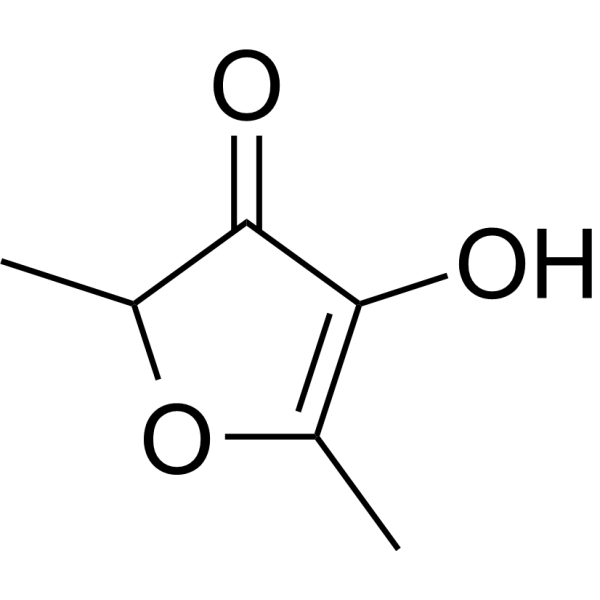
Physicochemical Properties
| Molecular Formula | C6H8O3 |
| Molecular Weight | 128.12592 |
| Exact Mass | 128.047 |
| CAS # | 3658-77-3 |
| PubChem CID | 19309 |
| Appearance | White to off-white solid powder |
| Density | 1.3±0.1 g/cm3 |
| Boiling Point | 215.5±40.0 °C at 760 mmHg |
| Melting Point | 73-77 °C(lit.) |
| Flash Point | 90.5±20.8 °C |
| Vapour Pressure | 0.0±0.9 mmHg at 25°C |
| Index of Refraction | 1.513 |
| LogP | 0.34 |
| Hydrogen Bond Donor Count | 1 |
| Hydrogen Bond Acceptor Count | 3 |
| Rotatable Bond Count | 0 |
| Heavy Atom Count | 9 |
| Complexity | 181 |
| Defined Atom Stereocenter Count | 0 |
| InChi Key | INAXVXBDKKUCGI-UHFFFAOYSA-N |
| InChi Code | InChI=1S/C6H8O3/c1-3-5(7)6(8)4(2)9-3/h3,8H,1-2H3 |
| Chemical Name | 4-hydroxy-2,5-dimethylfuran-3-one |
| HS Tariff Code | 2934.99.9001 |
| Storage |
Powder-20°C 3 years 4°C 2 years In solvent -80°C 6 months -20°C 1 month |
| Shipping Condition | Room temperature (This product is stable at ambient temperature for a few days during ordinary shipping and time spent in Customs) |
Biological Activity
| Targets |
- UDP-glucose: furaneol glucosyltransferase (VvFGT):Furaneol is the specific substrate of this enzyme, which catalyzes the glucosylation of Furaneol to form furaneol β -D-glucoside. [1] |
| ln Vitro |
1. Enzymatic glucosylation of Furaneol by recombinant VvFGT: - Recombinant VvFGT (expressed in E. coli) catalyzed the conversion of Furaneol to furaneol-β -D-glucoside in the presence of UDP-glucose (cofactor) [1] - Optimal reaction conditions for Furaneol glucosylation: pH 7.5, temperature 30°C; under these conditions, the enzyme showed maximum activity toward Furaneol, with a reaction efficiency 3.2-fold higher than that toward other structurally similar substrates (e.g., 4-hydroxy-2,5-dimethyl-3(2H)-furanone) [1] - Substrate specificity: VvFGT exhibited high selectivity for Furaneol; no detectable glucosylation activity was observed when using other aroma compounds (e.g., vanillin, hexanol) as substrates [1] - Product identification: The reaction product was confirmed as furaneol-β -D-glucoside via high-performance liquid chromatography (HPLC) and liquid chromatography-mass spectrometry (LC-MS), with a retention time matching the authentic standard [1] |
| Enzyme Assay |
1. VvFGT enzyme activity assay (using Furaneol as substrate): - Reaction system composition: Total volume 100 μl, containing 50 mM Tris-HCl buffer (pH 7.5), 5 mM UDP-glucose (cofactor), 1 mM Furaneol (substrate), and 10 μg recombinant VvFGT protein [1] - Incubation conditions: The reaction mixture was incubated at 30°C for 30 minutes; the reaction was terminated by adding 10 μl of 10% trichloroacetic acid (TCA) [1] - Product detection: The mixture was centrifuged at 12,000×g for 10 minutes; the supernatant was filtered through a 0.22 μm membrane and analyzed by HPLC [1] - HPLC conditions: C18 column (4.6 × 250 mm), mobile phase (acetonitrile: water = 10:90, v/v), flow rate 1 ml/min, detection wavelength 280 nm; furaneol-β -D-glucoside was quantified using a standard curve [1] 2. Recombinant VvFGT expression and purification: - The VvFGT gene was cloned into a prokaryotic expression vector and transformed into E. coli BL21 (DE3) cells [1] - Cells were cultured in LB medium containing antibiotics at 37°C until OD₆₀₀ reached 0.6; isopropyl β -D-thiogalactopyranoside (IPTG) was added to a final concentration of 0.5 mM to induce protein expression, followed by incubation at 18°C for 16 hours [1] - Cells were harvested by centrifugation (6,000×g for 10 minutes), resuspended in lysis buffer, and sonicated on ice; the lysate was centrifuged at 15,000×g for 20 minutes to collect the supernatant [1] - The recombinant VvFGT protein was purified from the supernatant using affinity chromatography (based on the His-tag fused to the protein) and desalted using a desalting column; protein purity was verified by SDS-PAGE [1] |
| ADME/Pharmacokinetics |
Absorption, Distribution and Excretion 2,5-Dimethyl-4-hydroxy-3[2H]furanone (Furaneol, DMHF) [3658-77-3], an important flavor constituent of strawberry fruit, was administered to four male and two female volunteers using fresh strawberries as a natural DMHF source. The amount excreted was determined by measuring urinary levels of DMHF and DMHF glucuronide. DMHF glucuronide was synthesized and the structure elucidated by mens of (1)H, (13)C and two dimensional nuclear magnetic resonance, as well as mass spectral data. Identification and quantification of DMHF glucuronide in human urine were achieved after solid phase extraction on XAD-2 using reverse-phase reverse-phase HPLC with either on-line UV/VIS or electrospray tandem mass spectrometry detection. Male and female volunteers excreted 59-69% and 81-94%, respectively, of the DMHF dose (total of free and glycosidically bound DMHF in strawberries) as DMHF glucuronide in urine within 24 hr. The amount of DMHF excretion was independent of the dose size and the ratio of free to glycosidically bound forms of DMHF in strawberry fruit. DMHF, DMHF glucoside and its 6'-O-malonyl derivative, naturally occurring in strawberries, were not detected in human urine. Fragrant hydroxyfuranone and dihydroxypyranone derivatives generated in the Maillard reaction of sugars and amino acids are detected in various processed foods and have been shown active to break DNA single-strand in the in vitro studies. In the present study, absorption of 2,5-dimethyl-4-hydroxy-3(2 H)-furanone (DMHF) and 4-hydroxy-2(or 5)-ethyl-5(or 2)-methyl-3(2 H)-furanone (HEMF), both found in soy sauce, into plasma after a single intraperitoneal or oral administration at doses of 0.5-1.0 g/kg to mice was examined. Both compounds appeared in plasma 15 min after intraperitoneal administration and disappeared 2 hr after the administration. They appeared in plasma 5 min after oral administration, reached maximum after 15-45 min, and gradually disappeared after 2 h, indicating that they are absorbed by the digestive tract. Both DMHF and HEMF induced micronucleated reticulocytes (MNRETs) in mouse peripheral blood in a dose-dependent manner after oral administration. The results indicate that DMHF and HEMF can cause genetic damage after oral administration. 4-Hydroxy-2,5-dimethyl-3(2H)-furanone is expected to share the same metabolic fate as the primary material, i.e. conjugation with glucuronic acid and excretion in the urine. Metabolism / Metabolites 4-Hydroxy-2,5-dimethyl-3(2H)-furanone is expected to share the same metabolic fate as the primary material, i.e. conjugation with glucuronic acid and excretion in the urine. |
| Toxicity/Toxicokinetics |
Toxicity Summary IDENTIFICATION AND USE: Dimethylhydroxy furanone is a beige powder. It is used as a flavoring agent and experimental medication. HUMAN EXPOSURE AND TOXICITY: 2,5-Dimethyl-4-hydroxy-3(2H)-furanone (2,5-DMHF), a caramel-like fragrant compound found in many processed foodstuffs, has been reported to be mutagenic. 2,5-DMHF generates superoxide and subsequently hydrogen peroxide to induce metal-dependent DNA damage. ANIMAL STUDIES: Groups of 60 male and 60 female rats were given diets containing 2,5-DMHF at a dose of 0 (control), 100, 200 or 400 mg/kg bw per day for 24 months. No significant compound-related effects were reported in any of the animals at 100 and 200 mg/kg bw per day. The mean body weights and body-weight gains of males and females at the highest dose (400 mg/kg bw per day) were significantly lower than those of control animals at 24 months. The mean survival rate for males in the group receiving the highest dose was significantly lower (approximately 20%, p<0.05) than that of males in the control group at 24 months. The authors concluded that this finding was attributable to an increased incidence of adenomas of the pars distalis of the pituitary, with subsequent compression of the hypothalamic region within the brains of males at the highest dose. It was concluded that these adenomas were common, spontaneous tumors that were unrelated to the administration of 2,5-DMHF. 2,5-DMHF showed mutagenicity to Salmonella typhimurium TA100 strain with and without metabolic activation, and induced micronucleated mouse peripheral reticulocytes. 2,5-DMHF induced micronucleated reticulocytes in mouse peripheral blood in a dose-dependent manner after oral administration /at doses of 0.5-1.0 g/kg/. The results indicate that DMHF can cause genetic damage after oral administration. Interactions 2,5-Dimethyl-4-hydroxy-3(2 H)-furanone (DMHF), produced by Maillard reaction of sugar/amino acid and found in various foodstuffs, showed mutagenicity to Salmonella typhimurium TA100 strain with and without S9 mix, and induced micronucleated mouse peripheral reticulocytes. DNA strand breaking activity of the compound at pH 7.4 increased with the increasing dose of the compound and with the increasing incubation time. The breaking activity was inhibited in the presence of superoxide dismutase, catalase, hydroxyl radical scavengers, spin trapping agents, thiol compounds and metal chelators, and also by removal of dissolved oxygen from the incubation mixture. Addition of Fe(III) ion to the incubation mixture enhanced the breaking activity. Incubation of DMHF with 5,5-dimethyl-1-pyrroline N-oxide (DMPO) gave electron spin resonance signals characteristic to DMPO-OH adduct, indicating generation of hydroxyl radical. It was found that DMHF generated hydroxyl radical with an aid of a trace amount of metal ions, and induced DNA strand breaking. Mutagenicity and induction of micronucleated reticulocytes by DMHF may be caused as a result of DNA modification via hydroxyl radical. Prooxidant properties of furanone compounds including 2,5-furanone (furaneol, 4-hydroxy-2,5-dimethyl-furan-3-one), 4,5-furanone (4,5-dimethyl-3-hydroxy-2(5H)-furanone) (sotolone) and cyclotene (2-hydroxy-3-methyl-2-cyclopenten-1-one) were analyzed in relation to the metal-reducing activity. Only 2,5-furanone known as a \"strawberry or pineapple furanone\" inactivated aconitase the most sensitive enzyme to active oxygen in the presence of ferrous sulfate, suggesting the furaneol/iron-mediated generation of reactive oxygen species. 2,5-Furanone caused strand scission of pBR322 DNA in the presence of copper. Treatment of calf thymus DNA with 2,5-furanone plus copper produced 8-hydroxy-2'-deoxyguanosine in DNA. 2,5-Furanone showed a potent copper-reducing activity, and thus, DNA strand breaks and the formation of 8-hydroxy-2'-deoxyguanosine by 2,5-furanone can be initiated by the production of superoxide radical through the reduction of cupric ion to cuprous ion, resulting in the conversion to hydrogen peroxide and hydroxyl radical. However, an isomer and analog of 2,5-furanone, 4,5-furanone and cyclotene, respectively, did not show an inactivation of aconitase, DNA injuries including strand breakage and the formation of 8-hydroxy-2'-deoxyguanosine, and copper-reducing activity. Cytotoxic effect of 2,5-furanone with hydroxyketone structure can be explained by its prooxidant properties: furaneol/transition metal complex generates reactive oxygen species causing the inactivation of aconitase and the formation of DNA base damage by hydroxyl radical. Non-Human Toxicity Values LD50 Mouse oral 1608 mg/kg |
| References |
[1]. Molecular cloning and characterization of UDP-glucose: furaneol glucosyltransferase gene from grapevine cultivar Muscat Bailey A (Vitis labrusca × V. vinifera. J Exp Bot. 2015 Oct;66(20):6167-74. |
| Additional Infomation |
4-hydroxy-2,5-dimethylfuran-3-one is a member of the class of furans that is 2,5-dimethylfuran carrying additional oxo and hydroxy groups at positions 3 and 4 respectively. It has been found particularly in strawberries and other such fruits. It has a role as a flavouring agent, a fragrance and a plant metabolite. It is a member of furans, an enol and a cyclic ketone. It is a conjugate acid of a 4-hydroxy-2,5-dimethylfuran-3-olate. Furaneol has been reported in Durio zibethinus, Capsicum annuum, and other organisms with data available. Furaneol is a metabolite found in or produced by Saccharomyces cerevisiae. Therapeutic Uses /EXPL THER/ ... 4-Hydroxy-5-methyl-3(2H)-furanone (HMF) and 4-hydroxy-2,5-dimethyl-3(2H)-furanone (HDMF) were administered individually in semipurified diet to female ICR mice previously treated with benzo[a]pyrene (1.5 mg/wk, orally for 4 wk) to initiate forestomach neoplasia. The mice were killed at 30 wk of age. Both furanones reduced forestomach neoplasms, with HDMF exhibiting more potency. The data indicate that HDMF and HMF ... inhibit carcinogenesis in this system by acting at the post-initiation stage. 1. Chemical background of Furaneol: - Furaneol (4-hydroxy-2,5-dimethyl-3(2H)-furanone) is a naturally occurring volatile compound with a caramel-like aroma; it is widely present in fruits such as grapes, strawberries, and pineapples, and contributes to the characteristic flavor of these fruits [1] 2. Metabolism of Furaneol in grapes: - In grape berries, Furaneol is synthesized during ripening and is mainly stored in the form of its glucoside (furaneol-β -D-glucoside) to reduce volatility and increase stability; this glucosylation reaction is catalyzed by the enzyme VvFGT (UDP-glucose: furaneol glucosyltransferase) [1] 3. Significance of VvFGT research related to Furaneol: - The cloning and characterization of VvFGT provide insights into the molecular mechanism of Furaneol glucosylation in grapes, which is crucial for regulating the aroma quality of grape products (e.g., wine) by manipulating the content of free Furaneol and its glucoside [1] |
Solubility Data
| Solubility (In Vitro) | DMSO : ~100 mg/mL (~780.46 mM) |
| Solubility (In Vivo) |
Solubility in Formulation 1: ≥ 2.5 mg/mL (19.51 mM) (saturation unknown) in 10% DMSO + 40% PEG300 + 5% Tween80 + 45% Saline (add these co-solvents sequentially from left to right, and one by one), clear solution. For example, if 1 mL of working solution is to be prepared, you can add 100 μL of 25.0 mg/mL clear DMSO stock solution to 400 μL PEG300 and mix evenly; then add 50 μL Tween-80 to the above solution and mix evenly; then add 450 μL normal saline to adjust the volume to 1 mL. Preparation of saline: Dissolve 0.9 g of sodium chloride in 100 mL ddH₂ O to obtain a clear solution. Solubility in Formulation 2: ≥ 2.5 mg/mL (19.51 mM) (saturation unknown) in 10% DMSO + 90% (20% SBE-β-CD in Saline) (add these co-solvents sequentially from left to right, and one by one), clear solution. For example, if 1 mL of working solution is to be prepared, you can add 100 μL of 25.0 mg/mL clear DMSO stock solution to 900 μL of 20% SBE-β-CD physiological saline solution and mix evenly. Preparation of 20% SBE-β-CD in Saline (4°C,1 week): Dissolve 2 g SBE-β-CD in 10 mL saline to obtain a clear solution. Solubility in Formulation 3: ≥ 2.5 mg/mL (19.51 mM) (saturation unknown) in 10% DMSO + 90% Corn Oil (add these co-solvents sequentially from left to right, and one by one), clear solution. For example, if 1 mL of working solution is to be prepared, you can add 100 μL of 25.0 mg/mL clear DMSO stock solution to 900 μL of corn oil and mix evenly. (Please use freshly prepared in vivo formulations for optimal results.) |
| Preparing Stock Solutions | 1 mg | 5 mg | 10 mg | |
| 1 mM | 7.8046 mL | 39.0229 mL | 78.0457 mL | |
| 5 mM | 1.5609 mL | 7.8046 mL | 15.6091 mL | |
| 10 mM | 0.7805 mL | 3.9023 mL | 7.8046 mL |