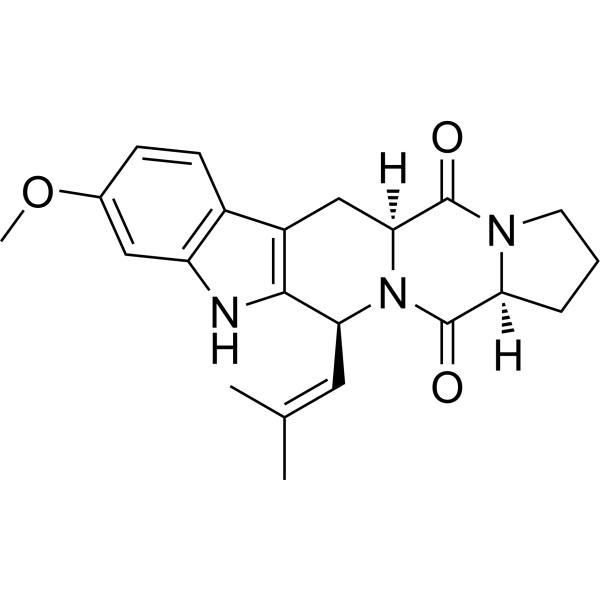
Physicochemical Properties
| Molecular Formula | C22H25N3O3 |
| Molecular Weight | 379.4522 |
| Exact Mass | 379.189 |
| CAS # | 118974-02-0 |
| PubChem CID | 403923 |
| Appearance | White to off-white solid powder |
| Density | 1.3±0.1 g/cm3 |
| Boiling Point | 642.9±55.0 °C at 760 mmHg |
| Melting Point | 259.5-260.5℃ |
| Flash Point | 342.6±31.5 °C |
| Vapour Pressure | 0.0±1.9 mmHg at 25°C |
| Index of Refraction | 1.676 |
| LogP | 1.74 |
| Hydrogen Bond Donor Count | 1 |
| Hydrogen Bond Acceptor Count | 3 |
| Rotatable Bond Count | 2 |
| Heavy Atom Count | 28 |
| Complexity | 703 |
| Defined Atom Stereocenter Count | 3 |
| SMILES | CC(=C[C@H]1C2=C(C[C@@H]3N1C(=O)[C@@H]4CCCN4C3=O)C5=C(N2)C=C(C=C5)OC)C |
| InChi Key | DBEYVIGIPJSTOR-FHWLQOOXSA-N |
| InChi Code | InChI=1S/C22H25N3O3/c1-12(2)9-18-20-15(14-7-6-13(28-3)10-16(14)23-20)11-19-21(26)24-8-4-5-17(24)22(27)25(18)19/h6-7,9-10,17-19,23H,4-5,8,11H2,1-3H3/t17-,18-,19-/m0/s1 |
| Chemical Name | (1S,12S,15S)-7-methoxy-12-(2-methylprop-1-enyl)-10,13,19-triazapentacyclo[11.7.0.03,11.04,9.015,19]icosa-3(11),4(9),5,7-tetraene-14,20-dione |
| HS Tariff Code | 2934.99.9001 |
| Storage |
Powder-20°C 3 years 4°C 2 years In solvent -80°C 6 months -20°C 1 month |
| Shipping Condition | Room temperature (This product is stable at ambient temperature for a few days during ordinary shipping and time spent in Customs) |
Biological Activity
| ln Vitro | In cancer chemotherapy, multidrug interactions (MDR) represent a significant challenge. In multidrug-selected cell lines, fumiremorgin C is incredibly successful in reversing the interaction of mitocinone, doxorubicin, and topotecan. Fugitremorgin C reversed doxorubicin-quinone selectivity (3-fold) and mitoxantrone-quinone selectivity (114-fold) in MCF-7/mtxR, a mitoxantrone-selected cell line. In S1M1-3.2 cells, fumiremorgin C (5/AM) markedly increased the toxicity of mitoxantrone (93-fold), doxorubicin (26-fold), and topotecan (24-fold). reversal of the activity in cells expressing MRP or Pgp at high levels [1]. Fumitremorgin C is a pharmacological marker of the expression and molecular function of this transporter, and it almost entirely recovers BCRP-mediated interactions in vitro. Additionally, mitoxantrone and topotecan were 2.5–5.6 times more lethal to vector-transfected MCF-7 cells when fumiremorgin C was present. At that point, untreated vector-transfected cells' IC50 for topotecan decreased to a value lower than that of BCRP-overexpressing cells [2]. |
| Toxicity/Toxicokinetics |
Toxicity Summary Fumitremorgin C inhibits ATP-binding cassette transporter (ACBG2), also known as breast cancer resistance protein. ACBG2 is known to confer multidrug resistance and also affects the bioavailability of different drugs. Thus fumitremorgin C is often used to sensitize cancer patients to chemotherapeutic drugs. Tremorgenic mycotoxins exert their toxic effects by interfering with neurotransmitter release, possibly by causing degeneration of nerve terminals. They are thought to inhibit gamma-aminobutyric acid (GABA) receptors, both pre- and postsynaptic, as well as inhibit transmitter breakdown at the GABA-T receptors. This would initially increase neurotransmitter levels, potentiating the GABA-induced chloride current, then lead to decreased levels of neurotransmitter in the synapse. (A2974, A2975, A2976, A3027) |
| References |
[1]. Reversal of a novel multidrug resistance mechanism in human colon carcinoma cells by fumitremorgin C. Cancer Res. 1998 Dec 15;58(24):5850-8. [2]. Fumitremorgin C reverses multidrug resistance in cells transfected with the breast cancer resistance protein. Cancer Res. 2000 Jan 1;60(1):47-50. |
| Additional Infomation |
Fumitremorgin C is an organic heteropentacyclic compound that is a mycotoxic indole alkaloid produced by several fungi. A potent and specific inhibitor of the breast cancer resistance protein multidrug transporter. It has a role as a mycotoxin and a breast cancer resistance protein inhibitor. It is an indole alkaloid, an organic heteropentacyclic compound and an aromatic ether. Fumitremorgin C has been reported in Aspergillus fischeri, Aspergillus fumigatus, and other organisms with data available. Fumitremorgin C is produced by Aspergillus fumigatus and Neosartorya fischeri. |
Solubility Data
| Solubility (In Vitro) | DMSO : ~50 mg/mL (~131.77 mM) |
| Solubility (In Vivo) |
Solubility in Formulation 1: ≥ 3 mg/mL (7.91 mM) (saturation unknown) in 10% DMSO + 40% PEG300 + 5% Tween80 + 45% Saline (add these co-solvents sequentially from left to right, and one by one), clear solution. For example, if 1 mL of working solution is to be prepared, you can add 100 μL of 30.0 mg/mL clear DMSO stock solution to 400 μL PEG300 and mix evenly; then add 50 μL Tween-80 to the above solution and mix evenly; then add 450 μL normal saline to adjust the volume to 1 mL. Preparation of saline: Dissolve 0.9 g of sodium chloride in 100 mL ddH₂ O to obtain a clear solution. Solubility in Formulation 2: ≥ 3 mg/mL (7.91 mM) (saturation unknown) in 10% DMSO + 90% Corn Oil (add these co-solvents sequentially from left to right, and one by one), clear solution. For example, if 1 mL of working solution is to be prepared, you can add 100 μL of 30.0 mg/mL clear DMSO stock solution to 900 μL of corn oil and mix evenly. (Please use freshly prepared in vivo formulations for optimal results.) |
| Preparing Stock Solutions | 1 mg | 5 mg | 10 mg | |
| 1 mM | 2.6354 mL | 13.1770 mL | 26.3539 mL | |
| 5 mM | 0.5271 mL | 2.6354 mL | 5.2708 mL | |
| 10 mM | 0.2635 mL | 1.3177 mL | 2.6354 mL |