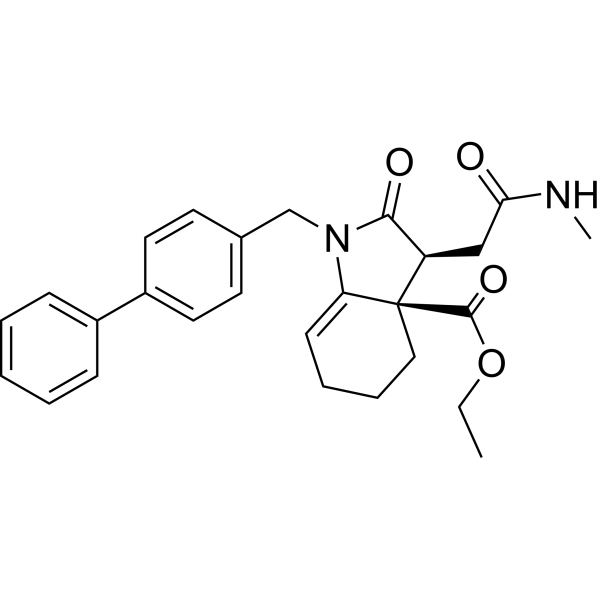
Physicochemical Properties
| Molecular Formula | C27H30N2O4 |
| Molecular Weight | 446.538107395172 |
| Exact Mass | 446.22 |
| CAS # | 1644060-37-6 |
| PubChem CID | 121230973 |
| Appearance | Off-white to yellow solid powder |
| Density | 1.2±0.1 g/cm3 |
| Boiling Point | 693.0±55.0 °C at 760 mmHg |
| Flash Point | 372.9±31.5 °C |
| Vapour Pressure | 0.0±2.2 mmHg at 25°C |
| Index of Refraction | 1.616 |
| LogP | 4.77 |
| Hydrogen Bond Donor Count | 1 |
| Hydrogen Bond Acceptor Count | 4 |
| Rotatable Bond Count | 8 |
| Heavy Atom Count | 33 |
| Complexity | 764 |
| Defined Atom Stereocenter Count | 2 |
| SMILES | CCOC(=O)[C@@]12CCCC=C1N(C(=O)[C@H]2CC(=O)NC)CC3=CC=C(C=C3)C4=CC=CC=C4 |
| InChi Key | VFGLXHHVYNTCPD-AJTFRIOCSA-N |
| InChi Code | InChI=1S/C27H30N2O4/c1-3-33-26(32)27-16-8-7-11-23(27)29(25(31)22(27)17-24(30)28-2)18-19-12-14-21(15-13-19)20-9-5-4-6-10-20/h4-6,9-15,22H,3,7-8,16-18H2,1-2H3,(H,28,30)/t22-,27-/m1/s1 |
| Chemical Name | ethyl (3S,3aR)-3-[2-(methylamino)-2-oxoethyl]-2-oxo-1-[(4-phenylphenyl)methyl]-3,4,5,6-tetrahydroindole-3a-carboxylate |
| HS Tariff Code | 2934.99.9001 |
| Storage |
Powder-20°C 3 years 4°C 2 years In solvent -80°C 6 months -20°C 1 month |
| Shipping Condition | Room temperature (This product is stable at ambient temperature for a few days during ordinary shipping and time spent in Customs) |
Biological Activity
| Targets | At an average IC50 value of 2.2 μM, fumarate hydrolase-IN-1 inhibits the following cell lines: SK-MEL-28, PC3, HCT-116, ACHN, and SW620 [1]. |
| ln Vitro |
At an average IC50 value of 2.2 μM, fumarate hydrolase-IN-1 inhibits the following cell lines: SK-MEL-28, PC3, HCT-116, ACHN, and SW620 [1]. Fumarate hydratase-IN-1 (compound 3) exhibited a nutrient-dependent antiproliferative activity against multiple human cancer cell lines. In SW620, ACHN, HCT-116, PC3, and SK-MEL-28 cell lines cultured in glucose-free L-15 medium, the mean IC50 for cell growth inhibition was approximately 2.2 μM. However, when the same cell lines were cultured in standard glucose-containing DME medium, the growth inhibitory activity was diminished more than 10-fold. [1] Replacing glucose with galactose or pyruvate as the carbon source also resulted in substantially lower survival of SW620 cells treated with compound 3, indicating heightened cytotoxicity under conditions where glycolysis is suppressed. [1] Treatment of SW620 cells with Fumarate hydratase-IN-1 (10 mM) in the presence of the glycolytic inhibitor 2-deoxyglucose (10 mM) led to a rapid decrease in cellular ATP levels within 30 minutes. In contrast, no ATP depletion was observed when cells were treated with compound 3 in the presence of the glucose transport inhibitor cytochalasin B (10 μM). This profile differs from that of typical OXPHOS inhibitors. [1] Compound 3 did not cause a rapid rise in cellular NADH levels, unlike OXPHOS inhibitors. [1] Fumarate hydratase-IN-1 dose-dependently inhibited the oxygen consumption rate (OCR) in SW620 cells. Real-time measurement using a Clark-type oxygen electrode showed that the inhibition of cellular respiration occurred immediately upon treatment with compound 3. This effect could not be rescued by the proton uncoupler FCCP. Succinate could re-initiate respiration in cells treated with compound 3, indicating that complexes II-IV of the electron transport chain remained functional. [1] The compound did not inhibit the activity of any individual complex (I-IV) of the mitochondrial electron transport chain in assays using submitochondrial particles. [1] |
| Enzyme Assay |
The inhibitory activity of Fumarate hydratase-IN-1 against fumarate hydratase was measured using a coupled enzyme assay. Fumarate hydratase activity was monitored by coupling the conversion of fumarate to L-malate to the subsequent oxidation of L-malate to oxaloacetate by malate dehydrogenase (MDH). The oxidation reaction was followed spectrophotometrically by measuring the reduction of NAD+ to NADH at 340 nm. Initial control experiments confirmed that compound 3 did not inhibit MDH activity. [1] In this assay, Fumarate hydratase-IN-1 inhibited fumarate hydratase in a dose-dependent manner. Kinetic analysis using Lineweaver-Burk plots demonstrated that it acted as a competitive inhibitor with a Ki value of 4.5 μM. The Km for the substrate fumarate was determined to be 1.3 mM, and the Vmax was 1.1 μM/min. [1] |
| Cell Assay |
Antiproliferative activity was assessed using cell viability assays. Cells (e.g., SW620, ACHN, HCT-116, PC3, SK-MEL-28) were seeded in 96-well plates and cultured in different media: standard DME medium containing glucose or glucose-free L-15 medium. Cells were treated with serial dilutions of Fumarate hydratase-IN-1 for 48 hours. Cell viability/proliferation was then measured using a standard assay (e.g., MTS, Alamar Blue), and IC50 values were calculated. [1] For ATP measurement assays, SW620 cells were treated with Fumarate hydratase-IN-1 (10 mM) in combination with either 2-deoxyglucose (10 mM) or cytochalasin B (10 μM) for 30 minutes. Cellular ATP levels were then quantified using a luminescence-based ATP assay kit. [1] Cellular oxygen consumption rate (OCR) was measured in real-time using an XFe96 extracellular flux analyzer. SW620 cells were seeded in XF96 plates, and baseline OCR was measured. Subsequently, cells were treated with different concentrations of Fumarate hydratase-IN-1 (0.5-5 μM), and OCR was monitored over time. Control compounds included oligomycin (1 μM, ATP synthase inhibitor), FCCP (0.5 μM, uncoupler), and a mixture of rotenone (1 μM) and antimycin A (1 μM, complex I and III inhibitors). [1] Detailed real-time kinetics of OCR inhibition were also assessed using a Clark-type oxygen electrode. SW620 cells were suspended in respiration buffer, and oxygen concentration was monitored continuously. After establishing a baseline, Fumarate hydratase-IN-1 was added, and the change in oxygen consumption rate was recorded. The ability of succinate to restore respiration was tested by adding it after compound treatment. [1] |
| References |
[1]. Identification of Fumarate Hydratase Inhibitors with Nutrient-Dependent Cytotoxicity. J Am Chem Soc, 2015 Jan 21, 137(2): 564-567. |
| Additional Infomation |
Fumarate hydratase-IN-1 is a cell-permeable small-molecule inhibitor of the tricarboxylic acid (TCA) cycle enzyme fumarate hydratase. [1] Its discovery originated from a high-throughput screen of a diverse chemical library for compounds exhibiting nutrient-dependent cytotoxicity, specifically higher potency under low-glucose conditions. [1] The compound (as the active metabolite of its ethyl ester pro-drug) localizes to mitochondria, as confirmed by confocal fluorescence microscopy. [1] Inhibition of fumarate hydratase by this compound class renders cells highly dependent on glucose metabolism for survival, as it impairs mitochondrial respiration. This mechanism may have therapeutic potential in contexts where disrupting cellular redox balance and enforcing glycolysis dependence is desirable. [1] The target (fumarate hydratase) was identified using a photoaffinity labeling strategy with a designed probe (compound 4), followed by protein isolation and LC-MS analysis. [1] |
Solubility Data
| Solubility (In Vitro) | DMSO : ~50 mg/mL (~111.97 mM) |
| Solubility (In Vivo) |
Solubility in Formulation 1: ≥ 2.5 mg/mL (5.60 mM) (saturation unknown) in 10% DMSO + 40% PEG300 + 5% Tween80 + 45% Saline (add these co-solvents sequentially from left to right, and one by one), clear solution. For example, if 1 mL of working solution is to be prepared, you can add 100 μL of 25.0 mg/mL clear DMSO stock solution to 400 μL PEG300 and mix evenly; then add 50 μL Tween-80 to the above solution and mix evenly; then add 450 μL normal saline to adjust the volume to 1 mL. Preparation of saline: Dissolve 0.9 g of sodium chloride in 100 mL ddH₂ O to obtain a clear solution. Solubility in Formulation 2: ≥ 2.5 mg/mL (5.60 mM) (saturation unknown) in 10% DMSO + 90% (20% SBE-β-CD in Saline) (add these co-solvents sequentially from left to right, and one by one), clear solution. For example, if 1 mL of working solution is to be prepared, you can add 100 μL of 25.0 mg/mL clear DMSO stock solution to 900 μL of 20% SBE-β-CD physiological saline solution and mix evenly. Preparation of 20% SBE-β-CD in Saline (4°C,1 week): Dissolve 2 g SBE-β-CD in 10 mL saline to obtain a clear solution. Solubility in Formulation 3: ≥ 2.5 mg/mL (5.60 mM) (saturation unknown) in 10% DMSO + 90% Corn Oil (add these co-solvents sequentially from left to right, and one by one), clear solution. For example, if 1 mL of working solution is to be prepared, you can add 100 μL of 25.0 mg/mL clear DMSO stock solution to 900 μL of corn oil and mix evenly. (Please use freshly prepared in vivo formulations for optimal results.) |
| Preparing Stock Solutions | 1 mg | 5 mg | 10 mg | |
| 1 mM | 2.2394 mL | 11.1972 mL | 22.3944 mL | |
| 5 mM | 0.4479 mL | 2.2394 mL | 4.4789 mL | |
| 10 mM | 0.2239 mL | 1.1197 mL | 2.2394 mL |