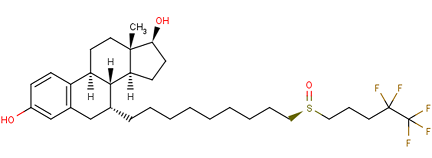
Fulvestrant R enantiomer is the R-isomer of fulvestrant (ICI182780; ZD-9238; ZM182780; ICI-182780; ZD9238; ZM-182780; Faslodex), which is a synthetic and potent estrogen receptor (ER) antagonist approved for the treatment of hormone receptor (HR)-positive breast cancer in postmenopausal women.
Physicochemical Properties
| Molecular Formula | C32H47F5O3S |
| Molecular Weight | 606.77080655098 |
| Exact Mass | 606.316 |
| Elemental Analysis | C, 63.34; H, 7.81; F, 15.66; O, 7.91; S, 5.28 |
| CAS # | 1807900-80-6 |
| Related CAS # | Fulvestrant;129453-61-8;Fulvestrant (S enantiomer);1316849-17-8 |
| PubChem CID | 104741 |
| Appearance | White powder ... the solution for injection is a clear, colorless to yellow, viscous liquid |
| LogP | 9.2 |
| Hydrogen Bond Donor Count | 2 |
| Hydrogen Bond Acceptor Count | 9 |
| Rotatable Bond Count | 14 |
| Heavy Atom Count | 41 |
| Complexity | 854 |
| Defined Atom Stereocenter Count | 6 |
| SMILES | S(CCCC(C(F)(F)F)(F)F)(CCCCCCCCCC1CC2C=C(C=CC=2C2CCC3(C)C(CCC3C21)O)O)=O |
| InChi Key | VWUXBMIQPBEWFH-WCCTWKNTSA-N |
| InChi Code | InChI=1S/C32H47F5O3S/c1-30-17-15-26-25-12-11-24(38)21-23(25)20-22(29(26)27(30)13-14-28(30)39)10-7-5-3-2-4-6-8-18-41(40)19-9-16-31(33,34)32(35,36)37/h11-12,21-22,26-29,38-39H,2-10,13-20H2,1H3/t22-,26-,27+,28+,29-,30+,41?/m1/s1 |
| Chemical Name | (7R,8R,9S,13S,14S,17S)-13-methyl-7-[9-(4,4,5,5,5-pentafluoropentylsulfinyl)nonyl]-6,7,8,9,11,12,14,15,16,17-decahydrocyclopenta[a]phenanthrene-3,17-diol |
| Synonyms | 13-methyl-7-[9-(4,4,5,5,5-pentafluoropentylsulfinyl)nonyl]-6,7,8,9,11,12,14,15,16,17-decahydrocyclopenta[a]phenanthrene-3,17-diol; Fulvestrant R enantiomer; 1807900-80-6; CID 3478439; (7R,8R,9S,13S,14S,17S)-13-methyl-7-[9-[(R)-4,4,5,5,5-pentafluoropentylsulfinyl]nonyl]-6,7,8,9,11,12,14,15,16,17-decahydrocyclopenta[a]phenanthrene-3,17-diol; 1316849-17-8; CID 138106603; SCHEMBL408338; |
| HS Tariff Code | 2934.99.9001 |
| Storage |
Powder-20°C 3 years 4°C 2 years In solvent -80°C 6 months -20°C 1 month |
| Shipping Condition | Room temperature (This product is stable at ambient temperature for a few days during ordinary shipping and time spent in Customs) |
Biological Activity
| Targets | Estrogen Receptor/ER |
| ln Vitro |
13-methyl-7-[9-(4,4,5,5,5-pentafluoropentylsulfinyl)nonyl]-6,7,8,9,11,12,14,15,16,17-decahydrocyclopenta[a]phenanthrene-3,17-diol is a steroid. It has a role as an estrogen. Fulvestrant (Faslodex®) was synthesized in four steps (35% overall yield) from 6-dehydronandrolone acetate. Catalyst controlled, room temperature, diastereoselective 1,6-addition of the zirconocene derived from commercially available 9-bromonon-1-ene was used in the key C-C bond forming step [1]. |
| ln Vivo | Sustained antiestrogenic effects, following a single parenteral dose of ICI 182,780 in oil suspension, were apparent in both rats and pigtail monkeys. In vivo, antitumor activity of ICI 182,780 was demonstrated with xenografts of MCF-7 and Br10 human breast cancers in nude mice. A single injection of ICI 182,780 provided antitumor efficacy equivalent to that of daily tamoxifen treatment for at least 4 weeks. The properties of ICI 182,780 identify this pure antiestrogen as a prime candidate with which to evaluate the potential therapeutic benefits of complete estrogen withdrawal in endocrine-responsive human breast cancer [2]. |
| ADME/Pharmacokinetics |
Absorption, Distribution and Excretion Was rapidly cleared by the hepatobiliary route with excretion primarily via the feces (approximately 90%) Fulvestrant. Was negligible (less than 1%) Renal elimination. 3 to 5 L/kg Of fulvestrant are attained approximately 7 days after IM administration and persist for at least 1 month Peak plasma concentrations. Usually are achieved within 3-6 months when the drug is administered once-monthly by IM injection Steady-state plasma fulvestrant concentrations. Fulvestrant appears to be rapidly and extensively distributed, principally into the extravascular space 99% (mainly VLDL, LDL, and HDL lipoprotein fractions). Has been shown to cross the placenta and distribute into milk in rats. For more Absorption, Distribution and Excretion (Complete) data for FULVESTRANT (8 total), please visit the HSDB record page. Metabolism / Metabolites Of fulvestrant appears to involve combinations of a number of possible biotransformation pathways analogous to those of endogenous steroids, including oxidation, aromatic hydroxylation, conjugation with glucuronic acid and/or sulphate at the 2, 3 and 17 positions of the steroid nucleus, and oxidation of the side chain sulphoxide Metabolism. Are either less active or exhibit similar activity to fulvestrant in antiestrogen models Identified metabolites. Studies using human liver preparations and recombinant human enzymes indicate that cytochrome P-450 3A4 (CYP 3A4) is the only P-450 isoenzyme involved in the oxidation of fulvestrant; however, the relative contribution of P-450 and non-P-450 routes in vivo is unknown. And disposition of fulvestrant in humans have been determined following intramuscular and intravenous administration of 14C-labeled fulvestrant Biotransformation. Of fulvestrant appears to involve combinations of a number of possible biotransformation pathways analogous to those of endogenous steroids, including oxidation, aromatic hydroxylation, conjugation with glucuronic acid and/or sulphate at the 2, 3 and 17 positions of the steroid nucleus, and oxidation of the side chain sulphoxide Metabolism. Of fulvestrant exhibit pharmacologic activity that is similar to or less than that of the parent compound Metabolites. In vitro studies indicate that CYP3A4 is the only enzyme involved in fulvestrant oxidation; however, the relative contribution of CYP and non-CYP routes in vivo currently is not known. Biological Half-Life 40 days The elimination half-life of fulvestrant is about 40 days. |
| Toxicity/Toxicokinetics |
Hepatotoxicity Is said to be associated with serum enzyme elevations in up to 15% of patients, but the elevations are generally asymptomatic, transient and mild, rarely requiring dose adjustment or discontinuation Fulvestrant therapy. Above 5 times the upper limit of normal occurred in only 1% to 2% of patients ALT elevations. However, specifics on the timing and course of serum enzyme elevations during fulvestrant therapy have not been described. In addition, no cases of clinically apparent liver injury with jaundice were reported in the prelicensure controlled trials of fulvestrant and none have been published since its approval in the United States and more wide-scale use. Nevertheless, the product label for fulvestrant mentions that "hepatitis and liver failure have been reported infrequently ( Likelihood score: E* (unproven but suspected cause of clinically apprent liver injury). Protein Binding 99% (mainly VLDL, LDL, and HDL) |
| References |
[1]. An alternative synthesis of the breast cancer drug fulvestrant (Faslodex®): catalyst control over C-C bond formation. Chem Commun (Camb). 2015;51(80):14866-14868. [2]. A potent specific pure antiestrogen with clinical potential. Cancer Res. 1991;51(15):3867-3873. |
| Additional Infomation |
Therapeutic Uses Antineoplastic Agents; Hormonal Estrogen Antagonists Is indicated for the treatment of hormone receptor positive metastatic breast cancer in postmenopausal women with disease progression following antiestrogen therapy Fulvestrant. /Included in US product label/ Drug Warnings /Fulvestrant is contraindicated in/ pregnancy, known hypersensitivity to fulvestrant, benzyl alcohol, or any ingredient in the formulation. Because fulvestrant is administered by IM injection, the drug should not be used in patients with bleeding diatheses or thrombocytopenia or in those receiving anticoagulant therapy. Are adverse GI effects (e.g., nausea, vomiting, constipation, diarrhea, abdominal pain), headache, back pain, vasodilation (hot flushes), and pharyngitis, which occurred in approximately 52, 15, 14, 18, and 16% of patients, respectively, who received the drug in clinical studies The most common adverse effects of fulvestrant. Other adverse effects occurring in 5-23% of patients receiving fulvestrant (in order of descending frequency) include asthenia, pain, nutritional disorders, bone pain, dyspnea, injection site pain, increased cough, pelvic pain, anorexia, peripheral edema, rash, chest pain, flu syndrome, dizziness, insomnia, fever, paresthesia, urinary tract infection, depression, anxiety, and sweating. With mild transient pain and inflammation were reported in 7% of patients receiving a single 5-mL injection of fulvestrant in one study and in 27% of those who received two 2.5-mL injections of the drug in another study Injection site reactions. For more Drug Warnings (Complete) data for FULVESTRANT (7 total), please visit the HSDB record page. Pharmacodynamics Fulvestrant for intramuscular administration is an estrogen receptor antagonist without known agonist effects. Previous studies from this laboratory have described a series of 7 alpha-alkylamide analogues of estradiol with pure antiestrogenic activity, exemplified by ICI 164,384. A new compound, 7 alpha-[9-(4,4,5,5,5-pentafluoropentylsulfinyl)nonyl]estra-1,3,5(10 )- triene-3,17 beta-diol (ICI 182,780) has now been identified which has significantly increased antiestrogenic potency and retains pure estrogen antagonist activity. Of ICI 182,780 in the immature rat was more than 10-fold greater than that of ICI 164,384 (50% effective doses of 0.06 and 0.9 mg/kg, respectively) The antiuterotrophic potency. This order of magnitude increase of in vivo potency was also reflected, in part, by intrinsic activity at the estrogen receptor. The relative binding affinities of ICI 182,780 and ICI 164,384 were 0.89 and 0.19, respectively, compared with that of estradiol (1.0). Similarly, the in vitro growth-inhibitory potency of ICI 182,780 exceeded that of ICI 164,384 in MCF-7 human breast cancer cells, where 50% inhibitory concentrations of 0.29 and 1.3 nM, respectively, were recorded. ICI 182,780 was a more effective inhibitor of MCF-7 growth than 4'-hydroxytamoxifen, producing an 80% reduction of cell number under conditions where 4'-hydroxytamoxifen achieved a maximum of 50% inhibition. This increased efficacy was reflected by a greater reduction of the proportion of cells engaged in DNA synthesis in ICI 182,780-treated cell cultures compared with tamoxifen-treated cells. [2] |
Solubility Data
| Solubility (In Vitro) | May dissolve in DMSO (in most cases), if not, try other solvents such as H2O, Ethanol, or DMF with a minute amount of products to avoid loss of samples |
| Solubility (In Vivo) |
Note: Listed below are some common formulations that may be used to formulate products with low water solubility (e.g. < 1 mg/mL), you may test these formulations using a minute amount of products to avoid loss of samples. Injection Formulations (e.g. IP/IV/IM/SC) Injection Formulation 1: DMSO : Tween 80: Saline = 10 : 5 : 85 (i.e. 100 μL DMSO stock solution → 50 μL Tween 80 → 850 μL Saline) *Preparation of saline: Dissolve 0.9 g of sodium chloride in 100 mL ddH ₂ O to obtain a clear solution. Injection Formulation 2: DMSO : PEG300 :Tween 80 : Saline = 10 : 40 : 5 : 45 (i.e. 100 μL DMSO → 400 μLPEG300 → 50 μL Tween 80 → 450 μL Saline) Injection Formulation 3: DMSO : Corn oil = 10 : 90 (i.e. 100 μL DMSO → 900 μL Corn oil) Example: Take the Injection Formulation 3 (DMSO : Corn oil = 10 : 90) as an example, if 1 mL of 2.5 mg/mL working solution is to be prepared, you can take 100 μL 25 mg/mL DMSO stock solution and add to 900 μL corn oil, mix well to obtain a clear or suspension solution (2.5 mg/mL, ready for use in animals). Injection Formulation 4: DMSO : 20% SBE-β-CD in saline = 10 : 90 [i.e. 100 μL DMSO → 900 μL (20% SBE-β-CD in saline)] *Preparation of 20% SBE-β-CD in Saline (4°C,1 week): Dissolve 2 g SBE-β-CD in 10 mL saline to obtain a clear solution. Injection Formulation 5: 2-Hydroxypropyl-β-cyclodextrin : Saline = 50 : 50 (i.e. 500 μL 2-Hydroxypropyl-β-cyclodextrin → 500 μL Saline) Injection Formulation 6: DMSO : PEG300 : castor oil : Saline = 5 : 10 : 20 : 65 (i.e. 50 μL DMSO → 100 μLPEG300 → 200 μL castor oil → 650 μL Saline) Injection Formulation 7: Ethanol : Cremophor : Saline = 10: 10 : 80 (i.e. 100 μL Ethanol → 100 μL Cremophor → 800 μL Saline) Injection Formulation 8: Dissolve in Cremophor/Ethanol (50 : 50), then diluted by Saline Injection Formulation 9: EtOH : Corn oil = 10 : 90 (i.e. 100 μL EtOH → 900 μL Corn oil) Injection Formulation 10: EtOH : PEG300:Tween 80 : Saline = 10 : 40 : 5 : 45 (i.e. 100 μL EtOH → 400 μLPEG300 → 50 μL Tween 80 → 450 μL Saline) Oral Formulations Oral Formulation 1: Suspend in 0.5% CMC Na (carboxymethylcellulose sodium) Oral Formulation 2: Suspend in 0.5% Carboxymethyl cellulose Example: Take the Oral Formulation 1 (Suspend in 0.5% CMC Na) as an example, if 100 mL of 2.5 mg/mL working solution is to be prepared, you can first prepare 0.5% CMC Na solution by measuring 0.5 g CMC Na and dissolve it in 100 mL ddH2O to obtain a clear solution; then add 250 mg of the product to 100 mL 0.5% CMC Na solution, to make the suspension solution (2.5 mg/mL, ready for use in animals). Oral Formulation 3: Dissolved in PEG400 Oral Formulation 4: Suspend in 0.2% Carboxymethyl cellulose Oral Formulation 5: Dissolve in 0.25% Tween 80 and 0.5% Carboxymethyl cellulose Oral Formulation 6: Mixing with food powders Note: Please be aware that the above formulations are for reference only. InvivoChem strongly recommends customers to read literature methods/protocols carefully before determining which formulation you should use for in vivo studies, as different compounds have different solubility properties and have to be formulated differently. (Please use freshly prepared in vivo formulations for optimal results.) |
| Preparing Stock Solutions | 1 mg | 5 mg | 10 mg | |
| 1 mM | 1.6481 mL | 8.2404 mL | 16.4807 mL | |
| 5 mM | 0.3296 mL | 1.6481 mL | 3.2961 mL | |
| 10 mM | 0.1648 mL | 0.8240 mL | 1.6481 mL |