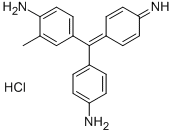
Fuchsine base monohydrochloride (rosaniline hydrochloride) is a triphenylmethane-based magenta dye use for acid-fast staining with carbol-fuchsin. It has been widely used in tissue-specific staining of biological and coloring several materials including orlon, cotton, leather, paper etc. It is also used to stain collagen, muscle and mitochondria.
Physicochemical Properties
| Molecular Formula | C20H20CLN3 |
| Molecular Weight | 337.8459 |
| Exact Mass | 337.134 |
| CAS # | 632-99-5 |
| Related CAS # | 3248-93-9 (Parent) |
| PubChem CID | 12447 |
| Appearance | METALLIC GREEN LUSTROUS CRYSTALS |
| Density | 0.999 g/mL at 20 °C |
| Boiling Point | 589.3ºC at 760 mmHg |
| Melting Point | 250 °C |
| Flash Point | 48 °F |
| Index of Refraction | n20/D 1.334 |
| LogP | 6.171 |
| Hydrogen Bond Donor Count | 4 |
| Hydrogen Bond Acceptor Count | 3 |
| Rotatable Bond Count | 2 |
| Heavy Atom Count | 24 |
| Complexity | 515 |
| Defined Atom Stereocenter Count | 0 |
| SMILES | Cl[H].N([H])([H])C1C([H])=C([H])C(=C([H])C=1[H])C(C1C([H])=C([H])C(=C([H])C=1[H])N([H])[H])=C1C([H])=C([H])C(C(C([H])([H])[H])=C1[H])=N[H] |c:29,43| |
| InChi Key | AXDJCCTWPBKUKL-UHFFFAOYSA-N |
| InChi Code | InChI=1S/C20H19N3.ClH/c1-13-12-16(6-11-19(13)23)20(14-2-7-17(21)8-3-14)15-4-9-18(22)10-5-15;/h2-12,23H,21-22H2,1H3;1H |
| Chemical Name | 4-[(4-aminophenyl)-(4-imino-3-methylcyclohexa-2,5-dien-1-ylidene)methyl]aniline;hydrochloride |
| Synonyms | Basic violet 14; 632-99-5; Fuchsin basic; Fuchsin; Basic fuchsine; MAGENTA; Fuchsine; Rosaniline; |
| HS Tariff Code | 2934.99.9001 |
| Storage |
Powder-20°C 3 years 4°C 2 years In solvent -80°C 6 months -20°C 1 month Note: Please store this product in a sealed and protected environment (e.g. under nitrogen), avoid exposure to moisture and light. |
| Shipping Condition | Room temperature (This product is stable at ambient temperature for a few days during ordinary shipping and time spent in Customs) |
Biological Activity
| ln Vitro |
C.i. basic violet 14 is a dark green powder. A dye derived from triphenylmethane. Rosanilin is a hydrochloride that is the monohydrochloride of 4-[(4-aminophenyl)(4-iminocyclohexa-2,5-dien-1-ylidene)methyl]-2-methylaniline. One of the major constituents of Basic fuchsin, together with pararosanilin, magenta II and new fuchsin. It has a role as a fluorochrome, a histological dye and a carcinogenic agent. It contains a rosanilin(1+). |
| ADME/Pharmacokinetics |
Absorption, Distribution and Excretion ...GAVE 12 MG MAGENTA IN ARACHIS OIL TO 60 STOCK MICE BY GASTRIC INSTILLATION FOR 52 WEEKS (TOTAL DOSE, 624 MG). DYE WAS FOUND TO HAVE STAINED THE TISSUES AT AUTOPSY. CATIONIC DYES ARE WELL KNOWN TO BIND TO NUCLEIC ACIDS. /CATIONIC DYES/ CATIONIC DYES APPEAR TO HAVE SPECIAL ATTRIBUTE OF NITROGEN ATOM WHICH IS PART OF RESONANT SYSTEM RESPONSIBLE FOR COLOR, & WHICH APPEARS TO BE ASSOC WITH PROPENSITY TO VERY STRONG BINDING TO CARBOXYL GROUPS OF CORNEAL MUCOPROTEINS. /CATIONIC DYES/ |
| References | [1]. https://link.springer.com/article/10.1007/BF01324083 |
| Additional Infomation |
C.i. basic violet 14 is a dark green powder. A dye derived from triphenylmethane. Rosanilin is a hydrochloride that is the monohydrochloride of 4-[(4-aminophenyl)(4-iminocyclohexa-2,5-dien-1-ylidene)methyl]-2-methylaniline. One of the major constituents of Basic fuchsin, together with pararosanilin, magenta II and new fuchsin. It has a role as a fluorochrome, a histological dye and a carcinogenic agent. It contains a rosanilin(1+). |
Solubility Data
| Solubility (In Vitro) |
DMSO : ~50 mg/mL (~147.99 mM) H2O : < 0.1 mg/mL |
| Solubility (In Vivo) |
Solubility in Formulation 1: ≥ 2.08 mg/mL (6.16 mM) (saturation unknown) in 10% DMSO + 40% PEG300 + 5% Tween80 + 45% Saline (add these co-solvents sequentially from left to right, and one by one), clear solution. For example, if 1 mL of working solution is to be prepared, you can add 100 μL of 20.8 mg/mL clear DMSO stock solution to 400 μL PEG300 and mix evenly; then add 50 μL Tween-80 to the above solution and mix evenly; then add 450 μL normal saline to adjust the volume to 1 mL. Preparation of saline: Dissolve 0.9 g of sodium chloride in 100 mL ddH₂ O to obtain a clear solution. Solubility in Formulation 2: ≥ 2.08 mg/mL (6.16 mM) (saturation unknown) in 10% DMSO + 90% (20% SBE-β-CD in Saline) (add these co-solvents sequentially from left to right, and one by one), clear solution. For example, if 1 mL of working solution is to be prepared, you can add 100 μL of 20.8 mg/mL clear DMSO stock solution to 900 μL of 20% SBE-β-CD physiological saline solution and mix evenly. Preparation of 20% SBE-β-CD in Saline (4°C,1 week): Dissolve 2 g SBE-β-CD in 10 mL saline to obtain a clear solution. (Please use freshly prepared in vivo formulations for optimal results.) |
| Preparing Stock Solutions | 1 mg | 5 mg | 10 mg | |
| 1 mM | 2.9599 mL | 14.7995 mL | 29.5989 mL | |
| 5 mM | 0.5920 mL | 2.9599 mL | 5.9198 mL | |
| 10 mM | 0.2960 mL | 1.4799 mL | 2.9599 mL |