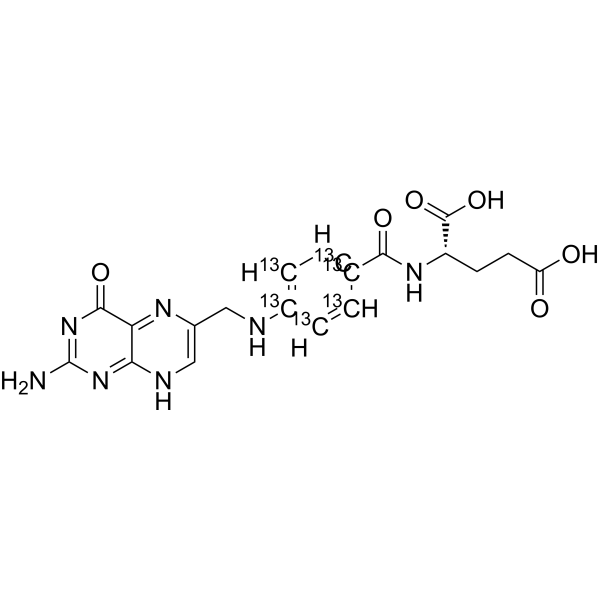
Physicochemical Properties
| Molecular Formula | C1313C6H19N7O6 |
| Molecular Weight | 447.35 |
| CAS # | 161406-20-8 |
| Appearance | Typically exists as solids at room temperature |
| Synonyms | Vitamin B9-13C6;Vitamin M-13C6 |
| HS Tariff Code | 2934.99.9001 |
| Storage |
Powder-20°C 3 years 4°C 2 years In solvent -80°C 6 months -20°C 1 month |
| Shipping Condition | Room temperature (This product is stable at ambient temperature for a few days during ordinary shipping and time spent in Customs) |
Biological Activity
| ln Vitro | Stable heavy isotopes of hydrogen, carbon, and other elements have been incorporated into drug molecules, primarily as quantitative tracers during drug development. Deuteration has attracted attention because it may affect the pharmacokinetics and metabolic profile of drugs[1]. Folic acid plays a key role in preventing chromosome breakage and DNA hypomethylation[2]. |
| ln Vivo | Folic acid plays a key role in preventing chromosome breakage and DNA hypomethylation[2]. Folic acid (10, 50, 100 mg/kg; oral) showed antidepressant-like effects in this behavioral mouse model[3]. Folic acid (1, 10 nmol/site) had no psychostimulant effect on mice acclimated to a new environment[3]. Folic acid (1, 5 mg/kg; oral) prevented epigenetic modification of gene expression in the liver of rat offspring[4]. When folic acid aqueous solution was orally administered to rats, the AUC was 1.4 μg h/mL and the oral bioavailability was 35%[6]. Induced acute kidney injury model[7] Pathogenic mechanism Folic acid requires higher levels of NADPH to reduce folic acid to THF, thereby reducing antioxidant defense capacity. Redox imbalance caused by folic acid metabolism is one of the main mechanisms of renal damage. Specific modeling method Rat: Wistar • male Administration: 300mg/ml • ip • single dose Note (1) Male Wistar rats with an initial body weight of 230-250 g were intraperitoneally injected with 300 mg/kg of folic acid (dissolved in 300 mM NaHCO3). (2) Plasma was collected for analysis on days 2, 4, 7, 14, and 28 after administration. Modeling success indicators Metabolic changes: The degree of renal damage was assessed by measuring blood urea nitrogen (BUN) and plasma creatinine. Individual phenotypic changes: The ratio of kidney weight to total rat weight was measured. Related products Acetylcysteine |
| References |
[1]. Impact of Deuterium Substitution on the Pharmacokinetics of Pharmaceuticals. Ann Pharmacother. 2019 Feb;53(2):211-216. [2]. Folic acid safety and toxicity: a brief review. Am J Clin Nutr. 1989 Aug;50(2):353-8. [3]. Zein nanoparticles for oral folic acid deliveryJ. Journal of Drug Delivery Science and Technology, 2015, 30: 450-457. [4]. Folic acid administration produces an antidepressant-like effect in mice: evidence for the involvement of the serotonergic and noradrenergic systems. Neuropharmacology. 2008 Feb;54(2):464-73. [5]. Chronic impairment of mitochondrial bioenergetics and β-oxidation promotes experimental AKI-to-CKD transition induced by folic acid. Free Radic Biol Med. 2020 Jul;154:18-32. |
Solubility Data
| Solubility (In Vitro) | May dissolve in DMSO (in most cases), if not, try other solvents such as H2O, Ethanol, or DMF with a minute amount of products to avoid loss of samples |
| Solubility (In Vivo) |
Note: Listed below are some common formulations that may be used to formulate products with low water solubility (e.g. < 1 mg/mL), you may test these formulations using a minute amount of products to avoid loss of samples. Injection Formulations (e.g. IP/IV/IM/SC) Injection Formulation 1: DMSO : Tween 80: Saline = 10 : 5 : 85 (i.e. 100 μL DMSO stock solution → 50 μL Tween 80 → 850 μL Saline) *Preparation of saline: Dissolve 0.9 g of sodium chloride in 100 mL ddH ₂ O to obtain a clear solution. Injection Formulation 2: DMSO : PEG300 :Tween 80 : Saline = 10 : 40 : 5 : 45 (i.e. 100 μL DMSO → 400 μLPEG300 → 50 μL Tween 80 → 450 μL Saline) Injection Formulation 3: DMSO : Corn oil = 10 : 90 (i.e. 100 μL DMSO → 900 μL Corn oil) Example: Take the Injection Formulation 3 (DMSO : Corn oil = 10 : 90) as an example, if 1 mL of 2.5 mg/mL working solution is to be prepared, you can take 100 μL 25 mg/mL DMSO stock solution and add to 900 μL corn oil, mix well to obtain a clear or suspension solution (2.5 mg/mL, ready for use in animals). Injection Formulation 4: DMSO : 20% SBE-β-CD in saline = 10 : 90 [i.e. 100 μL DMSO → 900 μL (20% SBE-β-CD in saline)] *Preparation of 20% SBE-β-CD in Saline (4°C,1 week): Dissolve 2 g SBE-β-CD in 10 mL saline to obtain a clear solution. Injection Formulation 5: 2-Hydroxypropyl-β-cyclodextrin : Saline = 50 : 50 (i.e. 500 μL 2-Hydroxypropyl-β-cyclodextrin → 500 μL Saline) Injection Formulation 6: DMSO : PEG300 : castor oil : Saline = 5 : 10 : 20 : 65 (i.e. 50 μL DMSO → 100 μLPEG300 → 200 μL castor oil → 650 μL Saline) Injection Formulation 7: Ethanol : Cremophor : Saline = 10: 10 : 80 (i.e. 100 μL Ethanol → 100 μL Cremophor → 800 μL Saline) Injection Formulation 8: Dissolve in Cremophor/Ethanol (50 : 50), then diluted by Saline Injection Formulation 9: EtOH : Corn oil = 10 : 90 (i.e. 100 μL EtOH → 900 μL Corn oil) Injection Formulation 10: EtOH : PEG300:Tween 80 : Saline = 10 : 40 : 5 : 45 (i.e. 100 μL EtOH → 400 μLPEG300 → 50 μL Tween 80 → 450 μL Saline) Oral Formulations Oral Formulation 1: Suspend in 0.5% CMC Na (carboxymethylcellulose sodium) Oral Formulation 2: Suspend in 0.5% Carboxymethyl cellulose Example: Take the Oral Formulation 1 (Suspend in 0.5% CMC Na) as an example, if 100 mL of 2.5 mg/mL working solution is to be prepared, you can first prepare 0.5% CMC Na solution by measuring 0.5 g CMC Na and dissolve it in 100 mL ddH2O to obtain a clear solution; then add 250 mg of the product to 100 mL 0.5% CMC Na solution, to make the suspension solution (2.5 mg/mL, ready for use in animals). Oral Formulation 3: Dissolved in PEG400 Oral Formulation 4: Suspend in 0.2% Carboxymethyl cellulose Oral Formulation 5: Dissolve in 0.25% Tween 80 and 0.5% Carboxymethyl cellulose Oral Formulation 6: Mixing with food powders Note: Please be aware that the above formulations are for reference only. InvivoChem strongly recommends customers to read literature methods/protocols carefully before determining which formulation you should use for in vivo studies, as different compounds have different solubility properties and have to be formulated differently. (Please use freshly prepared in vivo formulations for optimal results.) |
| Preparing Stock Solutions | 1 mg | 5 mg | 10 mg | |
| 1 mM | 2.2354 mL | 11.1769 mL | 22.3539 mL | |
| 5 mM | 0.4471 mL | 2.2354 mL | 4.4708 mL | |
| 10 mM | 0.2235 mL | 1.1177 mL | 2.2354 mL |