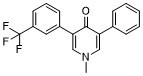
Fluridone is an herbicide acting as an inhibitor of abscisic acid (ABA) biosynthesis. Fluridone suppresses the expression of AchnFAR and TF genes and reduces the formation of primary alcohol. It inhibits phytoene desaturase (Ki = 0.03 µM), an enzyme involved in carotenoid biosynthesis.
Physicochemical Properties
| Molecular Formula | C19H14F3NO |
| Molecular Weight | 329.3158 |
| Exact Mass | 329.102 |
| CAS # | 59756-60-4 |
| PubChem CID | 43079 |
| Appearance | White to off-white solid powder |
| Density | 1.3±0.1 g/cm3 |
| Boiling Point | 444.4±45.0 °C at 760 mmHg |
| Melting Point | 154-155°C |
| Flash Point | 222.6±28.7 °C |
| Vapour Pressure | 0.0±1.1 mmHg at 25°C |
| Index of Refraction | 1.568 |
| LogP | 3.7 |
| Hydrogen Bond Donor Count | 0 |
| Hydrogen Bond Acceptor Count | 5 |
| Rotatable Bond Count | 2 |
| Heavy Atom Count | 24 |
| Complexity | 543 |
| Defined Atom Stereocenter Count | 0 |
| InChi Key | YWBVHLJPRPCRSD-UHFFFAOYSA-N |
| InChi Code | InChI=1S/C19H14F3NO/c1-23-11-16(13-6-3-2-4-7-13)18(24)17(12-23)14-8-5-9-15(10-14)19(20,21)22/h2-12H,1H3 |
| Chemical Name | 1-methyl-3-phenyl-5-[3-(trifluoromethyl)phenyl]pyridin-4-one |
| HS Tariff Code | 2934.99.9001 |
| Storage |
Powder-20°C 3 years 4°C 2 years In solvent -80°C 6 months -20°C 1 month Note: This product requires protection from light (avoid light exposure) during transportation and storage. |
| Shipping Condition | Room temperature (This product is stable at ambient temperature for a few days during ordinary shipping and time spent in Customs) |
Biological Activity
| ln Vitro | In human activated ischemia, fluridone (0.5-50 μM) decreases proliferation and cytokine production while also inhibiting the proliferation of aortic smooth muscle cells for four days. Fluridone suppresses the expression of COX-2 in human monocytes that have been activated. Human monocytes that have been induced to produce acid are inhibited by fluridone [1]. |
| ln Vivo | In mice treated with yeast, fluridone (8.25 mg/kg; i.p.; once) increases peritoneal regulatory factors [1]. |
| Cell Assay |
Cell proliferation assay [1] Cell Types: Lymphocytes Tested Concentrations: 0.5 μM, 2 μM, 5 μM, 50 μM Incubation Duration: 4 days Experimental Results: Inhibition of aortic smooth muscle cell proliferation. |
| Animal Protocol |
Animal/Disease Models: Male CD mice (20-22 g) treated with zymosan [1] Doses: 8.25 mg/kg Route of Administration: ip; Experimental Results: Peritoneal inflammation was diminished in mice treated with zymosan. |
| ADME/Pharmacokinetics |
Absorption, Distribution and Excretion /In a rat metabolism study/... Preliminary study: Group A, 2 male (M)/2 female (F) exposed to a single oral dose of [14C]fluridone (...radiopurity 99.8%; for test solutions [14C]fluridone was mixed w/[12C]fluridone, ...100% purity; test substance was suspended in 1% sodium carboxymethyl cellulose [CMC]) at ~10 mg/kg. Group B, 1M/1F exposed to a single oral dose at ~1000 mg/kg. Urine, feces and cage rinses were collected daily for 7 days (because expired (trapped) 14CO2 accounted for <1% of the dose after 24 hr, further 14CO2 measurements were discontinued). Definitive study: Group C, vehicle controls, 2M/2F exposed to a single oral dose of 1% CMC. Group D, 5M/5F exposed to a single oral dose at ~7.4 mg/kg. Group E, 7M/7F exposed to ~10 mg/kg unlabeled fluridone once daily for 14 days, then 5M/5F exposed on day 15 to ~10 mg/kg [14C]fluridone. Group F, 5M/5F exposed to a single oral dose at ~900 mg/kg. ...Clinical signs (lack of mobility, abnormal and rapid head movement, squinting, loss of balance and cage biting) occurred only at the HD (Groups B and F), clearing within 24 hr. Results, Group A: by 7 days, 12.52%/12.89% (M/F) was excreted in urine and 72.76%/81.79% in feces. Group B: by 7 days 4.83%/3.43% was excreted in urine and 86.43%/86.31% in feces. Group D: by 24 hr 11.14%/10.44% was excreted in urine and 72.46%/77.72% in feces. By 7 days 11.61%/10.93% was excreted in urine and 79.19%/84.62% in feces. Combined excretion (including cage rinse) by 7 days was 92.93%/98.74%. Group E: by 24 hr 9.54%/8.51% was excreted in urine and 70.69%/69.90% in feces. By 7 days 10.11%/9.14% was excreted in urine and 79.80%/81.79% in feces. Combined excretion (including cage rinse) by 7 days was 92.81%/94.21%. Group F: by 24 hr 2.40%/2.43% was excreted in urine and 27.16%/27.18% in feces (thus, a relative delay in fecal excretion at the HD). By 7 days 8.30%/8.07% was excreted in urine and 91.58%/90.09% in feces. Combined excretion (including cage rinse) by 7 days was 101.02%/99.62%. Total tissue residues were always <1% of the dose (Groups D-F). Under all conditions, highest tissue levels occurred in the liver. The major metabolites were a variety of polar and non-polar compounds resulting from aromatic hydroxylations and heteroaromatic N-demethylation. The parent compound was the primary fecal component over the 1st 72 hr. In a metabolism study in rats, fluridone was rapidly and almost completely absorbed into the systemic circulation and eliminated in both the male and female rats within 3 days. The total radioactivity recovered within 3 days after dosing in the urine and feces were 78-90% and 87- 97% of administered dose in males and females, respectively. The majority (approximately 70%) of the radioactivity was eliminated via feces. No tissue accumulation was observed. The rates of uptake of ... (14C) fluridone (1-methyl-3-phenyl-5-(3-trifluoromethylphenyl)-4-(1H)-pyridinone) from water by rainbow trout and Chironomus tentans (4th Instar) larvae were much lower than those for more hydrophobic compounds tested under similar conditions ... Uptake and clearance of fluridone ... by chironomid larvae were more rapid than for rainbow trout. /BCF/ for chironomid larvae /was/ estimated to be 128 for fluridone ... Liver, intestine, and pyloric caeca of adult rainbow trout accumulated the highest residues of (14C)-fluridone ... Most of the radioactivity was found to be in the form of fluridone or 4-hydroxyfluridone (1-methyl-3-(4-hydroxyphenyl)-5-(3-trifluoromethyl phenyl)-4(1H)-pyridinone) ... in tissues of fish exposed to /fluridone/ ... Metabolism / Metabolites The major metabolites were a variety of polar and non-polar compounds resulting from aromatic hydroxylations and heteroaromatic N-demethylation. The parent compound was the primary fecal component over the 1st 72 hr. Most of the radioactivity was found to be in the form of fluridone or 4-hydroxyfluridone (1-methyl-3-(4-hydroxyphenyl)-5-(3-trifluoromethyl phenyl)-4(1H)-pyridinone) ... in tissues of fish exposed to /fluridone/ ... |
| Toxicity/Toxicokinetics |
Toxicity Data LC50 (rat) > 2,130,000 mg/m3/1h Non-Human Toxicity Values LD50 Rat oral >10,000 mg/kg LD50 Mouse oral >10,000 mg/kg LD50 Dog oral >500 mg/kg LD50 Cat oral >250 mg/kg LD50 Rabbit percutaneous >5000 mg/kg |
| References |
[1]. Fluridone as a new anti-inflammatory drug. Eur J Pharmacol. 2013 Nov 15;720(1-3):7-15. [2]. MYB41, MYB107, and MYC2 promote ABA-mediated primary fatty alcohol accumulation via activation of AchnFAR in wound suberization in kiwifruit. Hortic Res. 2020;7(1):86. |
| Additional Infomation | Fluridone is a phenylpyridine. It has a role as a carotenoid biosynthesis inhibitor. |
Solubility Data
| Solubility (In Vitro) | DMSO : ~250 mg/mL (~759.14 mM) |
| Solubility (In Vivo) |
Note: Listed below are some common formulations that may be used to formulate products with low water solubility (e.g. < 1 mg/mL), you may test these formulations using a minute amount of products to avoid loss of samples. Injection Formulations (e.g. IP/IV/IM/SC) Injection Formulation 1: DMSO : Tween 80: Saline = 10 : 5 : 85 (i.e. 100 μL DMSO stock solution → 50 μL Tween 80 → 850 μL Saline) *Preparation of saline: Dissolve 0.9 g of sodium chloride in 100 mL ddH ₂ O to obtain a clear solution. Injection Formulation 2: DMSO : PEG300 :Tween 80 : Saline = 10 : 40 : 5 : 45 (i.e. 100 μL DMSO → 400 μLPEG300 → 50 μL Tween 80 → 450 μL Saline) Injection Formulation 3: DMSO : Corn oil = 10 : 90 (i.e. 100 μL DMSO → 900 μL Corn oil) Example: Take the Injection Formulation 3 (DMSO : Corn oil = 10 : 90) as an example, if 1 mL of 2.5 mg/mL working solution is to be prepared, you can take 100 μL 25 mg/mL DMSO stock solution and add to 900 μL corn oil, mix well to obtain a clear or suspension solution (2.5 mg/mL, ready for use in animals). Injection Formulation 4: DMSO : 20% SBE-β-CD in saline = 10 : 90 [i.e. 100 μL DMSO → 900 μL (20% SBE-β-CD in saline)] *Preparation of 20% SBE-β-CD in Saline (4°C,1 week): Dissolve 2 g SBE-β-CD in 10 mL saline to obtain a clear solution. Injection Formulation 5: 2-Hydroxypropyl-β-cyclodextrin : Saline = 50 : 50 (i.e. 500 μL 2-Hydroxypropyl-β-cyclodextrin → 500 μL Saline) Injection Formulation 6: DMSO : PEG300 : castor oil : Saline = 5 : 10 : 20 : 65 (i.e. 50 μL DMSO → 100 μLPEG300 → 200 μL castor oil → 650 μL Saline) Injection Formulation 7: Ethanol : Cremophor : Saline = 10: 10 : 80 (i.e. 100 μL Ethanol → 100 μL Cremophor → 800 μL Saline) Injection Formulation 8: Dissolve in Cremophor/Ethanol (50 : 50), then diluted by Saline Injection Formulation 9: EtOH : Corn oil = 10 : 90 (i.e. 100 μL EtOH → 900 μL Corn oil) Injection Formulation 10: EtOH : PEG300:Tween 80 : Saline = 10 : 40 : 5 : 45 (i.e. 100 μL EtOH → 400 μLPEG300 → 50 μL Tween 80 → 450 μL Saline) Oral Formulations Oral Formulation 1: Suspend in 0.5% CMC Na (carboxymethylcellulose sodium) Oral Formulation 2: Suspend in 0.5% Carboxymethyl cellulose Example: Take the Oral Formulation 1 (Suspend in 0.5% CMC Na) as an example, if 100 mL of 2.5 mg/mL working solution is to be prepared, you can first prepare 0.5% CMC Na solution by measuring 0.5 g CMC Na and dissolve it in 100 mL ddH2O to obtain a clear solution; then add 250 mg of the product to 100 mL 0.5% CMC Na solution, to make the suspension solution (2.5 mg/mL, ready for use in animals). Oral Formulation 3: Dissolved in PEG400 Oral Formulation 4: Suspend in 0.2% Carboxymethyl cellulose Oral Formulation 5: Dissolve in 0.25% Tween 80 and 0.5% Carboxymethyl cellulose Oral Formulation 6: Mixing with food powders Note: Please be aware that the above formulations are for reference only. InvivoChem strongly recommends customers to read literature methods/protocols carefully before determining which formulation you should use for in vivo studies, as different compounds have different solubility properties and have to be formulated differently. (Please use freshly prepared in vivo formulations for optimal results.) |
| Preparing Stock Solutions | 1 mg | 5 mg | 10 mg | |
| 1 mM | 3.0366 mL | 15.1828 mL | 30.3656 mL | |
| 5 mM | 0.6073 mL | 3.0366 mL | 6.0731 mL | |
| 10 mM | 0.3037 mL | 1.5183 mL | 3.0366 mL |