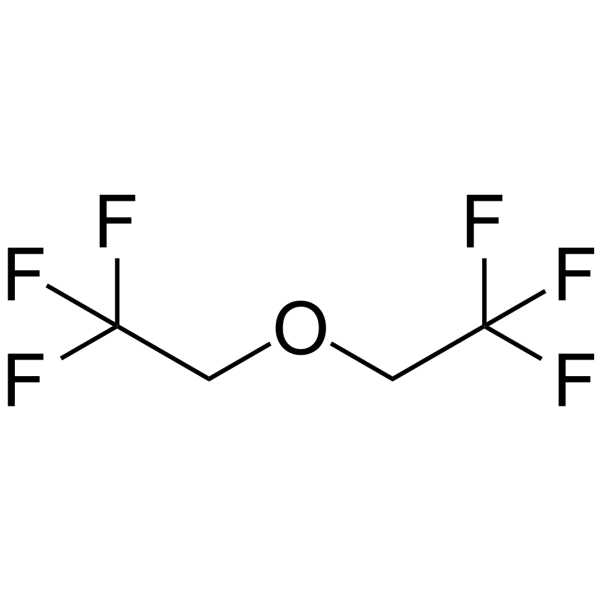
Physicochemical Properties
| Molecular Formula | C4H4OF6 |
| Molecular Weight | 182.06436 |
| Exact Mass | 182.017 |
| CAS # | 333-36-8 |
| PubChem CID | 9528 |
| Appearance | Colorless to light yellow liquid |
| Density | 1.404 g/mL at 25 °C(lit.) |
| Boiling Point | 62-63 °C(lit.) |
| Melting Point | 122.5-123 |
| Flash Point | 35 °F |
| Index of Refraction | n20/D 1.300(lit.) |
| LogP | 2.127 |
| Hydrogen Bond Donor Count | 0 |
| Hydrogen Bond Acceptor Count | 7 |
| Rotatable Bond Count | 2 |
| Heavy Atom Count | 11 |
| Complexity | 98.7 |
| Defined Atom Stereocenter Count | 0 |
| SMILES | FC(F)(F)COCC(F)(F)F |
| InChi Key | KGPPDNUWZNWPSI-UHFFFAOYSA-N |
| InChi Code | InChI=1S/C4H4F6O/c5-3(6,7)1-11-2-4(8,9)10/h1-2H2 |
| Chemical Name | 1,1,1-trifluoro-2-(2,2,2-trifluoroethoxy)ethane |
| HS Tariff Code | 2934.99.9001 |
| Storage |
Powder-20°C 3 years 4°C 2 years In solvent -80°C 6 months -20°C 1 month Note: Please store this product in a sealed and protected environment, avoid exposure to moisture. |
| Shipping Condition | Room temperature (This product is stable at ambient temperature for a few days during ordinary shipping and time spent in Customs) |
Biological Activity
| ln Vivo |
- Fluorothyl is a potent seizure-inducing agent used to establish a rat model of recurrent neonatal seizure. Neonatal rats (Postnatal Day 7, P7) exposed to Fluorothyl exhibited recurrent generalized tonic-clonic seizures, which were scored using the Racine scale (Grade 3-4 seizures: forelimb clonus with rearing). Repeated exposure (once daily for 7 consecutive days) induced persistent neurodamage, including activation of apoptotic pathways (increased Bax/Bcl-2 ratio and cleaved caspase-3 expression), abnormal autophagy (elevated LC3-II/LC3-I ratio and Beclin-1 levels), and NF-κB-mediated inflammatory responses (upregulated p-NF-κB p65, IL-1β, and TNF-α expression in the hippocampus and cortex) [1] - Fluorothyl-induced recurrent seizures led to significant neuronal loss in the hippocampal CA1 region and cerebral cortex (Nissl staining), as well as impaired neurobehavioral development (evaluated by negative geotaxis test and open field test) [1] |
| Animal Protocol | - Rat model of recurrent neonatal seizure: Postnatal Day 7 (P7) Sprague-Dawley rats were randomly divided into control and Fluorothyl-treated groups. Fluorothyl was administered via inhalation in a sealed chamber (concentration adjusted to induce Grade 3-4 seizures within 1-3 minutes). Seizure onset time, duration, and severity were recorded using the Racine scale. Rats in the treatment group received Fluorothyl exposure once daily for 7 consecutive days (P7-P13), while the control group was exposed to vehicle in the same chamber. On P14, rats were sacrificed, and hippocampal and cortical tissues were collected for Western blot (apoptosis, autophagy, NF-κB pathway proteins), Nissl staining (neuronal count), and immunohistochemistry (inflammatory factor expression) [1] |
| Toxicity/Toxicokinetics | - Fluorothyl exhibits significant neurotoxicity in neonatal rats. Repeated seizure induction caused hippocampal and cortical neuronal apoptosis, abnormal autophagic activation, and enhanced neuroinflammation, leading to neuronal loss and neurobehavioral deficits. [1] |
| References |
[1]. IL-33 Provides Neuroprotection through Suppressing Apoptotic, Autophagic and NF-κB-Mediated Inflammatory Pathways in a Rat Model of Recurrent Neonatal Seizure. Front Mol Neurosci. 2017 Dec 19;10:423. |
| Additional Infomation |
Flurotyl is an ether. Flurothyl is a convulsant primarily used in experimental animals. It was formerly used to induce convulsions as a alternative to electroshock therapy. A convulsant primarily used in experimental animals. It was formerly used to induce convulsions as a alternative to electroshock therapy. - Fluorothyl is a synthetic small-molecule compound widely used as a seizure-inducing tool to establish animal models of epilepsy [1] - Its core role is to induce recurrent generalized seizures in neonatal rats, mimicking clinical recurrent neonatal epilepsy, thereby providing a model for studying neuroprotective strategies (e.g., IL-33-mediated neuroprotection) [1] - It has no therapeutic applications and is exclusively used as a research reagent to induce pathological seizure states and associated neurodamage [1] |
Solubility Data
| Solubility (In Vitro) |
DMSO : ≥ 125 mg/mL (~686.59 mM) H2O : ~100 mg/mL (~549.27 mM) |
| Solubility (In Vivo) |
Solubility in Formulation 1: ≥ 2.08 mg/mL (11.42 mM) (saturation unknown) in 10% DMSO + 40% PEG300 +5% Tween-80 + 45% Saline (add these co-solvents sequentially from left to right, and one by one), clear solution. For example, if 1 mL of working solution is to be prepared, you can add 100 μL of 20.8 mg/mL clear DMSO stock solution to 400 μL PEG300 and mix evenly; then add 50 μL Tween-80 + to the above solution and mix evenly; then add 450 μL normal saline to adjust the volume to 1 mL. Preparation of saline: Dissolve 0.9 g of sodium chloride in 100 mL ddH₂ O to obtain a clear solution. (Please use freshly prepared in vivo formulations for optimal results.) |
| Preparing Stock Solutions | 1 mg | 5 mg | 10 mg | |
| 1 mM | 5.4927 mL | 27.4635 mL | 54.9269 mL | |
| 5 mM | 1.0985 mL | 5.4927 mL | 10.9854 mL | |
| 10 mM | 0.5493 mL | 2.7463 mL | 5.4927 mL |