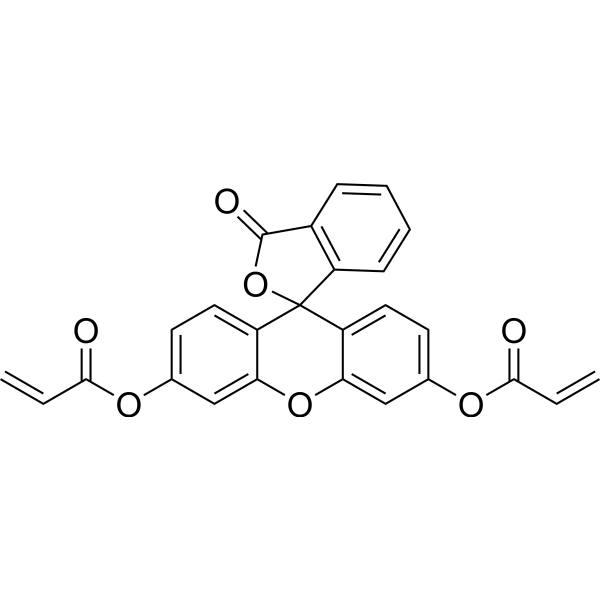
Physicochemical Properties
| Molecular Formula | C26H16O7 |
| Molecular Weight | 440.40 |
| Exact Mass | 440.089602 |
| CAS # | 7262-39-7 |
| PubChem CID | 4589514 |
| Appearance | Typically exists as solids at room temperature |
| Melting Point | 160-163ºC(lit.) |
| LogP | 4.8 |
| Hydrogen Bond Donor Count | 0 |
| Hydrogen Bond Acceptor Count | 7 |
| Rotatable Bond Count | 6 |
| Heavy Atom Count | 33 |
| Complexity | 788 |
| Defined Atom Stereocenter Count | 0 |
| SMILES | C=CC(=O)OC1=CC2=C(C=C1)C3(C4=C(O2)C=C(C=C4)OC(=O)C=C)C5=CC=CC=C5C(=O)O3 |
| InChi Key | GTQZGVDHWVBMOJ-UHFFFAOYSA-N |
| InChi Code | InChI=1S/C26H16O7/c1-3-23(27)30-15-9-11-19-21(13-15)32-22-14-16(31-24(28)4-2)10-12-20(22)26(19)18-8-6-5-7-17(18)25(29)33-26/h3-14H,1-2H2 |
| Chemical Name | (3-oxo-6'-prop-2-enoyloxyspiro[2-benzofuran-1,9'-xanthene]-3'-yl) prop-2-enoate |
| Synonyms | Diacryloyloxyfluorescein; Diacryloyloxyfluorescein; 7262-39-7; FLUORESCEIN O O'-DIACRYLATE 98; 3-Oxo-3h-spiro[isobenzofuran-1,9'-xanthene]-3',6'-diyl diacrylate; (3-oxo-6'-prop-2-enoyloxyspiro[2-benzofuran-1,9'-xanthene]-3'-yl) prop-2-enoate; Fluorescein O,O'-dimethacrylate; Fluorescein O,O'-diacrylate; Fluorescein O,O inverted exclamation marka-diacrylate; |
| HS Tariff Code | 2934.99.9001 |
| Storage |
Powder-20°C 3 years 4°C 2 years In solvent -80°C 6 months -20°C 1 month |
| Shipping Condition | Room temperature (This product is stable at ambient temperature for a few days during ordinary shipping and time spent in Customs) |
Biological Activity
| Targets | Fluorescent dye |
| ln Vitro |
Glutamate may be released from microglia by mechanisms other than SxC−. To confirm that SxC− was the transporter inhibited by the novel DBT analogs, cystine uptake was measured for two of the test substances. Primary microglia were treated for 15 h, and then 35DBTA7 and 35DBTSA12 were applied during uptake of selenocystine, which can be detected after conjugation with fluorescein O,O'-diacrylate (Fig. 5). A dose-dependent inhibition of cystine uptake into microglia was observed for both compounds at IC50 values roughly similar to those for glutamate release [1]. Another study developed fluorescent cationic and anionic nanogels linked with fluorescein O,O'-diacrylate for the visualization of cellular fluorescence and then loaded with dual therapeutic agents cisplatin and 5-fluorouracil for lung cancer (NCI-H1437) and colorectal cancer (HCT-116) pharmacotherapy and image processing functionality of the nanogel in response to pH. Both cationic and anionic nanogels had a higher fluorescence intensity in basic conditions and a substantially lower fluorescence intensity in acidic conditions [2]. |
| Enzyme Assay |
Cystine uptake assay [1] Cystine uptake was measured essentially as per Shimomura et al. using the Cystine Uptake Assay Kit (DOJINDO). Primary microglia were seeded as per glutamate release assays, and some cultures were treated the following day with 100 ng/ml LPS. After 15 h, the cultures were washed twice with Hank’s balanced salt solution (HBSS) and then incubated 5 min at 37 °C in HBSS containing fresh LPS and test substances at the indicated concentrations. The cultures were then exposed to HBSS containing selenocystine for 30 min at 37 °C, after which they were washed three times with ice-cold phosphate-buffered saline and then fixed in 50 μl methanol. A detection buffer comprising fluorescein O,O'-diacrylate and reducing agent was then added, and the plate was sealed and incubated for 30 min at 37 °C. Reaction product was then assayed in the Molecular Devices SpectraMax 3 with excitation at 490 nm and emission at 535 nm. Blanks consisted of wells containing only cells that had been washed, fixed with methanol, and incubated with the detection buffer, and the values from these wells were subtracted from the experimental values. |
| References |
[1]. Design, synthesis, and characterization of novel system xC− transport inhibitors: inhibition of microglial glutamate release and neurotoxicity. J Neuroinflammation. 2023 Dec 6;20:292. [2]. Advanced cisplatin nanoformulations as targeted drug delivery platforms for lung carcinoma treatment: a review. Journal of Materials Science. 2022,57, 16192–16227. |
| Additional Infomation |
Neuroinflammation appears to involve some degree of excitotoxicity promulgated by microglia, which release glutamate via the system xC− (SxC−) cystine-glutamate antiporter. With the aim of mitigating this source of neuronal stress and toxicity, we have developed a panel of inhibitors of the SxC− antiporter. The compounds were based on l-tyrosine, as elements of its structure align with those of glutamate, a primary physiological substrate of the SxC− antiporter. In addition to 3,5-dibromotyrosine, ten compounds were synthesized via amidation of that parent molecule with a selection of acyl halides. These agents were tested for the ability to inhibit release of glutamate from microglia activated with lipopolysaccharide (LPS), an activity exhibited by eight of the compounds. To confirm that the compounds were inhibitors of SxC−, two of them were further tested for the ability to inhibit cystine uptake. Finally, these agents were shown to protect primary cortical neurons from the toxicity exhibited by activated microglia. These agents may hold promise in reducing the neurodegenerative effects of neuroinflammation in conditions, such as encephalitis, traumatic brain injury, stroke, or neurodegenerative diseases.[1] Lung cancer accounts for the second-highest death rate globally among cancer-associated mortality. Cisplatin is a first-line chemotherapy medication used for the treatment of lung cancer. The most challenging problems in treating lung cancer with this drug include the development of drug resistance by the cells, low water solubility, and adverse effects on the normal cells. To address these concerns, nanotechnology-based drug delivery approach has shown promising results, resulting in an increase in the cellular absorption of drugs by the cancer cells with minimal adverse effects. According to the findings, cisplatin formulations including polymeric nanoparticles, micelles, dendrimers, and liposomes have a greater chance of delivering persistent cisplatin to the tumor in response to changes in the tumor microenvironment. This review deals with the various in vitro and in vivo studies of cisplatin nanoformulations and also covers the clinical trials carried out using nanocarrier-based cisplatin delivery. According to the best of our knowledge, this is the first detailed review article containing collective studies of cisplatin nanoformulations for lung cancer treatment. [2] |
Solubility Data
| Solubility (In Vitro) | May dissolve in DMSO (in most cases), if not, try other solvents such as H2O, Ethanol, or DMF with a minute amount of products to avoid loss of samples |
| Solubility (In Vivo) |
Note: Listed below are some common formulations that may be used to formulate products with low water solubility (e.g. < 1 mg/mL), you may test these formulations using a minute amount of products to avoid loss of samples. Injection Formulations (e.g. IP/IV/IM/SC) Injection Formulation 1: DMSO : Tween 80: Saline = 10 : 5 : 85 (i.e. 100 μL DMSO stock solution → 50 μL Tween 80 → 850 μL Saline) *Preparation of saline: Dissolve 0.9 g of sodium chloride in 100 mL ddH ₂ O to obtain a clear solution. Injection Formulation 2: DMSO : PEG300 :Tween 80 : Saline = 10 : 40 : 5 : 45 (i.e. 100 μL DMSO → 400 μLPEG300 → 50 μL Tween 80 → 450 μL Saline) Injection Formulation 3: DMSO : Corn oil = 10 : 90 (i.e. 100 μL DMSO → 900 μL Corn oil) Example: Take the Injection Formulation 3 (DMSO : Corn oil = 10 : 90) as an example, if 1 mL of 2.5 mg/mL working solution is to be prepared, you can take 100 μL 25 mg/mL DMSO stock solution and add to 900 μL corn oil, mix well to obtain a clear or suspension solution (2.5 mg/mL, ready for use in animals). Injection Formulation 4: DMSO : 20% SBE-β-CD in saline = 10 : 90 [i.e. 100 μL DMSO → 900 μL (20% SBE-β-CD in saline)] *Preparation of 20% SBE-β-CD in Saline (4°C,1 week): Dissolve 2 g SBE-β-CD in 10 mL saline to obtain a clear solution. Injection Formulation 5: 2-Hydroxypropyl-β-cyclodextrin : Saline = 50 : 50 (i.e. 500 μL 2-Hydroxypropyl-β-cyclodextrin → 500 μL Saline) Injection Formulation 6: DMSO : PEG300 : castor oil : Saline = 5 : 10 : 20 : 65 (i.e. 50 μL DMSO → 100 μLPEG300 → 200 μL castor oil → 650 μL Saline) Injection Formulation 7: Ethanol : Cremophor : Saline = 10: 10 : 80 (i.e. 100 μL Ethanol → 100 μL Cremophor → 800 μL Saline) Injection Formulation 8: Dissolve in Cremophor/Ethanol (50 : 50), then diluted by Saline Injection Formulation 9: EtOH : Corn oil = 10 : 90 (i.e. 100 μL EtOH → 900 μL Corn oil) Injection Formulation 10: EtOH : PEG300:Tween 80 : Saline = 10 : 40 : 5 : 45 (i.e. 100 μL EtOH → 400 μLPEG300 → 50 μL Tween 80 → 450 μL Saline) Oral Formulations Oral Formulation 1: Suspend in 0.5% CMC Na (carboxymethylcellulose sodium) Oral Formulation 2: Suspend in 0.5% Carboxymethyl cellulose Example: Take the Oral Formulation 1 (Suspend in 0.5% CMC Na) as an example, if 100 mL of 2.5 mg/mL working solution is to be prepared, you can first prepare 0.5% CMC Na solution by measuring 0.5 g CMC Na and dissolve it in 100 mL ddH2O to obtain a clear solution; then add 250 mg of the product to 100 mL 0.5% CMC Na solution, to make the suspension solution (2.5 mg/mL, ready for use in animals). Oral Formulation 3: Dissolved in PEG400 Oral Formulation 4: Suspend in 0.2% Carboxymethyl cellulose Oral Formulation 5: Dissolve in 0.25% Tween 80 and 0.5% Carboxymethyl cellulose Oral Formulation 6: Mixing with food powders Note: Please be aware that the above formulations are for reference only. InvivoChem strongly recommends customers to read literature methods/protocols carefully before determining which formulation you should use for in vivo studies, as different compounds have different solubility properties and have to be formulated differently. (Please use freshly prepared in vivo formulations for optimal results.) |
| Preparing Stock Solutions | 1 mg | 5 mg | 10 mg | |
| 1 mM | 2.2707 mL | 11.3533 mL | 22.7066 mL | |
| 5 mM | 0.4541 mL | 2.2707 mL | 4.5413 mL | |
| 10 mM | 0.2271 mL | 1.1353 mL | 2.2707 mL |