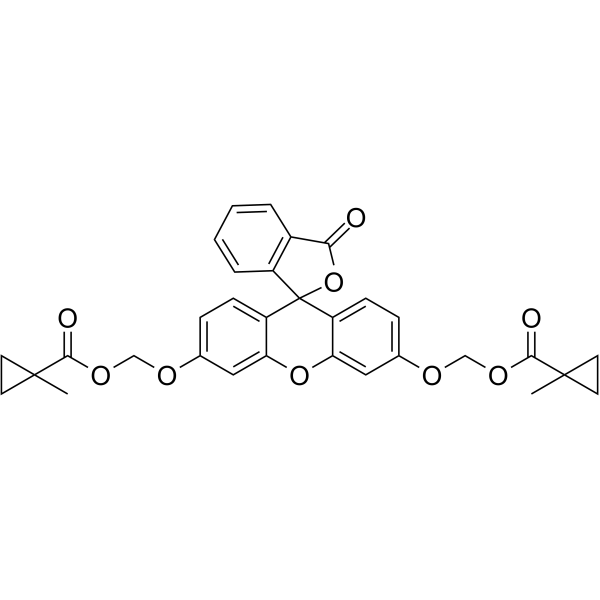
Physicochemical Properties
| Molecular Formula | C32H28O9 |
| Molecular Weight | 556.56 |
| CAS # | 1394821-44-3 |
| PubChem CID | 171038184 |
| Appearance | Solid powder |
| LogP | 5.614 |
| Hydrogen Bond Acceptor Count | 9 |
| Rotatable Bond Count | 10 |
| Heavy Atom Count | 41 |
| Complexity | 988 |
| Defined Atom Stereocenter Count | 0 |
| SMILES | CC1(CC1)C(=O)OCOC2=CC3=C(C=C2)C4(C5=C(O3)C=C(C=C5)OCOC(=O)C6(CC6)C)C7=CC=CC=C7C(=O)O4 |
| InChi Key | CEDGSMZXLBPDNN-UHFFFAOYSA-N |
| InChi Code | InChI=1S/C32H28O9/c1-30(11-12-30)28(34)38-17-36-19-7-9-23-25(15-19)40-26-16-20(37-18-39-29(35)31(2)13-14-31)8-10-24(26)32(23)22-6-4-3-5-21(22)27(33)41-32/h3-10,15-16H,11-14,17-18H2,1-2H3 |
| Chemical Name | [6'-[(1-methylcyclopropanecarbonyl)oxymethoxy]-3-oxospiro[2-benzofuran-1,9'-xanthene]-3'-yl]oxymethyl 1-methylcyclopropane-1-carboxylate |
| Synonyms | Fluorescein CM2; 1394821-44-3; |
| HS Tariff Code | 2934.99.9001 |
| Storage |
Powder-20°C 3 years 4°C 2 years In solvent -80°C 6 months -20°C 1 month Note: Please store this product in a sealed and protected environment (e.g. under nitrogen), avoid exposure to moisture and light. |
| Shipping Condition | Room temperature (This product is stable at ambient temperature for a few days during ordinary shipping and time spent in Customs) |
Biological Activity
| Targets | Fluorescein-CM2 is an ester-protected small molecule substrate designed to be hydrolyzed by esterases, specifically the engineered BS2 esterase. Its activation releases a fluorescent product, fluorescein. It is not a direct pharmacological agent but a probe for detecting esterase activity. |
| ln Vitro |
- In bacterial lysates, fluorescein-CM2 was used to monitor the activity of split BS2 esterase fragments. Upon complementation of the fragments, esterase activity on fluorescein-CM2 generated a fluorescent signal, which was enhanced in the presence of the small-molecule dimerizer rapamycin when the fragments were fused to FRB and FKBP domains. This demonstrated that split esterase assembly is proximity-dependent and can be detected using fluorescein-CM2. [1] - In a cell-free synthetic enzymatic detection system, fluorescein-CM2 cleavage by reconstituted split BS2 esterase from E. coli lysate was robust enough to be visualized by the naked eye, and the presence of rapamycin could be discerned. [1] - When incubated with different mammalian cell lines (including HeLa, CHO, neuronal cells, metastatic cancer cells, immune cells, and liver cells), fluorescein-CM2 exhibited varying levels of endogenous hydrolysis, indicating that background esterase activity is cell-type dependent. Some cell lines showed significant background fluorescence, while others had low endogenous activity. [1] |
| Enzyme Assay |
- In bacterial lysates, fluorescein-CM2 was used to monitor the activity of split BS2 esterase fragments. Upon complementation of the fragments, esterase activity on fluorescein-CM2 generated a fluorescent signal, which was enhanced in the presence of the small-molecule dimerizer rapamycin when the fragments were fused to FRB and FKBP domains. This demonstrated that split esterase assembly is proximity-dependent and can be detected using fluorescein-CM2. [1] - In a cell-free synthetic enzymatic detection system, fluorescein-CM2 cleavage by reconstituted split BS2 esterase from E. coli lysate was robust enough to be visualized by the naked eye, and the presence of rapamycin could be discerned. [1] - When incubated with different mammalian cell lines (including HeLa, CHO, neuronal cells, metastatic cancer cells, immune cells, and liver cells), fluorescein-CM2 exhibited varying levels of endogenous hydrolysis, indicating that background esterase activity is cell-type dependent. Some cell lines showed significant background fluorescence, while others had low endogenous activity. [1] |
| Cell Assay |
- In mammalian cell assays, HEK293T cells were transiently transfected with plasmids encoding split BS2 fragments fused to interacting protein pairs (e.g., FRB and FKBP, or Bcl-2 family proteins). After 24 hours post-transfection, the culture medium was replaced with fresh medium containing fluorescein-CM2. Cells were incubated for a period (exact duration not specified in the main text, but typically 1-2 hours in similar assays) and then analyzed for fluorescence using a plate reader or fluorescence microscopy. The resulting fluorescence signal correlated with PPI-dependent assembly of the split esterase. [1] - For inhibitor studies, cells expressing tBID-BS2N and Bcl-2-BS2C were treated with ABT-199 (Venetoclax) for various time points (0-3 hours) prior to addition of fluorescein-CM2. Fluorescence measurement after probe incubation showed time-dependent decrease in signal, demonstrating that split BS2 can report on pharmacological disruption of PPIs. [1] - To test endogenous esterase activity, different cell lines (including metastatic cancer cells, immune cells, and liver cells) were incubated directly with fluorescein-CM2 without transfection. Fluorescence was measured to assess background hydrolysis, revealing variable levels of endogenous esterase activity across cell types. [1] |
| ADME/Pharmacokinetics |
- Fluorescein-CM2 is a cell-permeable probe, as it is used in live-cell assays to report intracellular esterase activity. Its ester masking groups are designed to be cleaved by specific esterases, but the compound may also be subject to hydrolysis by endogenous esterases in certain cell types, affecting its bioavailability and signal-to-background ratio. [1] |
| References |
[1]. Development of a Split Esterase for Protein-Protein Interaction-Dependent Small-Molecule Activation. ACS Cent Sci. 2019 Nov 27;5(11):1768-1776. |
| Additional Infomation |
- Fluorescein-CM2 is a synthetic fluorogenic substrate based on a fluorescein core protected with a methylcyclopropyl (CM) ester group. The CM ester motif was previously developed to provide improved orthogonality to endogenous esterases compared to simpler esters like acetate. In this study, it serves as a versatile output for proximity-dependent split esterase activity, enabling fluorescent readout of protein-protein interactions in live cells and lysates. [1] - The probe is used in conjunction with the engineered BS2 esterase, which specifically hydrolyzes the CM ester bond. This system allows for the detection of PPIs and their modulation by small-molecule inhibitors, and can be multiplexed with other split reporters (e.g., NanoLuc) for simultaneous monitoring of multiple interactions. [1] |
Solubility Data
| Solubility (In Vitro) | DMSO : 100 mg/mL (179.68 mM; with sonication) |
| Solubility (In Vivo) |
Note: Listed below are some common formulations that may be used to formulate products with low water solubility (e.g. < 1 mg/mL), you may test these formulations using a minute amount of products to avoid loss of samples. Injection Formulations (e.g. IP/IV/IM/SC) Injection Formulation 1: DMSO : Tween 80: Saline = 10 : 5 : 85 (i.e. 100 μL DMSO stock solution → 50 μL Tween 80 → 850 μL Saline) *Preparation of saline: Dissolve 0.9 g of sodium chloride in 100 mL ddH ₂ O to obtain a clear solution. Injection Formulation 2: DMSO : PEG300 :Tween 80 : Saline = 10 : 40 : 5 : 45 (i.e. 100 μL DMSO → 400 μLPEG300 → 50 μL Tween 80 → 450 μL Saline) Injection Formulation 3: DMSO : Corn oil = 10 : 90 (i.e. 100 μL DMSO → 900 μL Corn oil) Example: Take the Injection Formulation 3 (DMSO : Corn oil = 10 : 90) as an example, if 1 mL of 2.5 mg/mL working solution is to be prepared, you can take 100 μL 25 mg/mL DMSO stock solution and add to 900 μL corn oil, mix well to obtain a clear or suspension solution (2.5 mg/mL, ready for use in animals). Injection Formulation 4: DMSO : 20% SBE-β-CD in saline = 10 : 90 [i.e. 100 μL DMSO → 900 μL (20% SBE-β-CD in saline)] *Preparation of 20% SBE-β-CD in Saline (4°C,1 week): Dissolve 2 g SBE-β-CD in 10 mL saline to obtain a clear solution. Injection Formulation 5: 2-Hydroxypropyl-β-cyclodextrin : Saline = 50 : 50 (i.e. 500 μL 2-Hydroxypropyl-β-cyclodextrin → 500 μL Saline) Injection Formulation 6: DMSO : PEG300 : castor oil : Saline = 5 : 10 : 20 : 65 (i.e. 50 μL DMSO → 100 μLPEG300 → 200 μL castor oil → 650 μL Saline) Injection Formulation 7: Ethanol : Cremophor : Saline = 10: 10 : 80 (i.e. 100 μL Ethanol → 100 μL Cremophor → 800 μL Saline) Injection Formulation 8: Dissolve in Cremophor/Ethanol (50 : 50), then diluted by Saline Injection Formulation 9: EtOH : Corn oil = 10 : 90 (i.e. 100 μL EtOH → 900 μL Corn oil) Injection Formulation 10: EtOH : PEG300:Tween 80 : Saline = 10 : 40 : 5 : 45 (i.e. 100 μL EtOH → 400 μLPEG300 → 50 μL Tween 80 → 450 μL Saline) Oral Formulations Oral Formulation 1: Suspend in 0.5% CMC Na (carboxymethylcellulose sodium) Oral Formulation 2: Suspend in 0.5% Carboxymethyl cellulose Example: Take the Oral Formulation 1 (Suspend in 0.5% CMC Na) as an example, if 100 mL of 2.5 mg/mL working solution is to be prepared, you can first prepare 0.5% CMC Na solution by measuring 0.5 g CMC Na and dissolve it in 100 mL ddH2O to obtain a clear solution; then add 250 mg of the product to 100 mL 0.5% CMC Na solution, to make the suspension solution (2.5 mg/mL, ready for use in animals). Oral Formulation 3: Dissolved in PEG400 Oral Formulation 4: Suspend in 0.2% Carboxymethyl cellulose Oral Formulation 5: Dissolve in 0.25% Tween 80 and 0.5% Carboxymethyl cellulose Oral Formulation 6: Mixing with food powders Note: Please be aware that the above formulations are for reference only. InvivoChem strongly recommends customers to read literature methods/protocols carefully before determining which formulation you should use for in vivo studies, as different compounds have different solubility properties and have to be formulated differently. (Please use freshly prepared in vivo formulations for optimal results.) |
| Preparing Stock Solutions | 1 mg | 5 mg | 10 mg | |
| 1 mM | 1.7968 mL | 8.9838 mL | 17.9675 mL | |
| 5 mM | 0.3594 mL | 1.7968 mL | 3.5935 mL | |
| 10 mM | 0.1797 mL | 0.8984 mL | 1.7968 mL |