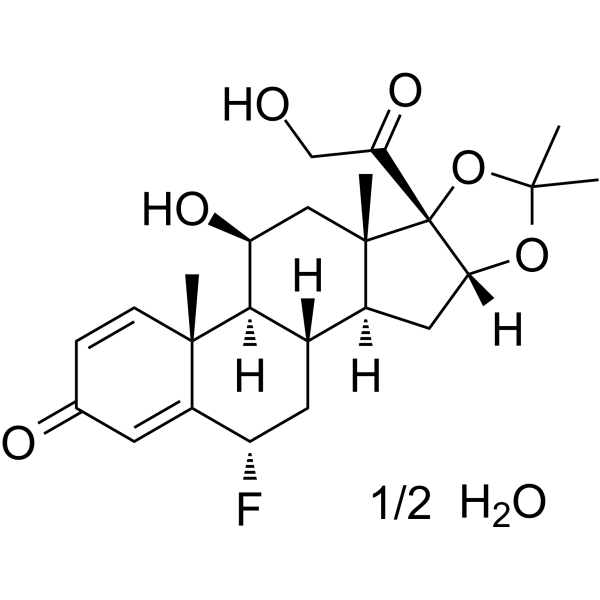
Physicochemical Properties
| Molecular Formula | 2[C24H31O6F].H2O |
| Molecular Weight | 887.010760000001 |
| Exact Mass | 886.431 |
| CAS # | 77326-96-6 |
| Related CAS # | Flunisolide;3385-03-3;Flunisolide-d6 |
| PubChem CID | 82153 |
| Appearance | Typically exists as solid at room temperature |
| Density | 1.33 g/cm3 |
| Boiling Point | 581.8ºC at 760 mmHg |
| Melting Point |
226-230 245 °C |
| Flash Point | 305.7ºC |
| LogP | 4.485 |
| Hydrogen Bond Donor Count | 2 |
| Hydrogen Bond Acceptor Count | 7 |
| Rotatable Bond Count | 2 |
| Heavy Atom Count | 31 |
| Complexity | 910 |
| Defined Atom Stereocenter Count | 9 |
| SMILES | CC1(OC2CC3C4CC(C5=CC(=O)C=CC5(C4C(CC3(C2(O1)C(=O)CO)C)O)C)F)C.CC1(OC2CC3C4CC(C5=CC(=O)C=CC5(C4C(CC3(C2(O1)C(=O)CO)C)O)C)F)C.O |
| InChi Key | XSFJVAJPIHIPKU-XWCQMRHXSA-N |
| InChi Code | InChI=1S/C24H31FO6/c1-21(2)30-19-9-14-13-8-16(25)15-7-12(27)5-6-22(15,3)20(13)17(28)10-23(14,4)24(19,31-21)18(29)11-26/h5-7,13-14,16-17,19-20,26,28H,8-11H2,1-4H3/t13-,14-,16-,17-,19+,20+,22-,23-,24+/m0/s1 |
| Chemical Name | (1S,2S,4R,8S,9S,11S,12S,13R,19S)-19-fluoro-11-hydroxy-8-(2-hydroxyacetyl)-6,6,9,13-tetramethyl-5,7-dioxapentacyclo[10.8.0.02,9.04,8.013,18]icosa-14,17-dien-16-one |
| HS Tariff Code | 2934.99.9001 |
| Storage |
Powder-20°C 3 years 4°C 2 years In solvent -80°C 6 months -20°C 1 month |
| Shipping Condition | Room temperature (This product is stable at ambient temperature for a few days during ordinary shipping and time spent in Customs) |
Biological Activity
| ln Vitro | Lung fibroblasts that have been isolated from the lung are inhibited from activating by flunisolide half hydrate (0.1–10 μM, 1 hour) [1]. Flunisolide hemiwater (10 μM, 24 h) causes sputum eosinophil apoptotic death and decreases the release of MMP-9, TIMP-1, TGF-β, and fibronectin from sputum cells isolated from patients with mild to moderate asthma[2]. In BEAS-2B cells, flunisolide hemiwater (0.1–10 µM µM, 24 h) can efficiently block TNF-α-induced ICAM-1 expression as well as GM-CSF and IL-5 production [3]. It has been demonstrated that flunisolide hemihydrate (115 µM, 0–3 hours) is ATP-dependent and can move polarizedly in Calu-3 cells from the apical (ap) to the basolateral (bl) direction [4]. |
| ln Vivo | Flunisolide hemihydrate (intranasal treatment, 0.3-10 µg/mouse, daily, days 21-27) can decrease lung inflammation, fibrosis, and airway hyperresponsiveness, and can also alleviate lung inflammation in silicic mice. The removal rate of partial silica particles [1]. Flunisolide hemihydrate (intranasal, 0.3-10 µg/mouse daily, days 21-27) reduces silica-induced accumulation of macrophages and myofibroblasts in lung tissue [ 1]. |
| Cell Assay |
Apoptosis analysis [2] Cell Types: eosinophils Tested Concentrations: 10 μM Incubation Duration: 24 h Experimental Results: Induced apoptosis of sputum eosinophils. |
| Animal Protocol |
Animal/Disease Models: Male Swiss Webster mouse (intranasal instillation, crystalline silica, 10 mg/50 µL, particle size 0.5-10 µm) [1] Doses: 0.3-10 µg/mouse daily, p. Results of intranasal administration for 21-27 days: diminished granulomatous reactions, collagen deposition associated with granuloma formation induced by silica particles. Reduce the number of F4/80 and α-SMA positive cells. |
| ADME/Pharmacokinetics |
Absorption, Distribution and Excretion Absorbed rapidly Metabolism / Metabolites Primarily hepatic, converted to the S beta-OH metabolite. Biological Half-Life 1.8 hours |
| Toxicity/Toxicokinetics |
Effects During Pregnancy and Lactation ◉ Summary of Use during Lactation Although not measured, the amounts of inhaled corticosteroids absorbed into the maternal bloodstream and excreted into breastmilk are probably too small to affect a breastfed infant. Expert opinion considers inhaled, nasal and oral corticosteroids acceptable to use during breastfeeding. ◉ Effects in Breastfed Infants None reported with any corticosteroid. ◉ Effects on Lactation and Breastmilk Relevant published information was not found as of the revision date. Protein Binding Approximately 40% after oral inhalation |
| References |
[1]. Intranasal Flunisolide Suppresses Pathological Alterations Caused by Silica Particles in the Lungs of Mice. Front Endocrinol (Lausanne). 2020 Jun 17;11:388. [2]. In vitro effects of flunisolide on MMP-9, TIMP-1, fibronectin, TGF-beta1 release and apoptosis in sputum cells freshly isolated from mild to moderate asthmatics. Allergy. 2004 Sep;59(9):927-32. [3]. Modulation by flunisolide of tumor necrosis factor-alpha-induced stimulation of airway epithelial cell activities related to eosinophil inflammation. J Asthma. 2010 May;47(4):381-7. [4]. Evidence of P-glycoprotein mediated apical to basolateral transport of flunisolide in human broncho-tracheal epithelial cells (Calu-3). Br J Pharmacol. 2001 Dec;134(7):1555-63. |
| Additional Infomation |
Flunisolide can cause developmental toxicity and female reproductive toxicity according to state or federal government labeling requirements. Flunisolide is a fluorinated steroid, a cyclic ketal, a 20-oxo steroid, a 21-hydroxy steroid, an 11beta-hydroxy steroid, a 3-oxo-Delta(1),Delta(4)-steroid and a primary alpha-hydroxy ketone. It has a role as an immunosuppressive agent, an anti-inflammatory drug and an anti-asthmatic drug. Flunisolide (marketed as AeroBid, Nasalide, Nasarel) is a corticosteroid with anti-inflammatory actions. It is often prescribed as treatment for allergic rhinitis and its principle mechanism of action involves activation of glucocorticoid receptors. Flunisolide anhydrous is a Corticosteroid. The mechanism of action of flunisolide anhydrous is as a Corticosteroid Hormone Receptor Agonist. Flunisolide is a synthetic corticosteroid with antiinflammatory and antiallergic properties. Flunisolide is a glucocorticoid receptor agonist that binds to cytoplasmic glucocorticoid receptors and subsequently translocates to the nucleus where it initiates the transcription of glucocorticoid-responsive genes such as lipocortins. Lipocortins inhibit phospholipase A2, thereby blocking the release of arachidonic acid from membrane phospholipids and preventing the synthesis of prostaglandins and leukotrienes, both are potent mediators of inflammation. Drug Indication For the maintenance treatment of asthma as a prophylactic therapy. FDA Label Mechanism of Action Flunisolide is a glucocorticoid receptor agonist. The antiinflammatory actions of corticosteroids are thought to involve lipocortins, phospholipase A2 inhibitory proteins which, through inhibition arachidonic acid, control the biosynthesis of prostaglandins and leukotrienes. The immune system is suppressed by corticosteroids due to a decrease in the function of the lymphatic system, a reduction in immunoglobulin and complement concentrations, the precipitation of lymphocytopenia, and interference with antigen-antibody binding. Flunisolide binds to plasma transcortin, and it becomes active when it is not bound to transcortin. |
Solubility Data
| Solubility (In Vitro) | May dissolve in DMSO (in most cases), if not, try other solvents such as H2O, Ethanol, or DMF with a minute amount of products to avoid loss of samples |
| Solubility (In Vivo) |
Note: Listed below are some common formulations that may be used to formulate products with low water solubility (e.g. < 1 mg/mL), you may test these formulations using a minute amount of products to avoid loss of samples. Injection Formulations (e.g. IP/IV/IM/SC) Injection Formulation 1: DMSO : Tween 80: Saline = 10 : 5 : 85 (i.e. 100 μL DMSO stock solution → 50 μL Tween 80 → 850 μL Saline) *Preparation of saline: Dissolve 0.9 g of sodium chloride in 100 mL ddH ₂ O to obtain a clear solution. Injection Formulation 2: DMSO : PEG300 :Tween 80 : Saline = 10 : 40 : 5 : 45 (i.e. 100 μL DMSO → 400 μLPEG300 → 50 μL Tween 80 → 450 μL Saline) Injection Formulation 3: DMSO : Corn oil = 10 : 90 (i.e. 100 μL DMSO → 900 μL Corn oil) Example: Take the Injection Formulation 3 (DMSO : Corn oil = 10 : 90) as an example, if 1 mL of 2.5 mg/mL working solution is to be prepared, you can take 100 μL 25 mg/mL DMSO stock solution and add to 900 μL corn oil, mix well to obtain a clear or suspension solution (2.5 mg/mL, ready for use in animals). Injection Formulation 4: DMSO : 20% SBE-β-CD in saline = 10 : 90 [i.e. 100 μL DMSO → 900 μL (20% SBE-β-CD in saline)] *Preparation of 20% SBE-β-CD in Saline (4°C,1 week): Dissolve 2 g SBE-β-CD in 10 mL saline to obtain a clear solution. Injection Formulation 5: 2-Hydroxypropyl-β-cyclodextrin : Saline = 50 : 50 (i.e. 500 μL 2-Hydroxypropyl-β-cyclodextrin → 500 μL Saline) Injection Formulation 6: DMSO : PEG300 : castor oil : Saline = 5 : 10 : 20 : 65 (i.e. 50 μL DMSO → 100 μLPEG300 → 200 μL castor oil → 650 μL Saline) Injection Formulation 7: Ethanol : Cremophor : Saline = 10: 10 : 80 (i.e. 100 μL Ethanol → 100 μL Cremophor → 800 μL Saline) Injection Formulation 8: Dissolve in Cremophor/Ethanol (50 : 50), then diluted by Saline Injection Formulation 9: EtOH : Corn oil = 10 : 90 (i.e. 100 μL EtOH → 900 μL Corn oil) Injection Formulation 10: EtOH : PEG300:Tween 80 : Saline = 10 : 40 : 5 : 45 (i.e. 100 μL EtOH → 400 μLPEG300 → 50 μL Tween 80 → 450 μL Saline) Oral Formulations Oral Formulation 1: Suspend in 0.5% CMC Na (carboxymethylcellulose sodium) Oral Formulation 2: Suspend in 0.5% Carboxymethyl cellulose Example: Take the Oral Formulation 1 (Suspend in 0.5% CMC Na) as an example, if 100 mL of 2.5 mg/mL working solution is to be prepared, you can first prepare 0.5% CMC Na solution by measuring 0.5 g CMC Na and dissolve it in 100 mL ddH2O to obtain a clear solution; then add 250 mg of the product to 100 mL 0.5% CMC Na solution, to make the suspension solution (2.5 mg/mL, ready for use in animals). Oral Formulation 3: Dissolved in PEG400 Oral Formulation 4: Suspend in 0.2% Carboxymethyl cellulose Oral Formulation 5: Dissolve in 0.25% Tween 80 and 0.5% Carboxymethyl cellulose Oral Formulation 6: Mixing with food powders Note: Please be aware that the above formulations are for reference only. InvivoChem strongly recommends customers to read literature methods/protocols carefully before determining which formulation you should use for in vivo studies, as different compounds have different solubility properties and have to be formulated differently. (Please use freshly prepared in vivo formulations for optimal results.) |
| Preparing Stock Solutions | 1 mg | 5 mg | 10 mg | |
| 1 mM | 1.1274 mL | 5.6369 mL | 11.2738 mL | |
| 5 mM | 0.2255 mL | 1.1274 mL | 2.2548 mL | |
| 10 mM | 0.1127 mL | 0.5637 mL | 1.1274 mL |