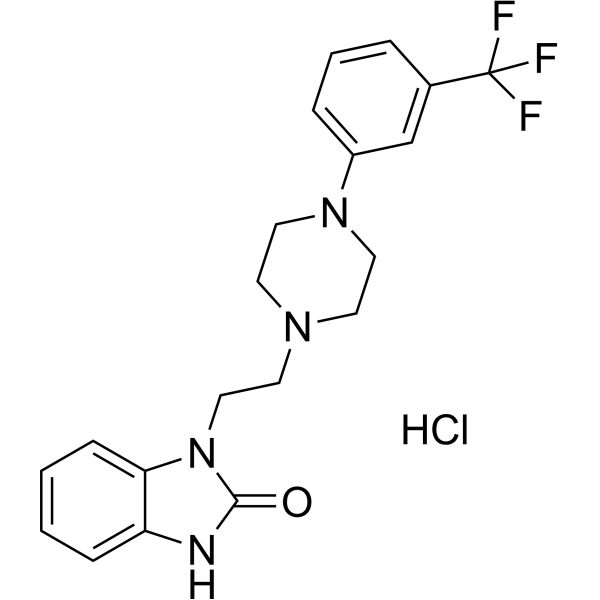
Physicochemical Properties
| Molecular Formula | C20H22CLF3N4O |
| Molecular Weight | 426.8631 |
| Exact Mass | 426.143 |
| CAS # | 147359-76-0 |
| Related CAS # | Flibanserin;167933-07-5;Flibanserin-d4 hydrochloride;Flibanserin-d4;2122830-90-2 |
| PubChem CID | 9845393 |
| Appearance | Typically exists as solid at room temperature |
| Melting Point | >225°C (dec.) |
| LogP | 3.975 |
| Hydrogen Bond Donor Count | 2 |
| Hydrogen Bond Acceptor Count | 6 |
| Rotatable Bond Count | 4 |
| Heavy Atom Count | 29 |
| Complexity | 550 |
| Defined Atom Stereocenter Count | 0 |
| SMILES | Cl[H].FC(C1C([H])=C([H])C([H])=C(C=1[H])N1C([H])([H])C([H])([H])N(C([H])([H])C([H])([H])N2C(N([H])C3=C([H])C([H])=C([H])C([H])=C23)=O)C([H])([H])C1([H])[H])(F)F |
| InChi Key | XGAGFLQFMFCIHZ-UHFFFAOYSA-N |
| InChi Code | InChI=1S/C20H21F3N4O.ClH/c21-20(22,23)15-4-3-5-16(14-15)26-11-8-25(9-12-26)10-13-27-18-7-2-1-6-17(18)24-19(27)28;/h1-7,14H,8-13H2,(H,24,28);1H |
| Chemical Name | 3-[2-[4-[3-(trifluoromethyl)phenyl]piperazin-1-yl]ethyl]-1H-benzimidazol-2-one;hydrochloride |
| HS Tariff Code | 2934.99.9001 |
| Storage |
Powder-20°C 3 years 4°C 2 years In solvent -80°C 6 months -20°C 1 month |
| Shipping Condition | Room temperature (This product is stable at ambient temperature for a few days during ordinary shipping and time spent in Customs) |
Biological Activity
| ln Vitro | After oxidative breakdown, two non-toxic potential degradation products, DP1 and DP2, can be produced from flibanserin hydrochloride (0.01-100 μM; 72 h) [1]. Determination of cell viability [1] |
| ln Vivo | In the hippocampus, midbrain, and prefrontal cortex, flibanserin hydrochloride (1, 10, 30 mg/kg; i.p.; single dose) exhibits unique pharmacological characteristics. The cortex appears to be more sensitive than other brain regions based on the occupancy of 5-HT1A receptors in this area [2]. When taken orally, twice daily for 22 days, flibanserin hydrochloride (15, 45 mg/kg) preferentially activates the mesolimbic dopaminergic pathway and the hypothalamic structures involved in the integration of sexual cues related to sexual motivation [3]. In a rat ultrasonic vocalization model, flobanserin hydrochloride (5, 10, 25, and 50 mg/kg; subcutaneous injection; single dose) has anxiolytic effects without causing motor side effects [4]. |
| Cell Assay |
Cell viability determination [1] Cell Types: NHSF cell lin Tested Concentrations: 0.01, 0.1, 1, 10, 100 μM Incubation Duration: 72 hrs (hours) Experimental Results: Cell viability reached 97.91% (DP1) and 96.73% (DP2) at 0.01 μM. Non-toxic at concentrations up to 100 μM (IC50 >100 μM). |
| Animal Protocol |
Animal/Disease Models: Long Evans female rat (225-250 g) [3] Doses: 15 mg/kg; 45 mg/kg Route of Administration: po (oral gavage); twice (two times) daily for 22 days Experimental Results: Ventral tegmental area The density of activated catecholaminergic neurons increased, but not in the locus coeruleus. After long-term 22-day treatment, Fos expression increased in the medial preoptic area and arcuate nucleus of the hypothalamus, ventral tegmental area, locus coeruleus, and lateral paragigantocellular nucleus. Animal/Disease Models: Infant rat anxiety ultrasonic vocalization model [4] Doses: 5, 10, 25 and 50 mg/kg Route of Administration: subcutaneous injection Experimental Results: Ultrasonic vocalization of infant mice diminished. Shown to be effective within 30 minutes, with no serious motor side effects at active doses. |
| References |
[1]. Fayed M, et al. Insights into Flibanserin Oxidative Stress Degradation Pathway: In Silico – In Vitro Toxicity Assessment of Its Degradates[J]. New Journal of Chemistry, 2021. [2]. Invernizzi RW, et al. A potential antidepressant drug, lowers 5-HT and raises dopamine and noradrenaline in the rat prefrontal cortex dialysate: role of 5-HT(1A) receptors. Br J Pharmacol. 2003 Aug;139(7):1281-8. [3]. Gelez H, et al. Brain neuronal activation induced by flibanserin treatment in female rats. Psychopharmacology (Berl). 2013 Dec;230(4):639-52. [4]. Podhorna J, et al. Flibanserin has anxiolytic effects without locomotor side effects in the infant rat ultrasonic vocalization model of anxiety. Br J Pharmacol. 2000 Jun;130(4):739-46. [5]. Gelman F, et al. Flibanserin for hypoactive sexual desire disorder: place in therapy. Ther Adv Chronic Dis. 2017 Jan;8(1):16-25. |
Solubility Data
| Solubility (In Vitro) | May dissolve in DMSO (in most cases), if not, try other solvents such as H2O, Ethanol, or DMF with a minute amount of products to avoid loss of samples |
| Solubility (In Vivo) |
Note: Listed below are some common formulations that may be used to formulate products with low water solubility (e.g. < 1 mg/mL), you may test these formulations using a minute amount of products to avoid loss of samples. Injection Formulations (e.g. IP/IV/IM/SC) Injection Formulation 1: DMSO : Tween 80: Saline = 10 : 5 : 85 (i.e. 100 μL DMSO stock solution → 50 μL Tween 80 → 850 μL Saline) *Preparation of saline: Dissolve 0.9 g of sodium chloride in 100 mL ddH ₂ O to obtain a clear solution. Injection Formulation 2: DMSO : PEG300 :Tween 80 : Saline = 10 : 40 : 5 : 45 (i.e. 100 μL DMSO → 400 μLPEG300 → 50 μL Tween 80 → 450 μL Saline) Injection Formulation 3: DMSO : Corn oil = 10 : 90 (i.e. 100 μL DMSO → 900 μL Corn oil) Example: Take the Injection Formulation 3 (DMSO : Corn oil = 10 : 90) as an example, if 1 mL of 2.5 mg/mL working solution is to be prepared, you can take 100 μL 25 mg/mL DMSO stock solution and add to 900 μL corn oil, mix well to obtain a clear or suspension solution (2.5 mg/mL, ready for use in animals). Injection Formulation 4: DMSO : 20% SBE-β-CD in saline = 10 : 90 [i.e. 100 μL DMSO → 900 μL (20% SBE-β-CD in saline)] *Preparation of 20% SBE-β-CD in Saline (4°C,1 week): Dissolve 2 g SBE-β-CD in 10 mL saline to obtain a clear solution. Injection Formulation 5: 2-Hydroxypropyl-β-cyclodextrin : Saline = 50 : 50 (i.e. 500 μL 2-Hydroxypropyl-β-cyclodextrin → 500 μL Saline) Injection Formulation 6: DMSO : PEG300 : castor oil : Saline = 5 : 10 : 20 : 65 (i.e. 50 μL DMSO → 100 μLPEG300 → 200 μL castor oil → 650 μL Saline) Injection Formulation 7: Ethanol : Cremophor : Saline = 10: 10 : 80 (i.e. 100 μL Ethanol → 100 μL Cremophor → 800 μL Saline) Injection Formulation 8: Dissolve in Cremophor/Ethanol (50 : 50), then diluted by Saline Injection Formulation 9: EtOH : Corn oil = 10 : 90 (i.e. 100 μL EtOH → 900 μL Corn oil) Injection Formulation 10: EtOH : PEG300:Tween 80 : Saline = 10 : 40 : 5 : 45 (i.e. 100 μL EtOH → 400 μLPEG300 → 50 μL Tween 80 → 450 μL Saline) Oral Formulations Oral Formulation 1: Suspend in 0.5% CMC Na (carboxymethylcellulose sodium) Oral Formulation 2: Suspend in 0.5% Carboxymethyl cellulose Example: Take the Oral Formulation 1 (Suspend in 0.5% CMC Na) as an example, if 100 mL of 2.5 mg/mL working solution is to be prepared, you can first prepare 0.5% CMC Na solution by measuring 0.5 g CMC Na and dissolve it in 100 mL ddH2O to obtain a clear solution; then add 250 mg of the product to 100 mL 0.5% CMC Na solution, to make the suspension solution (2.5 mg/mL, ready for use in animals). Oral Formulation 3: Dissolved in PEG400 Oral Formulation 4: Suspend in 0.2% Carboxymethyl cellulose Oral Formulation 5: Dissolve in 0.25% Tween 80 and 0.5% Carboxymethyl cellulose Oral Formulation 6: Mixing with food powders Note: Please be aware that the above formulations are for reference only. InvivoChem strongly recommends customers to read literature methods/protocols carefully before determining which formulation you should use for in vivo studies, as different compounds have different solubility properties and have to be formulated differently. (Please use freshly prepared in vivo formulations for optimal results.) |
| Preparing Stock Solutions | 1 mg | 5 mg | 10 mg | |
| 1 mM | 2.3427 mL | 11.7134 mL | 23.4269 mL | |
| 5 mM | 0.4685 mL | 2.3427 mL | 4.6854 mL | |
| 10 mM | 0.2343 mL | 1.1713 mL | 2.3427 mL |