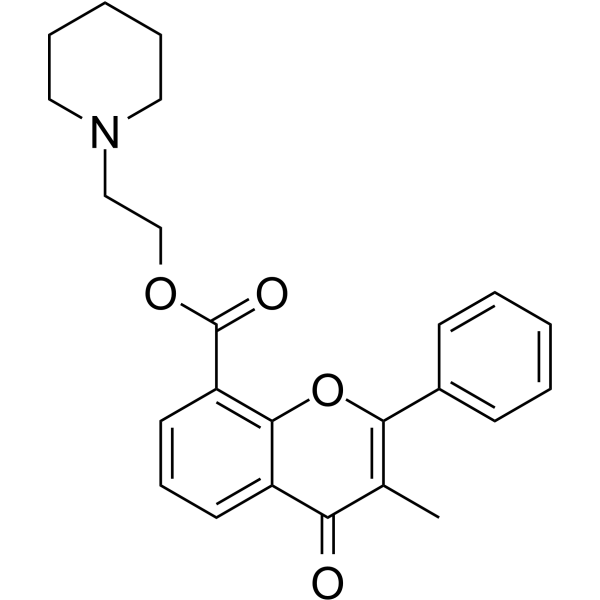
Flavoxate sulfate (Rec-7-0040; DW61) is a potent anticholinergic (AChR) agent that binds and inhibits muscarinic receptors, thereby suppressing the micturition reflex and increases urinary bladder capacity by modifying the micturition center in the brain stem. As an anticholinergic, Flavoxate has the potential to be used in various urinary syndromes and as an antispasmodic. Flavoxate (3 mg/kg, i.v.) completely abolished rhythmic bladder contractions in vehicle-pretreated rats, but not in PTX-pretreated rats. These findings suggest that signal transduction via Gi-coupled receptors is involved, at least in part, in the inhibition of the micturition reflex by flavoxate in rats.
Physicochemical Properties
| Molecular Formula | C24H25NO4 |
| Molecular Weight | 391.4596 |
| Exact Mass | 391.178 |
| CAS # | 15301-69-6 |
| Related CAS # | 3717-88-2 (HCl salt); 15301-69-6 |
| PubChem CID | 3354 |
| Appearance | Typically exists as solid at room temperature |
| Density | 1.2±0.1 g/cm3 |
| Boiling Point | 564.1±50.0 °C at 760 mmHg |
| Melting Point | 232-234 |
| Flash Point | 294.9±30.1 °C |
| Vapour Pressure | 0.0±1.5 mmHg at 25°C |
| Index of Refraction | 1.591 |
| LogP | 5.18 |
| Hydrogen Bond Donor Count | 0 |
| Hydrogen Bond Acceptor Count | 5 |
| Rotatable Bond Count | 6 |
| Heavy Atom Count | 29 |
| Complexity | 631 |
| Defined Atom Stereocenter Count | 0 |
| SMILES | CC1=C(C2=CC=CC=C2)OC3=C(C=CC=C3C(=O)OCCN4CCCCC4)C1=O |
| InChi Key | SPIUTQOUKAMGCX-UHFFFAOYSA-N |
| InChi Code | InChI=1S/C24H25NO4/c1-17-21(26)19-11-8-12-20(23(19)29-22(17)18-9-4-2-5-10-18)24(27)28-16-15-25-13-6-3-7-14-25/h2,4-5,8-12H,3,6-7,13-16H2,1H3 |
| Chemical Name | 2-piperidin-1-ylethyl 3-methyl-4-oxo-2-phenylchromene-8-carboxylate |
| HS Tariff Code | 2934.99.9001 |
| Storage |
Powder-20°C 3 years 4°C 2 years In solvent -80°C 6 months -20°C 1 month |
| Shipping Condition | Room temperature (This product is stable at ambient temperature for a few days during ordinary shipping and time spent in Customs) |
Biological Activity
| ln Vitro |
|
||
| ln Vivo |
|
||
| Animal Protocol |
|
||
| ADME/Pharmacokinetics |
Absorption, Distribution and Excretion Well absorbed from gastrointestinal tract. 57% of the flavoxate HCl was excreted in the urine within 24 hours. |
||
| Toxicity/Toxicokinetics |
Hepatotoxicity Like other anticholinergic agents, flavoxate has not been linked to episodes of liver enzyme elevations or clinically apparent liver injury. A major reason for its safety may relate to the low daily dose. References on the safety and potential hepatotoxicity of anticholinergics are given together after the Overview section on Anticholinergic Agents. Drug Class: Anticholinergic Agents Effects During Pregnancy and Lactation ◉ Summary of Use during Lactation No information is available on the use of flavoxate during breastfeeding. Long-term use of trihexyphenidyl might reduce milk production or milk letdown, but a single dose is not likely to interfere with breastfeeding. During long-term use, observe for signs of decreased lactation (e.g., insatiety, poor weight gain). ◉ Effects in Breastfed Infants Relevant published information was not found as of the revision date. ◉ Effects on Lactation and Breastmilk Anticholinergics can inhibit lactation in animals, apparently by inhibiting growth hormone and oxytocin secretion. Anticholinergic drugs can also reduce serum prolactin in nonnursing women. The prolactin level in a mother with established lactation may not affect her ability to breastfeed. |
||
| References | Brain Res.1996 Jul 15;727(1-2):91-8. | ||
| Additional Infomation |
Flavoxate is a carboxylic ester resulting from the formal condensation of 3-methylflavone-8-carboxylic acid with 2-(1-piperidinyl)ethanol. It has a role as a parasympatholytic, a muscarinic antagonist and an antispasmodic drug. It is a member of piperidines, a member of flavones, a carboxylic ester and a tertiary amino compound. It is functionally related to a 3-methylflavone-8-carboxylic acid and a 2-(piperidin-1-yl)ethanol. It is a conjugate base of a flavoxate(1+). Flavoxate is a Cholinergic Muscarinic Antagonist. The mechanism of action of flavoxate is as a Cholinergic Muscarinic Antagonist. Flavoxate is a synthetic anticholinergic agent that is used for treatment of urinary incontinence and overactive bladder syndrome. Flavoxate has not been implicated in causing liver enzyme elevations or clinically apparent acute liver injury. Flavoxate is a synthetic parasympatholytic with antimuscarinic, muscle relaxant and urinary antispasmodic properties. Flavoxate binds and inhibits muscarinic receptors, thereby suppressing the micturition reflex and increases urinary bladder capacity by modifying the micturition center in the brain stem. In addition, this agent has been found to inhibit cyclic AMP formation in striatal membranes of the brain through stimulation of pertussis toxin-sensitive G protein-coupled receptors which in turn suppress isovolumetric urinary bladder contraction. A drug that has been used in various urinary syndromes and as an antispasmodic. Its therapeutic usefulness and its mechanism of action are not clear. It may have local anesthetic activity and direct relaxing effects on smooth muscle as well as some activity as a muscarinic antagonist. See also: Flavoxate Hydrochloride (has salt form). Drug Indication For symptomatic relief of dysuria, urgency, nocturia, suprapubic pain, frequency and incontinence as may occur in cystitis, prostatitis, urethritis, urethrocystitis/urethrotrigonitis. Mechanism of Action Flavoxate acts as a direct antagonist at muscarinic acetylcholine receptors in cholinergically innervated organs. Its anticholinergic-parasympatholytic action reduces the tonus of smooth muscle in the bladder, effectively reducing the number of required voids, urge incontinence episodes, urge severity and improving retention, facilitating increased volume per void. Pharmacodynamics Flavoxate is a spasmolytic flavone derivative that acts by relaxing the smooth muscle in the urinary tract. Flavoxate is a competitive muscarinic receptor antagonist indicated for the treatment of overactive bladder with symptoms of urge urinary incontinence, urgency, and urinary frequency. Muscarinic receptors play an important role in several major cholin-ergically mediated functions, including contractions of urinary bladder smooth muscle and stimulation of salivary secretion. |
Solubility Data
| Solubility (In Vitro) | May dissolve in DMSO (in most cases), if not, try other solvents such as H2O, Ethanol, or DMF with a minute amount of products to avoid loss of samples |
| Solubility (In Vivo) |
Note: Listed below are some common formulations that may be used to formulate products with low water solubility (e.g. < 1 mg/mL), you may test these formulations using a minute amount of products to avoid loss of samples. Injection Formulations (e.g. IP/IV/IM/SC) Injection Formulation 1: DMSO : Tween 80: Saline = 10 : 5 : 85 (i.e. 100 μL DMSO stock solution → 50 μL Tween 80 → 850 μL Saline) *Preparation of saline: Dissolve 0.9 g of sodium chloride in 100 mL ddH ₂ O to obtain a clear solution. Injection Formulation 2: DMSO : PEG300 :Tween 80 : Saline = 10 : 40 : 5 : 45 (i.e. 100 μL DMSO → 400 μLPEG300 → 50 μL Tween 80 → 450 μL Saline) Injection Formulation 3: DMSO : Corn oil = 10 : 90 (i.e. 100 μL DMSO → 900 μL Corn oil) Example: Take the Injection Formulation 3 (DMSO : Corn oil = 10 : 90) as an example, if 1 mL of 2.5 mg/mL working solution is to be prepared, you can take 100 μL 25 mg/mL DMSO stock solution and add to 900 μL corn oil, mix well to obtain a clear or suspension solution (2.5 mg/mL, ready for use in animals). Injection Formulation 4: DMSO : 20% SBE-β-CD in saline = 10 : 90 [i.e. 100 μL DMSO → 900 μL (20% SBE-β-CD in saline)] *Preparation of 20% SBE-β-CD in Saline (4°C,1 week): Dissolve 2 g SBE-β-CD in 10 mL saline to obtain a clear solution. Injection Formulation 5: 2-Hydroxypropyl-β-cyclodextrin : Saline = 50 : 50 (i.e. 500 μL 2-Hydroxypropyl-β-cyclodextrin → 500 μL Saline) Injection Formulation 6: DMSO : PEG300 : castor oil : Saline = 5 : 10 : 20 : 65 (i.e. 50 μL DMSO → 100 μLPEG300 → 200 μL castor oil → 650 μL Saline) Injection Formulation 7: Ethanol : Cremophor : Saline = 10: 10 : 80 (i.e. 100 μL Ethanol → 100 μL Cremophor → 800 μL Saline) Injection Formulation 8: Dissolve in Cremophor/Ethanol (50 : 50), then diluted by Saline Injection Formulation 9: EtOH : Corn oil = 10 : 90 (i.e. 100 μL EtOH → 900 μL Corn oil) Injection Formulation 10: EtOH : PEG300:Tween 80 : Saline = 10 : 40 : 5 : 45 (i.e. 100 μL EtOH → 400 μLPEG300 → 50 μL Tween 80 → 450 μL Saline) Oral Formulations Oral Formulation 1: Suspend in 0.5% CMC Na (carboxymethylcellulose sodium) Oral Formulation 2: Suspend in 0.5% Carboxymethyl cellulose Example: Take the Oral Formulation 1 (Suspend in 0.5% CMC Na) as an example, if 100 mL of 2.5 mg/mL working solution is to be prepared, you can first prepare 0.5% CMC Na solution by measuring 0.5 g CMC Na and dissolve it in 100 mL ddH2O to obtain a clear solution; then add 250 mg of the product to 100 mL 0.5% CMC Na solution, to make the suspension solution (2.5 mg/mL, ready for use in animals). Oral Formulation 3: Dissolved in PEG400 Oral Formulation 4: Suspend in 0.2% Carboxymethyl cellulose Oral Formulation 5: Dissolve in 0.25% Tween 80 and 0.5% Carboxymethyl cellulose Oral Formulation 6: Mixing with food powders Note: Please be aware that the above formulations are for reference only. InvivoChem strongly recommends customers to read literature methods/protocols carefully before determining which formulation you should use for in vivo studies, as different compounds have different solubility properties and have to be formulated differently. (Please use freshly prepared in vivo formulations for optimal results.) |
| Preparing Stock Solutions | 1 mg | 5 mg | 10 mg | |
| 1 mM | 2.5545 mL | 12.7727 mL | 25.5454 mL | |
| 5 mM | 0.5109 mL | 2.5545 mL | 5.1091 mL | |
| 10 mM | 0.2555 mL | 1.2773 mL | 2.5545 mL |