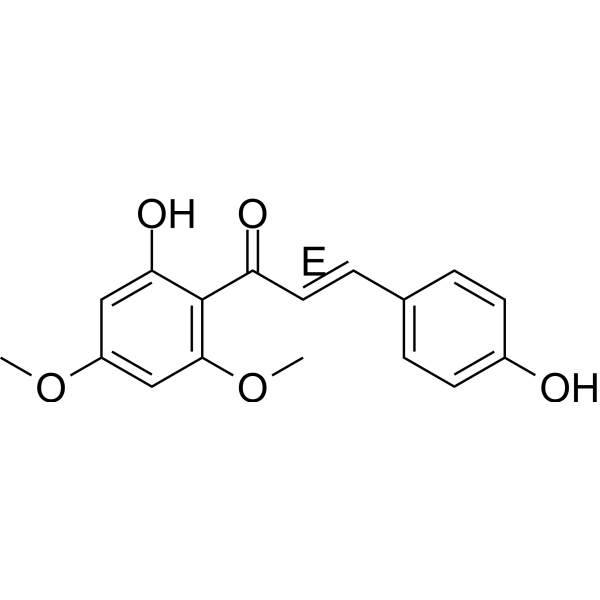
Physicochemical Properties
| Molecular Formula | C17H16O5 |
| Molecular Weight | 300.3059 |
| Exact Mass | 300.099 |
| CAS # | 37308-75-1 |
| PubChem CID | 6293081 |
| Appearance | Light yellow to orange solid powder |
| Density | 1.3±0.1 g/cm3 |
| Boiling Point | 556.0±50.0 °C at 760 mmHg |
| Melting Point | 179-182℃ |
| Flash Point | 207.3±23.6 °C |
| Vapour Pressure | 0.0±1.6 mmHg at 25°C |
| Index of Refraction | 1.637 |
| LogP | 3.48 |
| Hydrogen Bond Donor Count | 2 |
| Hydrogen Bond Acceptor Count | 5 |
| Rotatable Bond Count | 5 |
| Heavy Atom Count | 22 |
| Complexity | 387 |
| Defined Atom Stereocenter Count | 0 |
| SMILES | COC1=CC(=C(C(=C1)OC)C(=O)/C=C/C2=CC=C(C=C2)O)O |
| InChi Key | UXUFMIJZNYXWDX-VMPITWQZSA-N |
| InChi Code | InChI=1S/C17H16O5/c1-21-13-9-15(20)17(16(10-13)22-2)14(19)8-5-11-3-6-12(18)7-4-11/h3-10,18,20H,1-2H3/b8-5+ |
| Chemical Name | (E)-1-(2-hydroxy-4,6-dimethoxyphenyl)-3-(4-hydroxyphenyl)prop-2-en-1-one |
| HS Tariff Code | 2934.99.9001 |
| Storage |
Powder-20°C 3 years 4°C 2 years In solvent -80°C 6 months -20°C 1 month Note: This product requires protection from light (avoid light exposure) during transportation and storage. |
| Shipping Condition | Room temperature (This product is stable at ambient temperature for a few days during ordinary shipping and time spent in Customs) |
Biological Activity
| Targets |
- Flavokawain C does not target a single enzyme or receptor; instead, it regulates multiple signaling molecules, including MAPKs (p38, JNK, ERK) and Akt [1] |
| ln Vitro |
- Antiproliferative activity on HCT 116 cells: Flavokawain C inhibited the proliferation of HCT 116 human colon carcinoma cells in a dose-dependent manner, with an IC50 value of 12.5 μM after 48 hours of treatment [1] - Cell cycle arrest: Treatment with Flavokawain C (10 μM, 20 μM) for 24 hours induced G2/M phase arrest in HCT 116 cells. The proportion of cells in G2/M phase increased from 12.3% (control) to 35.6% (10 μM) and 48.2% (20 μM), accompanied by decreased expression of cyclin B1 and cdc2 (G2/M phase-related proteins) [1] - Apoptosis induction: Flavokawain C (10 μM, 20 μM) promoted apoptosis of HCT 116 cells after 48 hours. The apoptotic rate increased from 3.1% (control) to 22.5% (10 μM) and 38.7% (20 μM), as detected by Annexin V-FITC/PI staining. It upregulated the expression of cleaved caspase-3, cleaved caspase-9, and Bax, and downregulated Bcl-2 (apoptosis-related proteins) [1] - Endoplasmic reticulum (ER) stress induction: Flavokawain C (10 μM, 20 μM) induced ER stress in HCT 116 cells, as shown by increased expression of GRP78, CHOP, and ATF6 (ER stress markers) after 24 hours of treatment [1] - MAPKs and Akt signaling regulation: Flavokawain C (10 μM, 20 μM) activated p38 and JNK (MAPK subfamilies) in HCT 116 cells (increased phosphorylation levels) after 12 hours, but had no significant effect on ERK phosphorylation. It also inhibited Akt activation by reducing Akt phosphorylation levels [1] |
| Cell Assay |
- Cell viability (MTT) assay: HCT 116 cells were seeded in 96-well plates at a density of 5×10³ cells/well and incubated for 24 hours. Flavokawain C was dissolved in DMSO and added to wells at final concentrations of 2.5 μM, 5 μM, 10 μM, 20 μM, 40 μM (DMSO concentration <0.1% as control). After incubation for 24 h, 48 h, and 72 h at 37°C (5% CO₂), MTT reagent was added and incubated for 4 hours. The formazan crystals were dissolved with DMSO, and absorbance was measured at 570 nm. The IC50 value was calculated based on the dose-response curve [1] - Cell cycle analysis: HCT 116 cells were seeded in 6-well plates (2×10⁵ cells/well) and treated with Flavokawain C (10 μM, 20 μM) or DMSO (control) for 24 hours. Cells were harvested, fixed with 70% ethanol at 4°C overnight, stained with PI solution (containing RNase) for 30 minutes at room temperature, and analyzed by flow cytometry to determine the proportion of cells in each cell cycle phase [1] - Apoptosis detection (Annexin V-FITC/PI staining): HCT 116 cells were treated with Flavokawain C (10 μM, 20 μM) or DMSO for 48 hours, harvested, washed with PBS, and resuspended in binding buffer. Annexin V-FITC and PI were added sequentially, and the cells were incubated in the dark for 15 minutes at room temperature. Apoptotic rates were detected by flow cytometry [1] - Western blot analysis: HCT 116 cells were treated with Flavokawain C (10 μM, 20 μM) or DMSO for the specified time (12 h, 24 h, 48 h). Cells were lysed with RIPA buffer, and protein concentration was determined. Equal amounts of protein were separated by SDS-PAGE, transferred to PVDF membranes, blocked with non-fat milk, and incubated with primary antibodies (against cyclin B1, cdc2, cleaved caspase-3, GRP78, p38, phospho-p38, Akt, phospho-Akt, etc.) overnight at 4°C. After incubation with secondary antibodies, the bands were visualized using an enhanced chemiluminescence system, and band intensity was quantified by densitometry [1] |
| References |
[1]. Flavokawain C Inhibits Cell Cycle and Promotes Apoptosis, Associated with Endoplasmic Reticulum Stress and Regulation of MAPKs and Akt Signaling Pathways in HCT 116 Human Colon Carcinoma Cells. PLoS One. 2016 Feb 9;11(2):e0148775. |
| Additional Infomation |
Flavokawain C is a member of chalcones. 2',4-Dihydroxy-4',6'-dimethoxychalcone has been reported in Humulus lupulus, Boesenbergia rotunda, and other organisms with data available. - Flavokawain C is a natural chalcone derivative isolated from the roots of Piper methysticum (kava kava), a plant traditionally used in Pacific Island cultures [1] - The antiproliferative and proapoptotic effects of Flavokawain C on HCT 116 cells are closely associated with ER stress induction and the regulation of MAPKs (p38/JNK activation) and Akt (inhibition) signaling pathways [1] |
Solubility Data
| Solubility (In Vitro) | DMSO : ~125 mg/mL (~416.24 mM) |
| Solubility (In Vivo) |
Solubility in Formulation 1: ≥ 1.25 mg/mL (4.16 mM) (saturation unknown) in 10% DMSO + 40% PEG300 + 5% Tween80 + 45% Saline (add these co-solvents sequentially from left to right, and one by one), clear solution. For example, if 1 mL of working solution is to be prepared, you can add 100 μL of 12.5 mg/mL clear DMSO stock solution to 400 μL PEG300 and mix evenly; then add 50 μL Tween-80 to the above solution and mix evenly; then add 450 μL normal saline to adjust the volume to 1 mL. Preparation of saline: Dissolve 0.9 g of sodium chloride in 100 mL ddH₂ O to obtain a clear solution. Solubility in Formulation 2: ≥ 1.25 mg/mL (4.16 mM) (saturation unknown) in 10% DMSO + 90% (20% SBE-β-CD in Saline) (add these co-solvents sequentially from left to right, and one by one), clear solution. For example, if 1 mL of working solution is to be prepared, you can add 100 μL of 12.5 mg/mL clear DMSO stock solution to 900 μL of 20% SBE-β-CD physiological saline solution and mix evenly. Preparation of 20% SBE-β-CD in Saline (4°C,1 week): Dissolve 2 g SBE-β-CD in 10 mL saline to obtain a clear solution. Solubility in Formulation 3: ≥ 1.25 mg/mL (4.16 mM) (saturation unknown) in 10% DMSO + 90% Corn Oil (add these co-solvents sequentially from left to right, and one by one), clear solution. For example, if 1 mL of working solution is to be prepared, you can add 100 μL of 12.5 mg/mL clear DMSO stock solution to 900 μL of corn oil and mix evenly. (Please use freshly prepared in vivo formulations for optimal results.) |
| Preparing Stock Solutions | 1 mg | 5 mg | 10 mg | |
| 1 mM | 3.3299 mL | 16.6495 mL | 33.2989 mL | |
| 5 mM | 0.6660 mL | 3.3299 mL | 6.6598 mL | |
| 10 mM | 0.3330 mL | 1.6649 mL | 3.3299 mL |