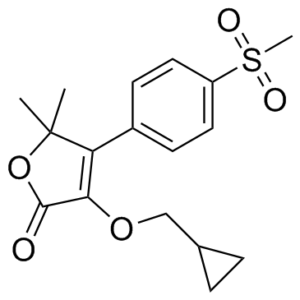
Firocoxib (formerly ML-1785713; ML1785713) is a novel, potent and selective cyclooxygenase (COX)-2 inhibitor (IC50 = 0.13 uM) with 58-fold sensitivity for COX2 over COX1. It is a non-steroidal anti-inflammatory drugs (NSAIDs) of the COX-2 inhibitor class, the conversion of arachidonic acid into prostaglandin is catalysed by the cyclo-oxygenases (COX-1/COX-2). Several studies indicate that COX-2 is overexpressed in actinic keratosis in humans and dogs. Firocoxib is a COX-2-selective inhibitor that blocks the biochemical activity of COX-2.
Physicochemical Properties
| Molecular Formula | C17H20O5S | |
| Molecular Weight | 336.4 | |
| Exact Mass | 336.103 | |
| CAS # | 189954-96-9 | |
| Related CAS # | Firocoxib-d4;1325700-11-5 | |
| PubChem CID | 208910 | |
| Appearance | White to off-white solid powder | |
| Density | 1.3±0.1 g/cm3 | |
| Boiling Point | 563.9±50.0 °C at 760 mmHg | |
| Melting Point | 78-80°C | |
| Flash Point | 294.8±30.1 °C | |
| Vapour Pressure | 0.0±1.5 mmHg at 25°C | |
| Index of Refraction | 1.584 | |
| LogP | 1.23 | |
| Hydrogen Bond Donor Count | 0 | |
| Hydrogen Bond Acceptor Count | 5 | |
| Rotatable Bond Count | 5 | |
| Heavy Atom Count | 23 | |
| Complexity | 614 | |
| Defined Atom Stereocenter Count | 0 | |
| InChi Key | FULAPETWGIGNMT-UHFFFAOYSA-N | |
| InChi Code | InChI=1S/C17H20O5S/c1-17(2)14(12-6-8-13(9-7-12)23(3,19)20)15(16(18)22-17)21-10-11-4-5-11/h6-9,11H,4-5,10H2,1-3H3 | |
| Chemical Name |
|
|
| Synonyms |
|
|
| HS Tariff Code | 2934.99.9001 | |
| Storage |
Powder-20°C 3 years 4°C 2 years In solvent -80°C 6 months -20°C 1 month Note: (1). This product requires protection from light (avoid light exposure) during transportation and storage.(2). Please store this product in a sealed and protected environment (e.g. under nitrogen), avoid exposure to moisture. |
|
| Shipping Condition | Room temperature (This product is stable at ambient temperature for a few days during ordinary shipping and time spent in Customs) |
Biological Activity
| ln Vitro | The IC50 values of COX-1 and COX-2 are typically compared in order to calculate the COX-1:COX-2 selectivity ratio. Compared to IC50 values, IC80 values are more indicative of steady-state plasma drug concentrations [1]. Based on the IC80 value, the selectivity ratio of firocoxib was 121 (the IC80 values for COX-2 and COX-1 were 0.36 μM and 43.6 μM, respectively). This suggests that COX-2 selectivity remains constant at concentrations higher than the IC50. Interestingly, doses of firocoxib that inhibit COX-2 by 80% to 95% also inhibit COX-1 by less than 20% [1]. |
| ln Vivo | Giving firocoxib to female domestic shorthair cats orally, either one or fourteen hours prior to an LPS challenge, effectively lowers their fever [1]. Male cats were used to test the pharmacokinetic characteristics of firocoxib following oral (3 mg/kg) and intravenous (2 mg/kg) administration. Firocoxib has an elimination half-life of 8.7 to 12.2 hours, a low plasma clearance of 4.7 to 5.8 mL/min/kg, and a moderate to high oral bioavailability of 54% to 70% [1]. |
| Animal Protocol |
Animal/Disease Models: 14 healthy female domestic shorthair cats (11-15 months old, 2.9-3.9 kg), lipopolysaccharide (LPS) [1] Doses: 0.75 mg/kg, 1.5 mg/kg Route of Administration: po (oral gavage) Experimental Results: Effective attenuation of febrile symptoms in cats when administered 1 or 14 hrs (hrs (hours)) before LPS challenge. |
| References |
[1]. Evaluation of the adverse effects of oral firocoxib in healthy dogs. J Vet Pharmacol Ther. 2007 Jun;30(3):218-23. [2]. Pharmacokinetics of firocoxib in preweaned calves after oral and intravenous administration. J Vet Pharmacol Ther. 2014 Oct;37(5):457-63. [3]. Clinical outcome and cyclo-oxygenase-2 expression in five dogs with solar dermatitis/actinic keratosis treated with firocoxib. Vet Dermatol. 2013 Dec;24(6):606-12, e147. [4]. In vitro effects and in vivo efficacy of a novel cyclooxygenase-2 inhibitor in cats with lipopolysaccharide-induced pyrexia. Am J Vet Res. 2005 Jul;66(7):1278-84. |
| Additional Infomation |
Firocoxib is an enol ether that is the cyclopropylmethyl ether of 3-hydroxy-5,5-dimethyl-4-[4-(methylsulfonyl)phenyl]furan-2-one. A selective cyclooxygenase 2 inhibitor, it is used in veterinary medicine for the control of pain and inflammation associated with osteoarthritis in horses and dogs. It has a role as a non-steroidal anti-inflammatory drug, a cyclooxygenase 2 inhibitor, an antineoplastic agent and a non-narcotic analgesic. It is a butenolide, a sulfone, an enol ether and a member of cyclopropanes. Firocoxib is a cycooxygenase-2 (COX-2) selective non-steroidal anti-inflammatory drug. It currently approved for veterinary use in dogs and horses under the brand names Equioxx and Previcox. Firocoxib was the first COX-2 inhibitor approved by the U.S. Food and Drug Administration for horses. Firocoxib is not intended or approved for use in human medicine. Drug Indication Used for the treatment of pain inflammation and fever in horses and dogs. Alleviation of pain and inflammation associated with osteoarthritis and reduction of associated lameness in horses. TabletsFor the relief of pain and inflammation associated with osteoarthritis in dogs. For the relief of postoperative pain and inflammation associated with soft-tissue, orthopaedic and dental surgery in dogs. Oral pasteAlleviation of pain and inflammation associated with osteoarthritis and reduction of associated lameness in horses. |
Solubility Data
| Solubility (In Vitro) |
|
|||
| Solubility (In Vivo) |
Note: Listed below are some common formulations that may be used to formulate products with low water solubility (e.g. < 1 mg/mL), you may test these formulations using a minute amount of products to avoid loss of samples. Injection Formulations (e.g. IP/IV/IM/SC) Injection Formulation 1: DMSO : Tween 80: Saline = 10 : 5 : 85 (i.e. 100 μL DMSO stock solution → 50 μL Tween 80 → 850 μL Saline) *Preparation of saline: Dissolve 0.9 g of sodium chloride in 100 mL ddH ₂ O to obtain a clear solution. Injection Formulation 2: DMSO : PEG300 :Tween 80 : Saline = 10 : 40 : 5 : 45 (i.e. 100 μL DMSO → 400 μLPEG300 → 50 μL Tween 80 → 450 μL Saline) Injection Formulation 3: DMSO : Corn oil = 10 : 90 (i.e. 100 μL DMSO → 900 μL Corn oil) Example: Take the Injection Formulation 3 (DMSO : Corn oil = 10 : 90) as an example, if 1 mL of 2.5 mg/mL working solution is to be prepared, you can take 100 μL 25 mg/mL DMSO stock solution and add to 900 μL corn oil, mix well to obtain a clear or suspension solution (2.5 mg/mL, ready for use in animals). Injection Formulation 4: DMSO : 20% SBE-β-CD in saline = 10 : 90 [i.e. 100 μL DMSO → 900 μL (20% SBE-β-CD in saline)] *Preparation of 20% SBE-β-CD in Saline (4°C,1 week): Dissolve 2 g SBE-β-CD in 10 mL saline to obtain a clear solution. Injection Formulation 5: 2-Hydroxypropyl-β-cyclodextrin : Saline = 50 : 50 (i.e. 500 μL 2-Hydroxypropyl-β-cyclodextrin → 500 μL Saline) Injection Formulation 6: DMSO : PEG300 : castor oil : Saline = 5 : 10 : 20 : 65 (i.e. 50 μL DMSO → 100 μLPEG300 → 200 μL castor oil → 650 μL Saline) Injection Formulation 7: Ethanol : Cremophor : Saline = 10: 10 : 80 (i.e. 100 μL Ethanol → 100 μL Cremophor → 800 μL Saline) Injection Formulation 8: Dissolve in Cremophor/Ethanol (50 : 50), then diluted by Saline Injection Formulation 9: EtOH : Corn oil = 10 : 90 (i.e. 100 μL EtOH → 900 μL Corn oil) Injection Formulation 10: EtOH : PEG300:Tween 80 : Saline = 10 : 40 : 5 : 45 (i.e. 100 μL EtOH → 400 μLPEG300 → 50 μL Tween 80 → 450 μL Saline) Oral Formulations Oral Formulation 1: Suspend in 0.5% CMC Na (carboxymethylcellulose sodium) Oral Formulation 2: Suspend in 0.5% Carboxymethyl cellulose Example: Take the Oral Formulation 1 (Suspend in 0.5% CMC Na) as an example, if 100 mL of 2.5 mg/mL working solution is to be prepared, you can first prepare 0.5% CMC Na solution by measuring 0.5 g CMC Na and dissolve it in 100 mL ddH2O to obtain a clear solution; then add 250 mg of the product to 100 mL 0.5% CMC Na solution, to make the suspension solution (2.5 mg/mL, ready for use in animals). Oral Formulation 3: Dissolved in PEG400 Oral Formulation 4: Suspend in 0.2% Carboxymethyl cellulose Oral Formulation 5: Dissolve in 0.25% Tween 80 and 0.5% Carboxymethyl cellulose Oral Formulation 6: Mixing with food powders Note: Please be aware that the above formulations are for reference only. InvivoChem strongly recommends customers to read literature methods/protocols carefully before determining which formulation you should use for in vivo studies, as different compounds have different solubility properties and have to be formulated differently. (Please use freshly prepared in vivo formulations for optimal results.) |
| Preparing Stock Solutions | 1 mg | 5 mg | 10 mg | |
| 1 mM | 2.9727 mL | 14.8633 mL | 29.7265 mL | |
| 5 mM | 0.5945 mL | 2.9727 mL | 5.9453 mL | |
| 10 mM | 0.2973 mL | 1.4863 mL | 2.9727 mL |