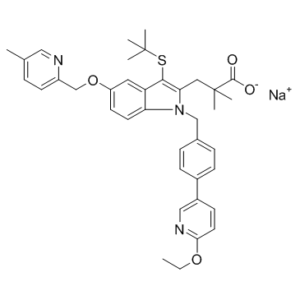
Fiboflapon sodium (also known as AM-803 and GSK2190915 sodium) is a novel,orally bioavailable and potent FLAP (5-Lipoxygenase-activating protein) inhibitor with binding IC50 of 2.9 nM. Fiboflapon attenuated the early (0-2 h) and late (4-10 h) asthmatic responses to inhaled allergen compared with placebo. GSK2190915 shows potential as a treatment for patients with asthma. Efficacy was demonstrated for GSK2190915 30 mg compared with placebo in day-time symptom scores and day-time SABA use.
Physicochemical Properties
| Molecular Formula | C38H42N3O4S-.NA+ |
| Molecular Weight | 659.813 |
| Exact Mass | 659.279 |
| CAS # | 1196070-26-4 |
| Related CAS # | Fiboflapon;936350-00-4 |
| PubChem CID | 44473150 |
| Appearance | White to off-white solid powder |
| LogP | 7.641 |
| Hydrogen Bond Donor Count | 0 |
| Hydrogen Bond Acceptor Count | 7 |
| Rotatable Bond Count | 13 |
| Heavy Atom Count | 47 |
| Complexity | 973 |
| Defined Atom Stereocenter Count | 0 |
| InChi Key | NOJNFULGOQGBKB-UHFFFAOYSA-M |
| InChi Code | InChI=1S/C38H43N3O4S.Na/c1-8-44-34-18-14-28(22-40-34)27-12-10-26(11-13-27)23-41-32-17-16-30(45-24-29-15-9-25(2)21-39-29)19-31(32)35(46-37(3,4)5)33(41)20-38(6,7)36(42)43;/h9-19,21-22H,8,20,23-24H2,1-7H3,(H,42,43);/q;+1/p-1 |
| Chemical Name | sodium;3-[3-tert-butylsulfanyl-1-[[4-(6-ethoxypyridin-3-yl)phenyl]methyl]-5-[(5-methylpyridin-2-yl)methoxy]indol-2-yl]-2,2-dimethylpropanoate |
| HS Tariff Code | 2934.99.9001 |
| Storage |
Powder-20°C 3 years 4°C 2 years In solvent -80°C 6 months -20°C 1 month Note: Please store this product in a sealed and protected environment, avoid exposure to moisture. |
| Shipping Condition | Room temperature (This product is stable at ambient temperature for a few days during ordinary shipping and time spent in Customs) |
Biological Activity
| ln Vitro | In rats and dogs, fibroflapon (AM803) has shown outstanding preclinical toxicity and pharmacokinetics. The rodent bronchoalveolar lavage (BAL) paradigm shows sustained pharmacodynamic effects when fibroflapon (AM803) is administered [1]. In ex vivo whole blood that has been challenged with an ionophore, oral administration of Fiboflapon (AM803) (1 mg/kg) sustainably reduces LTB4 production by >90% for 12 hours, with an EC50 of roughly 7 nM. Fiboflapon (AM803) suppressed the synthesis of cysteinyl leukotriene (CysLT) and LTB4 in rat lungs when they were exposed to calcium ionophores in vivo, with an ED50 of 0.12 mg/kg and 0.37 mg/kg, respectively. 16 hours following a single oral dose of 3 mg/kg, the inhibition of LTB4 and CysLT was 86% and 41%, respectively. In an acute inflammatory context, intraperitoneal zymosan injection-induced LTB4, CysLT, plasma protein extravasation, and neutrophil influx are all reduced in a dose-dependent manner by fibroflapon (AM803). Ultimately, mice given deadly intravenous infusions of platelet-activating factor (PAF) were able to survive longer when given AM803 [2]. |
| References |
[1]. 5-Lipoxygenase-activating protein (FLAP) inhibitors. Part 4: development of 3-[3-tert-butylsulfanyl-1-[4-(6-ethoxypyridin-3-yl)benzyl]-5-(5-methylpyridin-2-ylmethoxy)-1H-indol-2-yl]-2,2-dimethylpropionic acid (AM803), a potent, oral, once. [2]. Pharmacology of AM803, a novel selective five-lipoxygenase-activating protein (FLAP) inhibitor in rodent models of acute inflammation. Eur J Pharmacol. 2010 Aug 25;640(1-3):211-8. |
Solubility Data
| Solubility (In Vitro) | DMSO : ~100 mg/mL (~151.56 mM) |
| Solubility (In Vivo) |
Solubility in Formulation 1: 2.5 mg/mL (3.79 mM) in 10% DMSO + 40% PEG300 + 5% Tween80 + 45% Saline (add these co-solvents sequentially from left to right, and one by one), suspension solution; with sonication. For example, if 1 mL of working solution is to be prepared, you can add 100 μL of 25.0 mg/mL clear DMSO stock solution to 400 μL PEG300 and mix evenly; then add 50 μL Tween-80 to the above solution and mix evenly; then add 450 μL normal saline to adjust the volume to 1 mL. Preparation of saline: Dissolve 0.9 g of sodium chloride in 100 mL ddH₂ O to obtain a clear solution. Solubility in Formulation 2: ≥ 2.5 mg/mL (3.79 mM) (saturation unknown) in 10% DMSO + 90% (20% SBE-β-CD in Saline) (add these co-solvents sequentially from left to right, and one by one), clear solution. For example, if 1 mL of working solution is to be prepared, you can add 100 μL of 25.0 mg/mL clear DMSO stock solution to 900 μL of 20% SBE-β-CD physiological saline solution and mix evenly. Preparation of 20% SBE-β-CD in Saline (4°C,1 week): Dissolve 2 g SBE-β-CD in 10 mL saline to obtain a clear solution. Solubility in Formulation 3: ≥ 2.5 mg/mL (3.79 mM) (saturation unknown) in 10% DMSO + 90% Corn Oil (add these co-solvents sequentially from left to right, and one by one), clear solution. For example, if 1 mL of working solution is to be prepared, you can add 100 μL of 25.0 mg/mL clear DMSO stock solution to 900 μL of corn oil and mix evenly. (Please use freshly prepared in vivo formulations for optimal results.) |
| Preparing Stock Solutions | 1 mg | 5 mg | 10 mg | |
| 1 mM | 1.5156 mL | 7.5779 mL | 15.1559 mL | |
| 5 mM | 0.3031 mL | 1.5156 mL | 3.0312 mL | |
| 10 mM | 0.1516 mL | 0.7578 mL | 1.5156 mL |