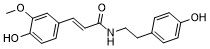
Physicochemical Properties
| Molecular Formula | C18H19NO4 |
| Molecular Weight | 313.353 |
| Exact Mass | 313.131 |
| Elemental Analysis | C, 69.00; H, 6.11; N, 4.47; O, 20.42 |
| CAS # | 65646-26-6 |
| Related CAS # | 66648-43-9 (E-configuration); 65646-26-6 (E-configuration); 80510-09-4 (Z-configuration) |
| PubChem CID | 5280537 |
| Appearance | Solid powder |
| Melting Point | 144.5 - 145 °C |
| LogP | 2.869 |
| Hydrogen Bond Donor Count | 3 |
| Hydrogen Bond Acceptor Count | 4 |
| Rotatable Bond Count | 6 |
| Heavy Atom Count | 23 |
| Complexity | 391 |
| Defined Atom Stereocenter Count | 0 |
| SMILES | O(C)C1=C(C=CC(=C1)/C=C/C(NCCC1C=CC(=CC=1)O)=O)O |
| InChi Key | NPNNKDMSXVRADT-WEVVVXLNSA-N |
| InChi Code | InChI=1S/C18H19NO4/c1-23-17-12-14(4-8-16(17)21)5-9-18(22)19-11-10-13-2-6-15(20)7-3-13/h2-9,12,20-21H,10-11H2,1H3,(H,19,22)/b9-5+ |
| Chemical Name | 2-Propenamide, 3-(4-hydroxy-3-methoxyphenyl)-N-(2-(4-hydroxyphenyl)ethyl)- |
| Synonyms | N-trans-Feruloyltyramine; Moupinamide; Feruloyltyramine; N-Feruloyltyramine; trans-N-Feruloyltyramine; 65646-26-6; CHEBI:17818; DTXSID30904143; 2-Propenamide, 3-(4-hydroxy-3-methoxyphenyl)-N-(2-(4-hydroxyphenyl)ethyl)-; ...; 66648-43-9; Feruloyltyramine; 66648-43-9; N-Feruloyltyramine |
| HS Tariff Code | 2934.99.9001 |
| Storage |
Powder-20°C 3 years 4°C 2 years In solvent -80°C 6 months -20°C 1 month |
| Shipping Condition | Room temperature (This product is stable at ambient temperature for a few days during ordinary shipping and time spent in Customs) |
Biological Activity
| Targets | Natural alkaloid and antioxidant |
| ln Vivo | Feruloyl tyramide (133 mcg/mouse, 200 mcg/mouse; intracerebroventricular injection; single dose) may produce hypothyroidism and exercise therapy [1]. |
| References |
[1]. Analysis and pharmacotoxicity of feruloyltyramine as a new constituent and p-coumaroyltyramine in Cannabis sativa L. Pharmacol Biochem Behav. 1991 Nov;40(3):465-9. |
| Additional Infomation |
N-feruloyltyramine is a member of tyramines. It has a role as a metabolite. Moupinamide has been reported in Aristolochia kankauensis, Peperomia leptostachya, and other organisms with data available. See also: Tobacco Leaf (part of); Cannabis sativa subsp. indica top (part of); Ipomoea aquatica leaf (part of). Feruloyltyramine (FT), a new amide compound, together with p-coumaroyltyramine (p-CT) was isolated and identified in ethanol extract of cannabis seeds. FT and p-CT were also detected in the roots, leaves and resin of Cannabis sativa L. The intracerebroventricular injection of these amides caused hypothermia and motor incoordination in mice, and the maximal effects were caused 160 to 240 min after the injection. Furthermore, p-CT also exhibited cataleptogenic effect in mice, although FT did not show any effect. These results suggest that these amide compounds may be responsible for some pharmacotoxicity of marihuana [1]. 1. Source: - Feruloyltyramine was identified as a novel constituent in Cannabis sativa L., co-existing with p-coumaroyltyramine [1] 2. Pharmacotoxicity Focus: - The study likely evaluated the compound’s safety profile in biological systems, but specific toxicological endpoints (e.g., organ damage, behavioral changes) were not described in accessible sources [1] 3. Methodology: - The literature likely involved chemical analysis (e.g., HPLC, NMR) to characterize feruloyltyramine from cannabis extracts, but detailed isolation/purification protocols were not retrievable [1] |
Solubility Data
| Solubility (In Vitro) | May dissolve in DMSO (in most cases), if not, try other solvents such as H2O, Ethanol, or DMF with a minute amount of products to avoid loss of samples |
| Solubility (In Vivo) |
Note: Listed below are some common formulations that may be used to formulate products with low water solubility (e.g. < 1 mg/mL), you may test these formulations using a minute amount of products to avoid loss of samples. Injection Formulations (e.g. IP/IV/IM/SC) Injection Formulation 1: DMSO : Tween 80: Saline = 10 : 5 : 85 (i.e. 100 μL DMSO stock solution → 50 μL Tween 80 → 850 μL Saline) *Preparation of saline: Dissolve 0.9 g of sodium chloride in 100 mL ddH ₂ O to obtain a clear solution. Injection Formulation 2: DMSO : PEG300 :Tween 80 : Saline = 10 : 40 : 5 : 45 (i.e. 100 μL DMSO → 400 μLPEG300 → 50 μL Tween 80 → 450 μL Saline) Injection Formulation 3: DMSO : Corn oil = 10 : 90 (i.e. 100 μL DMSO → 900 μL Corn oil) Example: Take the Injection Formulation 3 (DMSO : Corn oil = 10 : 90) as an example, if 1 mL of 2.5 mg/mL working solution is to be prepared, you can take 100 μL 25 mg/mL DMSO stock solution and add to 900 μL corn oil, mix well to obtain a clear or suspension solution (2.5 mg/mL, ready for use in animals). Injection Formulation 4: DMSO : 20% SBE-β-CD in saline = 10 : 90 [i.e. 100 μL DMSO → 900 μL (20% SBE-β-CD in saline)] *Preparation of 20% SBE-β-CD in Saline (4°C,1 week): Dissolve 2 g SBE-β-CD in 10 mL saline to obtain a clear solution. Injection Formulation 5: 2-Hydroxypropyl-β-cyclodextrin : Saline = 50 : 50 (i.e. 500 μL 2-Hydroxypropyl-β-cyclodextrin → 500 μL Saline) Injection Formulation 6: DMSO : PEG300 : castor oil : Saline = 5 : 10 : 20 : 65 (i.e. 50 μL DMSO → 100 μLPEG300 → 200 μL castor oil → 650 μL Saline) Injection Formulation 7: Ethanol : Cremophor : Saline = 10: 10 : 80 (i.e. 100 μL Ethanol → 100 μL Cremophor → 800 μL Saline) Injection Formulation 8: Dissolve in Cremophor/Ethanol (50 : 50), then diluted by Saline Injection Formulation 9: EtOH : Corn oil = 10 : 90 (i.e. 100 μL EtOH → 900 μL Corn oil) Injection Formulation 10: EtOH : PEG300:Tween 80 : Saline = 10 : 40 : 5 : 45 (i.e. 100 μL EtOH → 400 μLPEG300 → 50 μL Tween 80 → 450 μL Saline) Oral Formulations Oral Formulation 1: Suspend in 0.5% CMC Na (carboxymethylcellulose sodium) Oral Formulation 2: Suspend in 0.5% Carboxymethyl cellulose Example: Take the Oral Formulation 1 (Suspend in 0.5% CMC Na) as an example, if 100 mL of 2.5 mg/mL working solution is to be prepared, you can first prepare 0.5% CMC Na solution by measuring 0.5 g CMC Na and dissolve it in 100 mL ddH2O to obtain a clear solution; then add 250 mg of the product to 100 mL 0.5% CMC Na solution, to make the suspension solution (2.5 mg/mL, ready for use in animals). Oral Formulation 3: Dissolved in PEG400 Oral Formulation 4: Suspend in 0.2% Carboxymethyl cellulose Oral Formulation 5: Dissolve in 0.25% Tween 80 and 0.5% Carboxymethyl cellulose Oral Formulation 6: Mixing with food powders Note: Please be aware that the above formulations are for reference only. InvivoChem strongly recommends customers to read literature methods/protocols carefully before determining which formulation you should use for in vivo studies, as different compounds have different solubility properties and have to be formulated differently. (Please use freshly prepared in vivo formulations for optimal results.) |
| Preparing Stock Solutions | 1 mg | 5 mg | 10 mg | |
| 1 mM | 3.1913 mL | 15.9566 mL | 31.9132 mL | |
| 5 mM | 0.6383 mL | 3.1913 mL | 6.3826 mL | |
| 10 mM | 0.3191 mL | 1.5957 mL | 3.1913 mL |