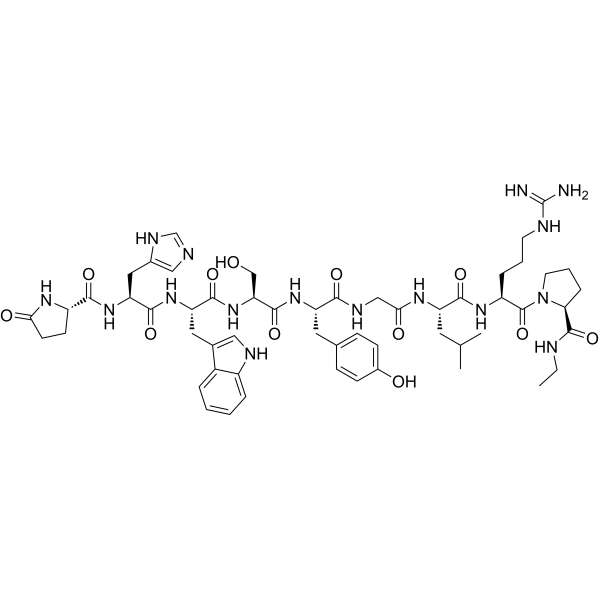
Physicochemical Properties
| Molecular Formula | C55H76N16O12 |
| Molecular Weight | 1153.2920 |
| Exact Mass | 1152.582 |
| CAS # | 38234-21-8 |
| Related CAS # | 66002-66-2 (acetate) |
| PubChem CID | 188304 |
| Appearance | White to off-white solid powder |
| Density | 1.5±0.1 g/cm3 |
| Index of Refraction | 1.698 |
| LogP | -1.35 |
| Hydrogen Bond Donor Count | 15 |
| Hydrogen Bond Acceptor Count | 14 |
| Rotatable Bond Count | 30 |
| Heavy Atom Count | 83 |
| Complexity | 2280 |
| Defined Atom Stereocenter Count | 8 |
| SMILES | CCNC(=O)[C@@H]1CCCN1C(=O)[C@H](CCCN=C(N)N)NC(=O)[C@H](CC(C)C)NC(=O)CNC(=O)[C@H](CC2=CC=C(C=C2)O)NC(=O)[C@H](CO)NC(=O)[C@H](CC3=CNC4=CC=CC=C43)NC(=O)[C@H](CC5=CN=CN5)NC(=O)[C@@H]6CCC(=O)N6 |
| InChi Key | DGCPIBPDYFLAAX-YTAGXALCSA-N |
| InChi Code | InChI=1S/C55H76N16O12/c1-4-59-53(82)44-12-8-20-71(44)54(83)38(11-7-19-60-55(56)57)66-49(78)39(21-30(2)3)65-46(75)27-62-47(76)40(22-31-13-15-34(73)16-14-31)67-52(81)43(28-72)70-50(79)41(23-32-25-61-36-10-6-5-9-35(32)36)68-51(80)42(24-33-26-58-29-63-33)69-48(77)37-17-18-45(74)64-37/h5-6,9-10,13-16,25-26,29-30,37-44,61,72-73H,4,7-8,11-12,17-24,27-28H2,1-3H3,(H,58,63)(H,59,82)(H,62,76)(H,64,74)(H,65,75)(H,66,78)(H,67,81)(H,68,80)(H,69,77)(H,70,79)(H4,56,57,60)/t37-,38-,39-,40-,41-,42-,43-,44-/m0/s1 |
| Chemical Name | (2S)-N-[(2S)-1-[[(2S)-1-[[(2S)-1-[[(2S)-1-[[2-[[(2S)-1-[[(2S)-5-(diaminomethylideneamino)-1-[(2S)-2-(ethylcarbamoyl)pyrrolidin-1-yl]-1-oxopentan-2-yl]amino]-4-methyl-1-oxopentan-2-yl]amino]-2-oxoethyl]amino]-3-(4-hydroxyphenyl)-1-oxopropan-2-yl]amino]-3-hydroxy-1-oxopropan-2-yl]amino]-3-(1H-indol-3-yl)-1-oxopropan-2-yl]amino]-3-(1H-imidazol-5-yl)-1-oxopropan-2-yl]-5-oxopyrrolidine-2-carboxamide |
| HS Tariff Code | 2934.99.9001 |
| Storage |
Powder-20°C 3 years 4°C 2 years In solvent -80°C 6 months -20°C 1 month Note: Please store this product in a sealed and protected environment (e.g. under nitrogen), avoid exposure to moisture and light. |
| Shipping Condition | Room temperature (This product is stable at ambient temperature for a few days during ordinary shipping and time spent in Customs) |
Biological Activity
| Targets |
The action target of Fertirelin is the luteinizing hormone-releasing hormone (LH-RH) receptor (also known as GnRH receptor) [1][2] |
| ln Vivo |
Fertirelin, a GnRH analog, is the preferred treatment for treating follicular cysts because it is 2.5–10 times more effective than natural GnRH [1]. High dosages of fertirelin have been shown in studies to decrease the response to superovulation [2]. 1. Effect on cows with follicular cysts: Cows diagnosed with follicular cysts via milk progesterone test (progesterone < 5 ng/mL) were treated with Fertirelin. After 14 days of Fertirelin treatment, fenprostalene was administered. Results showed: - The interval from Fertirelin treatment to conception was significantly shortened: the treatment group had an interval of 18.2 ± 3.5 days, while the untreated control group (only fenprostalene) had an interval of 28.6 ± 4.2 days [1] - The cyst recovery rate was 85.7% (18/21 cows) in the Fertirelin + fenprostalene group, higher than the 61.9% (13/21 cows) in the fenprostalene-only group [1] - The conception rate within 60 days after Fertirelin treatment was 76.2% (16/21 cows), compared to 52.4% (11/21 cows) in the control group [1] 2. Effect on superovulation in mice: ICR female mice (8–10 weeks old) were intraperitoneally injected with Fertirelin at doses of 0.1 μg/mouse, 0.5 μg/mouse, and 1.0 μg/mouse (control group: normal saline). Results showed: - The 0.5 μg/mouse dose was the optimal dose for superovulation: it yielded 16.2 ± 2.3 oocytes per mouse, significantly higher than 8.5 ± 1.8 (0.1 μg/mouse), 12.3 ± 2.1 (1.0 μg/mouse), and 5.1 ± 1.2 (control) [1] - The fertilization rate of oocytes from the 0.5 μg/mouse group was 88.7 ± 3.5%, which was not significantly different from other Fertirelin groups but higher than the control group (72.3 ± 4.1%) [2] |
| Animal Protocol |
1. Cow experiment (follicular cyst treatment, literature [1]): - Animal selection: Holstein cows (2–5 years old) with a history of anestrus for >30 days, diagnosed with follicular cysts via milk progesterone test (progesterone concentration < 5 ng/mL) [1] - Drug administration: Fertirelin was administered via intramuscular injection at a dose of 200 μg per cow. Fourteen days after Fertirelin injection, fenprostalene (500 μg per cow) was intramuscularly injected [1] - Observation and detection: Cows were observed for estrus signs twice daily (morning and evening). Cows showing estrus were inseminated artificially. Milk progesterone was measured weekly to confirm pregnancy; the interval from Fertirelin treatment to conception and conception rate were recorded [1] 2. Mouse experiment (superovulation induction, literature [2]): - Animal selection: 8–10-week-old female ICR mice, housed under controlled conditions (23±1°C, 12-hour light/dark cycle) with free access to food and water [2] - Drug administration: Fertirelin was dissolved in normal saline to prepare solutions of 0.1 μg/100 μL, 0.5 μg/100 μL, and 1.0 μg/100 μL. Mice in each group received 100 μL of the corresponding solution via intraperitoneal injection; the control group received 100 μL of normal saline [2] - Sample collection and detection: After Fertirelin injection, each female mouse was caged with a fertile male mouse (1:1). Forty-eight hours later, mice were sacrificed by cervical dislocation, and oviducts were excised to collect oocytes. The number of oocytes per mouse was counted, and oocytes were cultured in vitro to detect fertilization rate [2] |
| References |
[1]. Effect of fenprostalene 14 days after fertirelin treatment on intervals from treatment to conception in cows with follicular cysts diagnosed by milk progesterone test. J Vet Med Sci. 1993 Apr;55(2):207-10. [2]. Optimum dose of LH-RH analogue Fertirelin Acetate for the induction of superovulation in mice. Exp Anim. 2005 Jan;54(1):97-9. |
| Additional Infomation |
Fertirelin is an oligopeptide. 1. Background of Fertirelin: Fertirelin is a synthetic analog of luteinizing hormone-releasing hormone (LH-RH, also called gonadotropin-releasing hormone, GnRH), which acts as an LH-RH agonist to stimulate the release of luteinizing hormone (LH) and follicle-stimulating hormone (FSH) from the anterior pituitary [1][2] 2. Mechanism in cows: Fertirelin stimulates the pituitary to secrete LH, which promotes the luteinization of cystic follicles in cows, restoring normal ovarian function and shortening the interval to conception when combined with fenprostalene (a prostaglandin analog that induces luteolysis) [1] 3. Mechanism in mice: Fertirelin stimulates the pituitary to secrete FSH, which promotes the development and maturation of multiple ovarian follicles in mice, thereby inducing superovulation. The 0.5 μg/mouse dose balances follicle development and oocyte quality, achieving the optimal superovulation effect [2] |
Solubility Data
| Solubility (In Vitro) |
DMSO : ~100 mg/mL (~86.71 mM) H2O : ~100 mg/mL (~86.71 mM) |
| Solubility (In Vivo) |
Solubility in Formulation 1: ≥ 2.5 mg/mL (2.17 mM) (saturation unknown) in 10% DMSO + 40% PEG300 + 5% Tween80 + 45% Saline (add these co-solvents sequentially from left to right, and one by one), clear solution. For example, if 1 mL of working solution is to be prepared, you can add 100 μL of 25.0 mg/mL clear DMSO stock solution to 400 μL PEG300 and mix evenly; then add 50 μL Tween-80 to the above solution and mix evenly; then add 450 μL normal saline to adjust the volume to 1 mL. Preparation of saline: Dissolve 0.9 g of sodium chloride in 100 mL ddH₂ O to obtain a clear solution. Solubility in Formulation 2: ≥ 2.5 mg/mL (2.17 mM) (saturation unknown) in 10% DMSO + 90% (20% SBE-β-CD in Saline) (add these co-solvents sequentially from left to right, and one by one), clear solution. For example, if 1 mL of working solution is to be prepared, you can add 100 μL of 25.0 mg/mL clear DMSO stock solution to 900 μL of 20% SBE-β-CD physiological saline solution and mix evenly. Preparation of 20% SBE-β-CD in Saline (4°C,1 week): Dissolve 2 g SBE-β-CD in 10 mL saline to obtain a clear solution. Solubility in Formulation 3: ≥ 2.5 mg/mL (2.17 mM) (saturation unknown) in 10% DMSO + 90% Corn Oil (add these co-solvents sequentially from left to right, and one by one), clear solution. For example, if 1 mL of working solution is to be prepared, you can add 100 μL of 25.0 mg/mL clear DMSO stock solution to 900 μL of corn oil and mix evenly. Solubility in Formulation 4: 50 mg/mL (43.35 mM) in PBS (add these co-solvents sequentially from left to right, and one by one), clear solution; with ultrasonication. (Please use freshly prepared in vivo formulations for optimal results.) |
| Preparing Stock Solutions | 1 mg | 5 mg | 10 mg | |
| 1 mM | 0.8671 mL | 4.3354 mL | 8.6708 mL | |
| 5 mM | 0.1734 mL | 0.8671 mL | 1.7342 mL | |
| 10 mM | 0.0867 mL | 0.4335 mL | 0.8671 mL |