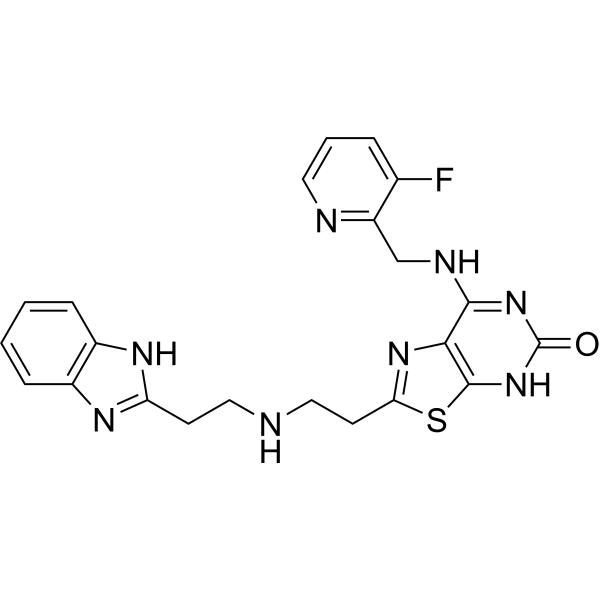
Physicochemical Properties
| Exact Mass | 464.15430 |
| CAS # | 2443432-65-1 |
| PubChem CID | 146662427 |
| Appearance | White to off-white solid powder |
| LogP | 1.7 |
| Hydrogen Bond Donor Count | 4 |
| Hydrogen Bond Acceptor Count | 8 |
| Rotatable Bond Count | 9 |
| Heavy Atom Count | 33 |
| Complexity | 833 |
| Defined Atom Stereocenter Count | 0 |
| InChi Key | AMCFSVKOAOALFO-UHFFFAOYSA-N |
| InChi Code | InChI=1S/C22H21FN8OS/c23-13-4-3-9-25-16(13)12-26-20-19-21(31-22(32)30-20)33-18(29-19)8-11-24-10-7-17-27-14-5-1-2-6-15(14)28-17/h1-6,9,24H,7-8,10-12H2,(H,27,28)(H2,26,30,31,32) |
| Chemical Name | 2-[2-[2-(1H-benzimidazol-2-yl)ethylamino]ethyl]-7-[(3-fluoropyridin-2-yl)methylamino]-6H-[1,3]thiazolo[5,4-d]pyrimidin-5-one |
| Synonyms | Ferroportin-IN-1; 2443432-65-1; SCHEMBL22075649; |
| HS Tariff Code | 2934.99.9001 |
| Storage |
Powder-20°C 3 years 4°C 2 years In solvent -80°C 6 months -20°C 1 month |
| Shipping Condition | Room temperature (This product is stable at ambient temperature for a few days during ordinary shipping and time spent in Customs) |
Biological Activity
| Targets | Ferroportin |
| ln Vitro | The ferroportin inhibition activity of the compounds of Formula I and pharmaceutically acceptable salts thereof provide methods particularly suitable for the use in the inhibition of iron transport mediated by ferroportin. As such, the compounds of Formula I and pharmaceutically acceptable salts thereof are useful in the prophylaxis and/or treatment of iron metabolism disorders leading to increased iron levels, of diseases related to or caused by increased iron levels, increased iron absorption or iron overload, such as in particular of tissue iron overload, of diseases associated with ineffective erythropoiesis, or of diseases caused by reduced levels of hepcidin. Further, the compounds of Formula I are suitable for the use in an adjunctive therapy by limiting the amount of iron available to pathogenic microorganisms, e.g. the siderophilic bacteria Vibrio vulnificus and Yersinia enterocolitica, and common pathogens (e.g. Escherichia coli), thereby preventing or treating infections, inflammation, sepsis, and septic shock caused by said pathogenic microorganisms.[1] |
| References |
[1]. Ferroportin inhibitors and methods of use. WO2020123850A1. |
| Additional Infomation | Ferroportin is an iron transporter that plays a key role in regulating iron uptake and distribution in the body and thus in controlling iron levels in the blood. The transport protein ferroportin is a transmembrane protein consisting of 571 amino acids which is formed in the liver, spleen, kidneys, heart, intestine and placenta. In particular, ferroportin is localized in the basolateral membrane of intestinal epithelial cells. Ferroportin bound in this way thus acts to export the iron into the blood. In this case, it is most probable that ferroportin transports iron as Fe2+. If hepcidin binds to ferroportin, ferroportin is transported into the interior of the cell, where its breakdown takes place so that the release of the phagocytotically recycled iron from the cells is then almost completely blocked. If the ferroportin is inactivated, for example by hepcidin, so that it is unable to export the iron which is stored in the mucosal cells, the stored iron is lost with the natural shedding of cells via the stools. The absorption of iron in the intestine is therefore reduced, when ferroportin is inactivated or inhibited, for example by hepcidin.[1] |
Solubility Data
| Solubility (In Vitro) | May dissolve in DMSO (in most cases), if not, try other solvents such as H2O, Ethanol, or DMF with a minute amount of products to avoid loss of samples |
| Solubility (In Vivo) |
Note: Listed below are some common formulations that may be used to formulate products with low water solubility (e.g. < 1 mg/mL), you may test these formulations using a minute amount of products to avoid loss of samples. Injection Formulations (e.g. IP/IV/IM/SC) Injection Formulation 1: DMSO : Tween 80: Saline = 10 : 5 : 85 (i.e. 100 μL DMSO stock solution → 50 μL Tween 80 → 850 μL Saline) *Preparation of saline: Dissolve 0.9 g of sodium chloride in 100 mL ddH ₂ O to obtain a clear solution. Injection Formulation 2: DMSO : PEG300 :Tween 80 : Saline = 10 : 40 : 5 : 45 (i.e. 100 μL DMSO → 400 μLPEG300 → 50 μL Tween 80 → 450 μL Saline) Injection Formulation 3: DMSO : Corn oil = 10 : 90 (i.e. 100 μL DMSO → 900 μL Corn oil) Example: Take the Injection Formulation 3 (DMSO : Corn oil = 10 : 90) as an example, if 1 mL of 2.5 mg/mL working solution is to be prepared, you can take 100 μL 25 mg/mL DMSO stock solution and add to 900 μL corn oil, mix well to obtain a clear or suspension solution (2.5 mg/mL, ready for use in animals). Injection Formulation 4: DMSO : 20% SBE-β-CD in saline = 10 : 90 [i.e. 100 μL DMSO → 900 μL (20% SBE-β-CD in saline)] *Preparation of 20% SBE-β-CD in Saline (4°C,1 week): Dissolve 2 g SBE-β-CD in 10 mL saline to obtain a clear solution. Injection Formulation 5: 2-Hydroxypropyl-β-cyclodextrin : Saline = 50 : 50 (i.e. 500 μL 2-Hydroxypropyl-β-cyclodextrin → 500 μL Saline) Injection Formulation 6: DMSO : PEG300 : castor oil : Saline = 5 : 10 : 20 : 65 (i.e. 50 μL DMSO → 100 μLPEG300 → 200 μL castor oil → 650 μL Saline) Injection Formulation 7: Ethanol : Cremophor : Saline = 10: 10 : 80 (i.e. 100 μL Ethanol → 100 μL Cremophor → 800 μL Saline) Injection Formulation 8: Dissolve in Cremophor/Ethanol (50 : 50), then diluted by Saline Injection Formulation 9: EtOH : Corn oil = 10 : 90 (i.e. 100 μL EtOH → 900 μL Corn oil) Injection Formulation 10: EtOH : PEG300:Tween 80 : Saline = 10 : 40 : 5 : 45 (i.e. 100 μL EtOH → 400 μLPEG300 → 50 μL Tween 80 → 450 μL Saline) Oral Formulations Oral Formulation 1: Suspend in 0.5% CMC Na (carboxymethylcellulose sodium) Oral Formulation 2: Suspend in 0.5% Carboxymethyl cellulose Example: Take the Oral Formulation 1 (Suspend in 0.5% CMC Na) as an example, if 100 mL of 2.5 mg/mL working solution is to be prepared, you can first prepare 0.5% CMC Na solution by measuring 0.5 g CMC Na and dissolve it in 100 mL ddH2O to obtain a clear solution; then add 250 mg of the product to 100 mL 0.5% CMC Na solution, to make the suspension solution (2.5 mg/mL, ready for use in animals). Oral Formulation 3: Dissolved in PEG400 Oral Formulation 4: Suspend in 0.2% Carboxymethyl cellulose Oral Formulation 5: Dissolve in 0.25% Tween 80 and 0.5% Carboxymethyl cellulose Oral Formulation 6: Mixing with food powders Note: Please be aware that the above formulations are for reference only. InvivoChem strongly recommends customers to read literature methods/protocols carefully before determining which formulation you should use for in vivo studies, as different compounds have different solubility properties and have to be formulated differently. (Please use freshly prepared in vivo formulations for optimal results.) |