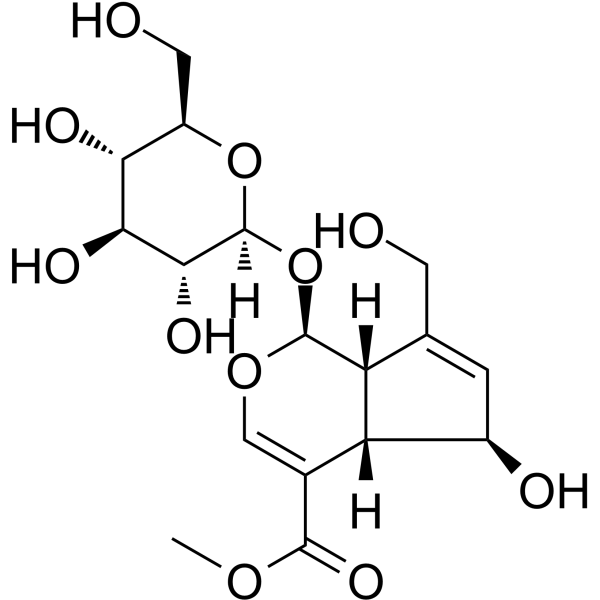
Physicochemical Properties
| Molecular Formula | C17H24O11 |
| Molecular Weight | 404.3659 |
| Exact Mass | 404.131 |
| CAS # | 27530-67-2 |
| PubChem CID | 442433 |
| Appearance | White to off-white solid powder |
| Density | 1.6±0.1 g/cm3 |
| Boiling Point | 696.3±55.0 °C at 760 mmHg |
| Flash Point | 250.9±25.0 °C |
| Vapour Pressure | 0.0±5.0 mmHg at 25°C |
| Index of Refraction | 1.641 |
| LogP | -2.72 |
| Hydrogen Bond Donor Count | 6 |
| Hydrogen Bond Acceptor Count | 11 |
| Rotatable Bond Count | 6 |
| Heavy Atom Count | 28 |
| Complexity | 647 |
| Defined Atom Stereocenter Count | 9 |
| SMILES | COC(=O)C1=CO[C@H]([C@H]2[C@@H]1[C@@H](C=C2CO)O)O[C@H]3[C@@H]([C@H]([C@@H]([C@H](O3)CO)O)O)O |
| InChi Key | WSGPLSDARZNMCW-LPGRTNKPSA-N |
| InChi Code | InChI=1S/C17H24O11/c1-25-15(24)7-5-26-16(10-6(3-18)2-8(20)11(7)10)28-17-14(23)13(22)12(21)9(4-19)27-17/h2,5,8-14,16-23H,3-4H2,1H3/t8-,9-,10-,11+,12-,13+,14-,16+,17+/m1/s1 |
| Chemical Name | methyl (1S,4aS,5R,7aS)-5-hydroxy-7-(hydroxymethyl)-1-[(2S,3R,4S,5S,6R)-3,4,5-trihydroxy-6-(hydroxymethyl)oxan-2-yl]oxy-1,4a,5,7a-tetrahydrocyclopenta[c]pyran-4-carboxylate |
| HS Tariff Code | 2934.99.9001 |
| Storage |
Powder-20°C 3 years 4°C 2 years In solvent -80°C 6 months -20°C 1 month |
| Shipping Condition | Room temperature (This product is stable at ambient temperature for a few days during ordinary shipping and time spent in Customs) |
Biological Activity
| Targets |
- Heat shock factor 1 (HSF1) [1] |
| ln Vitro |
The bark of Eucommiae Cortex (Euccomiaceae) is used as a traditional medicine in Korea, Japan and China to cure high blood pressure, strengthen bones and muscles, and restore damaged liver and kidney function. Feretoside raised the expression of HSF1 by 1.214, 1.144, 1.153, 1.114, 1.159, 1.041 and 1.167 times respectively at 3 mm [1]. - Feretoside is a natural HSF1 inducer with cytoprotective activity. At concentrations of 10, 20, and 40 μM, it dose-dependently activated HSF1 in HeLa cells, as evidenced by a 1.8±0.1, 2.5±0.2, and 3.2±0.3-fold increase in HSF1-dependent luciferase activity, respectively [1] - It induced the expression of heat shock proteins (HSPs): 40 μM Feretoside increased HSP70 mRNA levels by 3.8±0.3-fold and protein levels by 3.5±0.2-fold in HeLa cells [1] - It protected cells against stress-induced damage: Pretreatment with 40 μM Feretoside improved the viability of HeLa cells exposed to heat shock (43°C for 2 hours) by 58±4% and against H₂O₂-induced oxidative stress (200 μM for 24 hours) by 52±3% [1] - No significant cytotoxicity was observed in HeLa cells at concentrations up to 80 μM, with cell viability maintained above 90% [1] |
| Cell Assay |
- HSF1 activation assay: HeLa cells transfected with HSF1-dependent luciferase reporter plasmid were seeded in 96-well plates. After overnight incubation, cells were treated with Feretoside (5–40 μM) for 16 hours. Luciferase activity was measured using a luminometer to evaluate HSF1 activation [1] - HSP expression assay: HeLa cells were treated with Feretoside (10–40 μM) for 24 hours. Total RNA was extracted for RT-PCR to detect HSP70 mRNA levels; cell lysates were prepared for Western blot analysis of HSP70 protein [1] - Cytoprotection assay: HeLa cells were pretreated with Feretoside (10–40 μM) for 16 hours, then exposed to heat shock (43°C, 2 hours) or H₂O₂ (200 μM, 24 hours). Cell viability was measured by MTT assay to calculate protection rate [1] - Cytotoxicity assay: HeLa cells were treated with Feretoside (20–80 μM) for 24 hours, and cell viability was detected by MTT assay [1] |
| Toxicity/Toxicokinetics |
- Feretoside showed no obvious cytotoxicity to HeLa cells at concentrations up to 80 μM, with cell viability >90% [1] |
| References |
[1]. Heat shock factor 1 inducers from the bark of Eucommia ulmoides as cytoprotective agents. Chem Biodivers. 2013 Jul;10(7):1322-7. |
| Additional Infomation |
Scandoside methyl ester is a terpene glycoside. Scandoside methyl ester has been reported in Oldenlandia herbacea var. herbacea, Gardenia jasminoides, and other organisms with data available. - Feretoside is a flavonoid glycoside isolated from the bark of Eucommia ulmoides (Du Zhong), a traditional Chinese medicinal plant [1] - Its cytoprotective mechanism involves activating HSF1, which upregulates the expression of HSPs (e.g., HSP70) to counteract stress-induced cellular damage [1] - It acts as a potential natural cytoprotective agent, targeting HSF1-mediated stress response pathways [1] |
Solubility Data
| Solubility (In Vitro) | May dissolve in DMSO (in most cases), if not, try other solvents such as H2O, Ethanol, or DMF with a minute amount of products to avoid loss of samples |
| Solubility (In Vivo) |
Note: Listed below are some common formulations that may be used to formulate products with low water solubility (e.g. < 1 mg/mL), you may test these formulations using a minute amount of products to avoid loss of samples. Injection Formulations (e.g. IP/IV/IM/SC) Injection Formulation 1: DMSO : Tween 80: Saline = 10 : 5 : 85 (i.e. 100 μL DMSO stock solution → 50 μL Tween 80 → 850 μL Saline) *Preparation of saline: Dissolve 0.9 g of sodium chloride in 100 mL ddH ₂ O to obtain a clear solution. Injection Formulation 2: DMSO : PEG300 :Tween 80 : Saline = 10 : 40 : 5 : 45 (i.e. 100 μL DMSO → 400 μLPEG300 → 50 μL Tween 80 → 450 μL Saline) Injection Formulation 3: DMSO : Corn oil = 10 : 90 (i.e. 100 μL DMSO → 900 μL Corn oil) Example: Take the Injection Formulation 3 (DMSO : Corn oil = 10 : 90) as an example, if 1 mL of 2.5 mg/mL working solution is to be prepared, you can take 100 μL 25 mg/mL DMSO stock solution and add to 900 μL corn oil, mix well to obtain a clear or suspension solution (2.5 mg/mL, ready for use in animals). Injection Formulation 4: DMSO : 20% SBE-β-CD in saline = 10 : 90 [i.e. 100 μL DMSO → 900 μL (20% SBE-β-CD in saline)] *Preparation of 20% SBE-β-CD in Saline (4°C,1 week): Dissolve 2 g SBE-β-CD in 10 mL saline to obtain a clear solution. Injection Formulation 5: 2-Hydroxypropyl-β-cyclodextrin : Saline = 50 : 50 (i.e. 500 μL 2-Hydroxypropyl-β-cyclodextrin → 500 μL Saline) Injection Formulation 6: DMSO : PEG300 : castor oil : Saline = 5 : 10 : 20 : 65 (i.e. 50 μL DMSO → 100 μLPEG300 → 200 μL castor oil → 650 μL Saline) Injection Formulation 7: Ethanol : Cremophor : Saline = 10: 10 : 80 (i.e. 100 μL Ethanol → 100 μL Cremophor → 800 μL Saline) Injection Formulation 8: Dissolve in Cremophor/Ethanol (50 : 50), then diluted by Saline Injection Formulation 9: EtOH : Corn oil = 10 : 90 (i.e. 100 μL EtOH → 900 μL Corn oil) Injection Formulation 10: EtOH : PEG300:Tween 80 : Saline = 10 : 40 : 5 : 45 (i.e. 100 μL EtOH → 400 μLPEG300 → 50 μL Tween 80 → 450 μL Saline) Oral Formulations Oral Formulation 1: Suspend in 0.5% CMC Na (carboxymethylcellulose sodium) Oral Formulation 2: Suspend in 0.5% Carboxymethyl cellulose Example: Take the Oral Formulation 1 (Suspend in 0.5% CMC Na) as an example, if 100 mL of 2.5 mg/mL working solution is to be prepared, you can first prepare 0.5% CMC Na solution by measuring 0.5 g CMC Na and dissolve it in 100 mL ddH2O to obtain a clear solution; then add 250 mg of the product to 100 mL 0.5% CMC Na solution, to make the suspension solution (2.5 mg/mL, ready for use in animals). Oral Formulation 3: Dissolved in PEG400 Oral Formulation 4: Suspend in 0.2% Carboxymethyl cellulose Oral Formulation 5: Dissolve in 0.25% Tween 80 and 0.5% Carboxymethyl cellulose Oral Formulation 6: Mixing with food powders Note: Please be aware that the above formulations are for reference only. InvivoChem strongly recommends customers to read literature methods/protocols carefully before determining which formulation you should use for in vivo studies, as different compounds have different solubility properties and have to be formulated differently. (Please use freshly prepared in vivo formulations for optimal results.) |
| Preparing Stock Solutions | 1 mg | 5 mg | 10 mg | |
| 1 mM | 2.4730 mL | 12.3649 mL | 24.7298 mL | |
| 5 mM | 0.4946 mL | 2.4730 mL | 4.9460 mL | |
| 10 mM | 0.2473 mL | 1.2365 mL | 2.4730 mL |