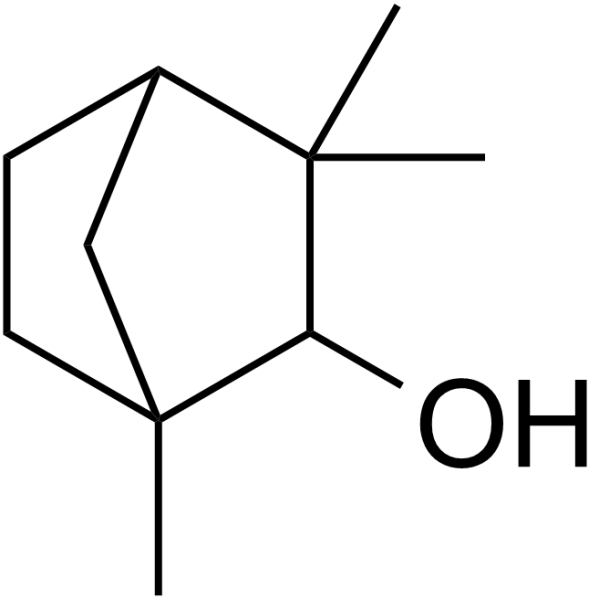
Physicochemical Properties
| Molecular Formula | C10H18O |
| Molecular Weight | 154.2493 |
| Exact Mass | 154.135 |
| CAS # | 1632-73-1 |
| PubChem CID | 15406 |
| Appearance | Colorless to light yellow solid-liquid Mixture |
| Density | 1.0±0.1 g/cm3 |
| Boiling Point | 202.9±8.0 °C at 760 mmHg |
| Melting Point | 35-40ºC |
| Flash Point | 73.9±0.0 °C |
| Vapour Pressure | 0.1±0.9 mmHg at 25°C |
| Index of Refraction | 1.502 |
| LogP | 2.71 |
| Hydrogen Bond Donor Count | 1 |
| Hydrogen Bond Acceptor Count | 1 |
| Rotatable Bond Count | 0 |
| Heavy Atom Count | 11 |
| Complexity | 185 |
| Defined Atom Stereocenter Count | 0 |
| SMILES | O([H])C1([H])C(C([H])([H])[H])(C([H])([H])[H])C2([H])C([H])([H])C([H])([H])C1(C([H])([H])[H])C2([H])[H] |
| InChi Key | IAIHUHQCLTYTSF-UHFFFAOYSA-N |
| InChi Code | InChI=1S/C10H18O/c1-9(2)7-4-5-10(3,6-7)8(9)11/h7-8,11H,4-6H2,1-3H3 |
| Chemical Name | 1,3,3-trimethylbicyclo[2.2.1]heptan-2-ol |
| HS Tariff Code | 2934.99.9001 |
| Storage |
Powder-20°C 3 years 4°C 2 years In solvent -80°C 6 months -20°C 1 month |
| Shipping Condition | Room temperature (This product is stable at ambient temperature for a few days during ordinary shipping and time spent in Customs) |
Biological Activity
| ln Vitro |
Fenchyl alcohol was assessed in the Bluescreen assay for genotoxic potential and was found negative for genotoxicity and cytotoxicity both in the presence and absence of metabolic activation (S9 mix). [1] |
| Cell Assay |
A bacterial reverse mutation assay (Ames test) was conducted according to OECD TG 471 using the plate incorporation method as a read-across for genotoxicity assessment. Salmonella typhimurium strains TA1535, TA1537, TA98, TA102, and TA100 and Escherichia coli strain WP2uvrA were treated with the read-across material (l-Borneol) in dimethyl sulfoxide at concentrations up to 1000 μg/plate, with and without S9 metabolic activation. [1] An in vitro micronucleus assay was conducted according to OECD TG 487 as a read-across for clastogenicity assessment. Human peripheral blood lymphocytes were exposed to the read-across material (l-Borneol) in dimethyl sulfoxide at concentrations up to 600 μg/mL for 4 hours with and without metabolic activation, and for 24 hours without metabolic activation. [1] |
| Animal Protocol |
A gavage 13-week subchronic toxicity study was conducted in rats using the read-across material Isobornyl acetate. The study identified a No Observed Effect Level (NOEL) of 15 mg/kg/day based on increased urinary cell excretion. [1] An OECD TG 414 developmental toxicity limit dose study was conducted in rats using the read-across material Isobornyl acetate via gavage administration. A NOAEL of 1000 mg/kg/day was determined, which was the only dose level tested. [1] An enhanced OECD TG 415 one-generation reproductive toxicity study was conducted in rats using the read-across material Isobornyl acetate via gavage administration. A NOAEL for parental reproductive toxicity of 300 mg/kg/day was determined, which was the highest dose tested. [1] |
| Toxicity/Toxicokinetics |
Genotoxicity: Fenchyl alcohol was found not genotoxic in the Bluescreen assay. Read-across to l-Borneol showed it was not mutagenic in a bacterial reverse mutation assay and not clastogenic in an in vitro micronucleus assay. [1] Repeated Dose Toxicity: The most conservative systemic exposure derived NOAEL from read-across (Isobornyl acetate) is 15 mg/kg/day. The Margin of Exposure (MOE) for Fenchyl alcohol, based on total systemic exposure of 0.0014 mg/kg/day and assuming 100% dermal and inhalation absorption, is 10,714. [1] Developmental and Reproductive Toxicity: The developmental toxicity NOAEL from read-across (Isobornyl acetate) is 1000 mg/kg/day, resulting in an MOE of 714,286. The reproductive toxicity NOAEL from read-across is 300 mg/kg/day, resulting in an MOE of 214,286. [1] Skin Sensitization: In a human maximization test, no reactions indicative of sensitization were observed with 4% Fenchyl alcohol in petrolatum (0/25). Exposure in hydroalcoholic products (0.001%) is below the Dermal Sensitization Threshold (DST) for non-reactive materials. [1] Phototoxicity/Photoallergenicity: UV/Vis spectra indicate no significant absorption between 290 and 700 nm, with a molar absorption coefficient below the benchmark of concern, indicating Fenchyl alcohol does not present a concern for phototoxicity or photoallergenicity. [1] Local Respiratory Toxicity: No inhalation toxicity data (NOAEC) are available. The estimated inhalation exposure (0.005 mg/day) is below the Threshold of Toxicological Concern (TTC) Cramer Class I limit of 1.4 mg/day for local respiratory effects. [1] Environmental Toxicity: The 48-hour Daphnia magna LC50 is 13.38 mg/L. The RIFM Predicted No Effect Concentration (PNEC) is 1.338 μg/L. [1] |
| References |
[1]. RIFM fragrance ingredient safety assessment, Fenchyl alcohol, CAS registry number 1632-73-1. Food Chem Toxicol. 2015 Oct;84 Suppl:S25-32. [2]. Effect of Various Essential Oils Isolated from Douglas Fir Needles upon Sheep and Deer Rumen Microbial Activity. Appl Microbiol. 1967 Jul;15(4):777-84. |
| Additional Infomation |
Fenchol has been reported in Magnolia officinalis, Baeckea frutescens, and other organisms with data available. Fenchyl alcohol is a fragrance ingredient used in personal care and cosmetic products. Its worldwide volume of use is in the 10-100 metric tons per year band. [1] The Cramer classification for Fenchyl alcohol is Class I (Low toxicity), based on expert judgment using the Cramer decision tree, as it is considered a common terpene. [1] Fenchyl alcohol occurs naturally in various foods and plants, including fennel, ginger, citrus fruits, eucalyptus, grape, nutmeg, rosemary, and thyme. [1] The material was evaluated as safe under the current conditions of use within the fragrance industry based on the available toxicological data and calculated Margins of Exposure. [1] |
Solubility Data
| Solubility (In Vitro) | H2O : ~41.67 mg/mL (~270.15 mM) |
| Solubility (In Vivo) |
Note: Listed below are some common formulations that may be used to formulate products with low water solubility (e.g. < 1 mg/mL), you may test these formulations using a minute amount of products to avoid loss of samples. Injection Formulations (e.g. IP/IV/IM/SC) Injection Formulation 1: DMSO : Tween 80: Saline = 10 : 5 : 85 (i.e. 100 μL DMSO stock solution → 50 μL Tween 80 → 850 μL Saline) *Preparation of saline: Dissolve 0.9 g of sodium chloride in 100 mL ddH ₂ O to obtain a clear solution. Injection Formulation 2: DMSO : PEG300 :Tween 80 : Saline = 10 : 40 : 5 : 45 (i.e. 100 μL DMSO → 400 μLPEG300 → 50 μL Tween 80 → 450 μL Saline) Injection Formulation 3: DMSO : Corn oil = 10 : 90 (i.e. 100 μL DMSO → 900 μL Corn oil) Example: Take the Injection Formulation 3 (DMSO : Corn oil = 10 : 90) as an example, if 1 mL of 2.5 mg/mL working solution is to be prepared, you can take 100 μL 25 mg/mL DMSO stock solution and add to 900 μL corn oil, mix well to obtain a clear or suspension solution (2.5 mg/mL, ready for use in animals). Injection Formulation 4: DMSO : 20% SBE-β-CD in saline = 10 : 90 [i.e. 100 μL DMSO → 900 μL (20% SBE-β-CD in saline)] *Preparation of 20% SBE-β-CD in Saline (4°C,1 week): Dissolve 2 g SBE-β-CD in 10 mL saline to obtain a clear solution. Injection Formulation 5: 2-Hydroxypropyl-β-cyclodextrin : Saline = 50 : 50 (i.e. 500 μL 2-Hydroxypropyl-β-cyclodextrin → 500 μL Saline) Injection Formulation 6: DMSO : PEG300 : castor oil : Saline = 5 : 10 : 20 : 65 (i.e. 50 μL DMSO → 100 μLPEG300 → 200 μL castor oil → 650 μL Saline) Injection Formulation 7: Ethanol : Cremophor : Saline = 10: 10 : 80 (i.e. 100 μL Ethanol → 100 μL Cremophor → 800 μL Saline) Injection Formulation 8: Dissolve in Cremophor/Ethanol (50 : 50), then diluted by Saline Injection Formulation 9: EtOH : Corn oil = 10 : 90 (i.e. 100 μL EtOH → 900 μL Corn oil) Injection Formulation 10: EtOH : PEG300:Tween 80 : Saline = 10 : 40 : 5 : 45 (i.e. 100 μL EtOH → 400 μLPEG300 → 50 μL Tween 80 → 450 μL Saline) Oral Formulations Oral Formulation 1: Suspend in 0.5% CMC Na (carboxymethylcellulose sodium) Oral Formulation 2: Suspend in 0.5% Carboxymethyl cellulose Example: Take the Oral Formulation 1 (Suspend in 0.5% CMC Na) as an example, if 100 mL of 2.5 mg/mL working solution is to be prepared, you can first prepare 0.5% CMC Na solution by measuring 0.5 g CMC Na and dissolve it in 100 mL ddH2O to obtain a clear solution; then add 250 mg of the product to 100 mL 0.5% CMC Na solution, to make the suspension solution (2.5 mg/mL, ready for use in animals). Oral Formulation 3: Dissolved in PEG400 Oral Formulation 4: Suspend in 0.2% Carboxymethyl cellulose Oral Formulation 5: Dissolve in 0.25% Tween 80 and 0.5% Carboxymethyl cellulose Oral Formulation 6: Mixing with food powders Note: Please be aware that the above formulations are for reference only. InvivoChem strongly recommends customers to read literature methods/protocols carefully before determining which formulation you should use for in vivo studies, as different compounds have different solubility properties and have to be formulated differently. (Please use freshly prepared in vivo formulations for optimal results.) |
| Preparing Stock Solutions | 1 mg | 5 mg | 10 mg | |
| 1 mM | 6.4830 mL | 32.4149 mL | 64.8298 mL | |
| 5 mM | 1.2966 mL | 6.4830 mL | 12.9660 mL | |
| 10 mM | 0.6483 mL | 3.2415 mL | 6.4830 mL |