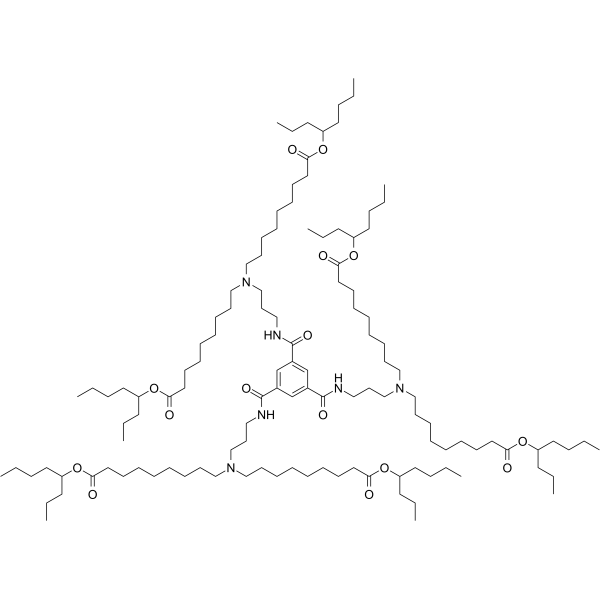
Physicochemical Properties
| Molecular Formula | C120H222N6O15 |
| Molecular Weight | 1989.07791852951 |
| Exact Mass | 1988.682 |
| CAS # | 2328129-27-5 |
| PubChem CID | 147104571 |
| Appearance | Colorless to light yellow liquid |
| LogP | 34.7 |
| Hydrogen Bond Donor Count | 3 |
| Hydrogen Bond Acceptor Count | 18 |
| Rotatable Bond Count | 111 |
| Heavy Atom Count | 141 |
| Complexity | 2470 |
| Defined Atom Stereocenter Count | 0 |
| InChi Key | BLHSRXBNFPZCBY-UHFFFAOYSA-N |
| InChi Code | InChI=1S/C120H222N6O15/c1-13-25-76-106(70-19-7)136-112(127)82-55-43-31-37-49-61-91-124(92-62-50-38-32-44-56-83-113(128)137-107(71-20-8)77-26-14-2)97-67-88-121-118(133)103-100-104(119(134)122-89-68-98-125(93-63-51-39-33-45-57-84-114(129)138-108(72-21-9)78-27-15-3)94-64-52-40-34-46-58-85-115(130)139-109(73-22-10)79-28-16-4)102-105(101-103)120(135)123-90-69-99-126(95-65-53-41-35-47-59-86-116(131)140-110(74-23-11)80-29-17-5)96-66-54-42-36-48-60-87-117(132)141-111(75-24-12)81-30-18-6/h100-102,106-111H,13-99H2,1-12H3,(H,121,133)(H,122,134)(H,123,135) |
| Chemical Name | octan-4-yl 9-[3-[[3,5-bis[3-[bis(9-octan-4-yloxy-9-oxononyl)amino]propylcarbamoyl]benzoyl]amino]propyl-(9-octan-4-yloxy-9-oxononyl)amino]nonanoate |
| HS Tariff Code | 2934.99.9001 |
| Storage |
Powder-20°C 3 years 4°C 2 years In solvent -80°C 6 months -20°C 1 month |
| Shipping Condition | Room temperature (This product is stable at ambient temperature for a few days during ordinary shipping and time spent in Customs) |
Biological Activity
| References |
[1]. Functionalized lipid-like nanoparticles for in vivo mRNA delivery and base editing. Sci Adv. 2020;6(34):eabc2315. |
Solubility Data
| Solubility (In Vitro) | DMSO : ~50 mg/mL (~25.14 mM) |
| Solubility (In Vivo) |
Solubility in Formulation 1: ≥ 2.5 mg/mL (1.26 mM) (saturation unknown) in 10% DMSO + 40% PEG300 + 5% Tween80 + 45% Saline (add these co-solvents sequentially from left to right, and one by one), clear solution. For example, if 1 mL of working solution is to be prepared, you can add 100 μL of 25.0 mg/mL clear DMSO stock solution to 400 μL PEG300 and mix evenly; then add 50 μL Tween-80 to the above solution and mix evenly; then add 450 μL normal saline to adjust the volume to 1 mL. Preparation of saline: Dissolve 0.9 g of sodium chloride in 100 mL ddH₂ O to obtain a clear solution. Solubility in Formulation 2: ≥ 2.5 mg/mL (1.26 mM) (saturation unknown) in 10% DMSO + 90% (20% SBE-β-CD in Saline) (add these co-solvents sequentially from left to right, and one by one), clear solution. For example, if 1 mL of working solution is to be prepared, you can add 100 μL of 25.0 mg/mL clear DMSO stock solution to 900 μL of 20% SBE-β-CD physiological saline solution and mix evenly. Preparation of 20% SBE-β-CD in Saline (4°C,1 week): Dissolve 2 g SBE-β-CD in 10 mL saline to obtain a clear solution. Solubility in Formulation 3: ≥ 2.5 mg/mL (1.26 mM) (saturation unknown) in 10% DMSO + 90% Corn Oil (add these co-solvents sequentially from left to right, and one by one), clear solution. For example, if 1 mL of working solution is to be prepared, you can add 100 μL of 25.0 mg/mL clear DMSO stock solution to 900 μL of corn oil and mix evenly. (Please use freshly prepared in vivo formulations for optimal results.) |
| Preparing Stock Solutions | 1 mg | 5 mg | 10 mg | |
| 1 mM | 0.5027 mL | 2.5137 mL | 5.0274 mL | |
| 5 mM | 0.1005 mL | 0.5027 mL | 1.0055 mL | |
| 10 mM | 0.0503 mL | 0.2514 mL | 0.5027 mL |