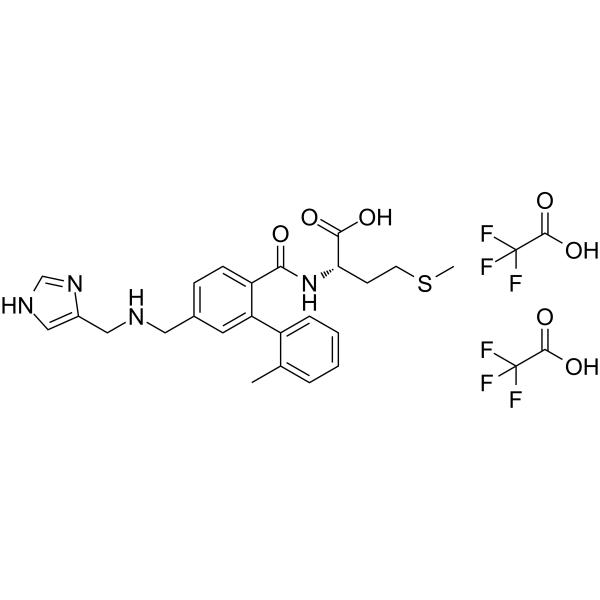
Physicochemical Properties
| Molecular Formula | C24H28N4O3S.2C2HF3O2 |
| Molecular Weight | 680.62 |
| Exact Mass | 566.181 |
| CAS # | 817586-01-9 |
| Related CAS # | FTI-2148;251577-09-0 |
| PubChem CID | 168011754 |
| Appearance | Typically exists as solid at room temperature |
| Hydrogen Bond Donor Count | 5 |
| Hydrogen Bond Acceptor Count | 11 |
| Rotatable Bond Count | 11 |
| Heavy Atom Count | 39 |
| Complexity | 691 |
| Defined Atom Stereocenter Count | 1 |
| SMILES | CC1=CC=CC=C1C2=C(C=CC(=C2)CNCC3=CN=CN3)C(=O)N[C@@H](CCSC)C(=O)O.C(=O)(C(F)(F)F)O |
| InChi Key | ZCCUFUPJNUTGJM-FTBISJDPSA-N |
| InChi Code | InChI=1S/C24H28N4O3S.C2HF3O2/c1-16-5-3-4-6-19(16)21-11-17(12-25-13-18-14-26-15-27-18)7-8-20(21)23(29)28-22(24(30)31)9-10-32-2;3-2(4,5)1(6)7/h3-8,11,14-15,22,25H,9-10,12-13H2,1-2H3,(H,26,27)(H,28,29)(H,30,31);(H,6,7)/t22-;/m0./s1 |
| Chemical Name | (2S)-2-[[4-[(1H-imidazol-5-ylmethylamino)methyl]-2-(2-methylphenyl)benzoyl]amino]-4-methylsulfanylbutanoic acid;2,2,2-trifluoroacetic acid |
| Synonyms | FTI2148 diTFA; FTI 2148 diTFA |
| HS Tariff Code | 2934.99.9001 |
| Storage |
Powder-20°C 3 years 4°C 2 years In solvent -80°C 6 months -20°C 1 month |
| Shipping Condition | Room temperature (This product is stable at ambient temperature for a few days during ordinary shipping and time spent in Customs) |
Biological Activity
| ln Vitro | In NIH3T3 cells transformed with all 3 RAS, FTI-2148 (30 μM) suppresses farnesylation of the single farnesylated protein, HDJ2 [1]. Against P. falciparum PFT, mammalian PFT, and mammalian PGGT-I, FTI-2148 diTFA has an IC50 of 15 nM, 0.82 nM, and 1700 nM, correspondingly. PGGT-I is geranylgeranyl transferase-I; PFT is protein farnesyl transferase[2]. |
| ln Vivo | In human lung adenocarcinoma A-549 cells, FTI-2148 (ip; 25 or 50 mpk/day using minipump; start on day 15, pause on day 45, restart on days 53-83) suppresses tumors. mouse model with growth 91% stimulated [1]. In a human xenograft nude mouse model, FTI-2148 (subcutaneous injection; 25 mpk/day using minipump; 14 days) reduced tumor development by 77% at the conclusion of two weeks of treatment [1]. In a ras transgenic mouse model, FTI-2148 (subcutaneous injection; 100 mg/kg/day; 14 days) promotes breast tumor regression [3]. In mouse mammary tumors cultured in vivo, FTI-2148 (subcutaneous injection; 100 mg/kg/day; 4 days) suppresses 85-88% of FTase activity but not GGTase I enzyme activity [3]. |
| Cell Assay |
Western Blot Analysis[1] Cell Types: NIH3T3 cells transformed with KRAS HRAS and NRAS Tested Concentrations: 30 μM Incubation Duration: Experimental Results: Inhibition of prenylation of KRAS and NRAS. |
| Animal Protocol |
Animal/Disease Models: Ras transgenic mouse model [3] Doses: 100 mg/kg/day Route of Administration: subcutaneous injection; 100 mg/kg/day; 14-day Experimental Results: The regression of breast cancer in mice was diminished by 87 ± 3%. |
| References |
[1]. Sun J, et al. Antitumor efficacy of a novel class of non-thiol-containing peptidomimetic inhibitors of farnesyltransferase and geranylgeranyltransferase I: combination therapy with the cytotoxic agents cisplatin, Taxol, and gemcitabine.Cancer Res. 1999 Oc [2]. Carrico D, et al.In vitro and in vivo antimalarial activity of peptidomimetic protein farnesyltransferase inhibitors with improved membrane permeability.Bioorg Med Chem. 2004 Dec 15;12(24):6517-26. [3]. 3. Sun J, et al. Geranylgeranyltransferase I inhibitor GGTI-2154 induces breast carcinoma apoptosis and tumor regression in H-Ras transgenic mice.Cancer Res. 2003 Dec 15;63(24):8922-9. |
Solubility Data
| Solubility (In Vitro) | Ethanol : ~5 mg/mL (~7.35 mM) |
| Solubility (In Vivo) |
Solubility in Formulation 1: ≥ 0.5 mg/mL (0.73 mM) (saturation unknown) in 10% EtOH + 40% PEG300 + 5% Tween80 + 45% Saline (add these co-solvents sequentially from left to right, and one by one), clear solution. For example, if 1 mL of working solution is to be prepared, you can add 100 μL of 5.0 mg/mL clear EtOH stock solution to 400 μL of PEG300 and mix evenly; then add 50 μL of Tween-80 to the above solution and mix evenly; then add 450 μL of normal saline to adjust the volume to 1 mL. Preparation of saline: Dissolve 0.9 g of sodium chloride in 100 mL ddH₂ O to obtain a clear solution. Solubility in Formulation 2: ≥ 0.5 mg/mL (0.73 mM) (saturation unknown) in 10% EtOH + 90% (20% SBE-β-CD in Saline) (add these co-solvents sequentially from left to right, and one by one), clear solution. For example, if 1 mL of working solution is to be prepared, you can add 100 μL of 5.0 mg/mL clear EtOH stock solution to 900 μL of 20% SBE-β-CD physiological saline solution and mix evenly. Preparation of 20% SBE-β-CD in Saline (4°C,1 week): Dissolve 2 g SBE-β-CD in 10 mL saline to obtain a clear solution. Solubility in Formulation 3: ≥ 0.5 mg/mL (0.73 mM) (saturation unknown) in 10% EtOH + 90% Corn Oil (add these co-solvents sequentially from left to right, and one by one), clear solution. For example, if 1 mL of working solution is to be prepared, you can add 100 μL of 5.0 mg/mL clear EtOH stock solution to 900 μL of corn oil and mix evenly. (Please use freshly prepared in vivo formulations for optimal results.) |
| Preparing Stock Solutions | 1 mg | 5 mg | 10 mg | |
| 1 mM | 1.4692 mL | 7.3462 mL | 14.6925 mL | |
| 5 mM | 0.2938 mL | 1.4692 mL | 2.9385 mL | |
| 10 mM | 0.1469 mL | 0.7346 mL | 1.4692 mL |