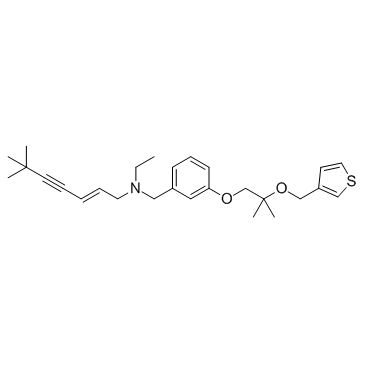
FR194738 (FR-194738 ) free base is a novel and potent squalene epoxidase inhibitor that inhibits squalene epoxidase activity in HepG2 cell homogenates with an IC50 of 9.8 nM.
Physicochemical Properties
| Molecular Formula | C27H37NO2S |
| Molecular Weight | 439.653186559677 |
| Exact Mass | 439.254 |
| CAS # | 204067-45-8 |
| Related CAS # | FR194738;204067-52-7 |
| PubChem CID | 9803248 |
| Appearance | Typically exists as solid at room temperature |
| LogP | 6.3 |
| Hydrogen Bond Donor Count | 0 |
| Hydrogen Bond Acceptor Count | 4 |
| Rotatable Bond Count | 12 |
| Heavy Atom Count | 31 |
| Complexity | 610 |
| Defined Atom Stereocenter Count | 0 |
| SMILES | CCN(C/C=C/C#CC(C)(C)C)CC1=CC(=CC=C1)OCC(C)(C)OCC2=CSC=C2 |
| InChi Key | FQZFIVOMFHKBCE-CSKARUKUSA-N |
| InChi Code | InChI=1S/C27H37NO2S/c1-7-28(16-10-8-9-15-26(2,3)4)19-23-12-11-13-25(18-23)29-22-27(5,6)30-20-24-14-17-31-21-24/h8,10-14,17-18,21H,7,16,19-20,22H2,1-6H3/b10-8+ |
| Chemical Name | (E)-N-ethyl-6,6-dimethyl-N-[[3-[2-methyl-2-(thiophen-3-ylmethoxy)propoxy]phenyl]methyl]hept-2-en-4-yn-1-amine |
| HS Tariff Code | 2934.99.9001 |
| Storage |
Powder-20°C 3 years 4°C 2 years In solvent -80°C 6 months -20°C 1 month |
| Shipping Condition | Room temperature (This product is stable at ambient temperature for a few days during ordinary shipping and time spent in Customs) |
Biological Activity
| ln Vitro | The incorporation of [14C]acetate into free cholesterol and cholesteryl ester is concentration-dependently inhibited in intact HepG2 cells by FR194738, with IC50 values of 4.9 and 8.0 nM, respectively. Intracellular buildup of [14C]squalene is induced by FR194738. An intermediary in the production of cholesterol, squalene, incorporates [14C]acetate more readily when FR194738 is present[1]. In HepG2 cell homogenate and liver microsomes from dogs and rats, FR194738 potently inhibits squalene epoxidase (SE). FR194738's ability to reduce cholesterol manufacture in HepG2 cells is compared to those of the HMG-CoA reductase inhibitors, Pravastatin, Fluvastatin, and Simvastatin. FR194738 has an IC50 of 2.1 nM, making it the most powerful of these drugs. The half-life of simvastatin is 40 nM, fluvastatin is 28 nM, and pravastatin is 5100 nM, respectively[2]. With an IC50 of 14 nM, FR194738 exhibits concentration-dependent inhibition of hamster liver microsomal squalene epoxidase activity[3]. | |
| ln Vivo | After daily FR194738 and Pravastatin injection for 10 days, the serum cholesterol levels in the hamsters are measured. Serum levels of triglycerides, total, non-high density lipoprotein (HDL), and HDL cholesterol are all lowered with FR194738. When FR194738 is administered to hamsters, their HMG-CoA reductase activity is increased by 1.3 times at 32 mg/kg in comparison to the control group, but it does not change appreciably at 100 mg/kg[3]. | |
| Cell Assay |
|
|
| References |
[1]. Sawada M, et al. Effect of FR194738, a potent inhibitor of squalene epoxidase, on cholesterol metabolism in HepG2 cells. Eur J Pharmacol. 2001 Nov 9;431(1):11-6. [2]. Sawada M, et al. Synthesis and biological activity of a novel squalene epoxidase inhibitor, FR194738. Bioorg Med Chem Lett. 2004 Feb 9;14(3):633-7. [3]. Sawada M, et al. Inhibition of cholesterol synthesis causes both hypercholesterolemia and hypocholesterolemia in hamsters. Biol Pharm Bull. 2002 Dec;25(12):1577-82 |
Solubility Data
| Solubility (In Vitro) | DMSO : ~100 mg/mL (~227.45 mM) |
| Solubility (In Vivo) |
Solubility in Formulation 1: ≥ 2.5 mg/mL (5.69 mM) (saturation unknown) in 10% DMSO + 40% PEG300 + 5% Tween80 + 45% Saline (add these co-solvents sequentially from left to right, and one by one), clear solution. For example, if 1 mL of working solution is to be prepared, you can add 100 μL of 25.0 mg/mL clear DMSO stock solution to 400 μL PEG300 and mix evenly; then add 50 μL Tween-80 to the above solution and mix evenly; then add 450 μL normal saline to adjust the volume to 1 mL. Preparation of saline: Dissolve 0.9 g of sodium chloride in 100 mL ddH₂ O to obtain a clear solution. Solubility in Formulation 2: 2.5 mg/mL (5.69 mM) in 10% DMSO + 90% (20% SBE-β-CD in Saline) (add these co-solvents sequentially from left to right, and one by one), suspension solution; with ultrasonication. For example, if 1 mL of working solution is to be prepared, you can add 100 μL of 25.0 mg/mL clear DMSO stock solution to 900 μL of 20% SBE-β-CD physiological saline solution and mix evenly. Preparation of 20% SBE-β-CD in Saline (4°C,1 week): Dissolve 2 g SBE-β-CD in 10 mL saline to obtain a clear solution. Solubility in Formulation 3: ≥ 2.5 mg/mL (5.69 mM) (saturation unknown) in 10% DMSO + 90% Corn Oil (add these co-solvents sequentially from left to right, and one by one), clear solution. For example, if 1 mL of working solution is to be prepared, you can add 100 μL of 25.0 mg/mL clear DMSO stock solution to 900 μL of corn oil and mix evenly. (Please use freshly prepared in vivo formulations for optimal results.) |
| Preparing Stock Solutions | 1 mg | 5 mg | 10 mg | |
| 1 mM | 2.2745 mL | 11.3727 mL | 22.7454 mL | |
| 5 mM | 0.4549 mL | 2.2745 mL | 4.5491 mL | |
| 10 mM | 0.2275 mL | 1.1373 mL | 2.2745 mL |