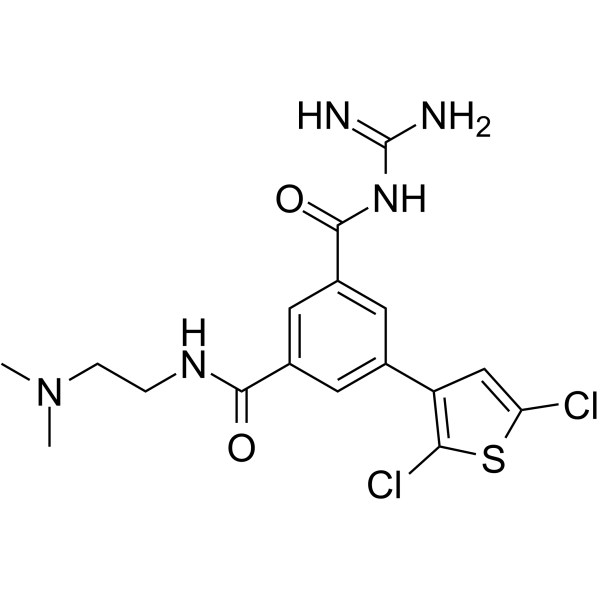
Physicochemical Properties
| Molecular Formula | C17H19CL2N5O2S |
| Molecular Weight | 428.336059808731 |
| Exact Mass | 427.063 |
| CAS # | 239440-20-1 |
| PubChem CID | 6918361 |
| Appearance | White to off-white solid powder |
| LogP | 3.4 |
| Hydrogen Bond Donor Count | 3 |
| Hydrogen Bond Acceptor Count | 4 |
| Rotatable Bond Count | 6 |
| Heavy Atom Count | 27 |
| Complexity | 574 |
| Defined Atom Stereocenter Count | 0 |
| SMILES | C1(C(NC(N)=N)=O)=CC(C2C=C(Cl)SC=2Cl)=CC(C(NCCN(C)C)=O)=C1 |
| InChi Key | WRLFHDDGGGWFLH-UHFFFAOYSA-N |
| InChi Code | InChI=1S/C17H19Cl2N5O2S/c1-24(2)4-3-22-15(25)10-5-9(12-8-13(18)27-14(12)19)6-11(7-10)16(26)23-17(20)21/h5-8H,3-4H2,1-2H3,(H,22,25)(H4,20,21,23,26) |
| Chemical Name | 3-N-(diaminomethylidene)-5-(2,5-dichlorothiophen-3-yl)-1-N-[2-(dimethylamino)ethyl]benzene-1,3-dicarboxamide |
| HS Tariff Code | 2934.99.9001 |
| Storage |
Powder-20°C 3 years 4°C 2 years In solvent -80°C 6 months -20°C 1 month |
| Shipping Condition | Room temperature (This product is stable at ambient temperature for a few days during ordinary shipping and time spent in Customs) |
Biological Activity
| Targets | - Na+/H+ exchanger (NHE) |
| ln Vitro |
FR183998 free base is a Na+/H+ exchange inhibitor that, when measured by pHi changes in rat lymphocytes, rat and human platelets, has an IC50 of 0.3 nM, 6.5 nM, and 3.1 nM, respectively [1]. - FR183998 free base inhibited Na+/H+ exchange activity in cardiac cells, reducing intracellular H+ efflux and preventing intracellular Na+ overload [1] - In cultured hepatocytes, FR183998 free base suppressed the induction of inducible nitric oxide synthase (iNOS) mRNA and protein expression, thereby reducing nitric oxide (NO) production [2] - The compound attenuated hydrogen peroxide-induced oxidative stress in hepatocytes by inhibiting NHE activity, leading to reduced cell damage [2] |
| ln Vivo |
FR183998 (0.1 and 1.0 mg/kg, i.v.) showed no effect on hemodynamic parameters and did not influence mean blood pressure and heart rate in awake rats. 0.01, 0.032, 0.10 mg/kg FR183998 pretreatment or intravenous injection of 0.032 and 0.10 mg/kg FR183998 post-treatment can dose-dependently reduce reperfusion-induced ventricular fibrillation (VF) and death from reperfusion-induced arrhythmia in anesthetized rats. The rates (ED50) relative to VF were 0.015 mg/kg and 0.070 mg/kg respectively. FR183998 can also diminish myocardial infarct size and regulate arrhythmias in anesthetized rats [1]. FR183998 (1 mg/kg, intravenous injection) can minimize the increase in blood alanine aminotransferase, aspartate aminotransferase, and lactate dehydrogenase levels induced by hepatic ischemia-reperfusion, and prevent liver necrosis, apoptosis, and neutralization. Occurrence of neutrophil infiltration. FR183998 limits I/R-induced NF-κB activation, lowers iNOS induction and inhibits nitric oxide generation. FR183998 also lowers the production of iNOS gene antisense transcripts in the livers of hepatic I/R rats [2]. - In rat cardiac ischemia-reperfusion (I/R) model, preischemic intravenous administration of FR183998 free base (0.3, 1, 3 mg/kg) dose-dependently reduced myocardial infarct size; the 3 mg/kg dose decreased infarct size by 40% compared with the control group [1] - Postischemic administration of FR183998 free base (3 mg/kg, iv) also exerted cardioprotective effects, reducing infarct size and improving cardiac function (left ventricular developed pressure and dp/dt max) [1] - In rat hepatic I/R model, intravenous injection of FR183998 free base (1, 3 mg/kg) 10 minutes before reperfusion dose-dependently reduced serum aspartate aminotransferase (AST) and alanine aminotransferase (ALT) levels, alleviating hepatic tissue damage [2] - The compound inhibited hepatic iNOS protein expression and NO production in the hepatic I/R model, and reduced the number of apoptotic hepatocytes, as evidenced by TUNEL staining [2] |
| Enzyme Assay |
- For NHE activity assay, cardiac myocytes were loaded with the pH-sensitive fluorescent dye BCECF-AM. After acidification of the cytosol by ammonium chloride prepulse, the recovery of intracellular pH (pHi) was monitored by fluorescence spectroscopy. FR183998 free base was added to the reaction system, and the rate of pHi recovery (an indicator of NHE activity) was calculated to evaluate the inhibitory effect [1] - iNOS activity assay was performed using hepatocyte lysates; the reaction mixture contained L-arginine, NADPH, and other cofactors. FR183998 free base was preincubated with the lysates, and NO production was measured by Griess reagent to assess iNOS activity inhibition [2] |
| Cell Assay |
- Cardiac myocytes were isolated from rat hearts and cultured in serum-containing medium. Cells were treated with FR183998 free base at different concentrations (0.1, 1, 10 μM) for 30 minutes before exposure to simulated ischemia (glucose-free, oxygen-free medium) for 2 hours, followed by reperfusion (normal medium) for 1 hour. Cell viability was determined by MTT assay, and intracellular Na+ concentration was measured by flame photometry [1] - Primary hepatocytes were isolated from rat livers and cultured. Cells were pretreated with FR183998 free base (0.3, 1, 3 μM) for 1 hour, then exposed to hydrogen peroxide (100 μM) for 24 hours. Cell damage was evaluated by measuring lactate dehydrogenase (LDH) release, and iNOS mRNA and protein levels were detected by RT-PCR and Western blot, respectively [2] |
| Animal Protocol |
Cardiac I/R model: Male Wistar rats (250-300 g) were anesthetized, intubated, and ventilated. The left anterior descending coronary artery was ligated for 30 minutes to induce ischemia, followed by 2 hours of reperfusion. FR183998 free base was dissolved in physiological saline and administered intravenously at doses of 0.3, 1, 3 mg/kg either 5 minutes before ischemia (preischemic treatment) or 5 minutes after reperfusion (postischemic treatment). Control rats received an equal volume of physiological saline [1] - Hepatic I/R model: Male Sprague-Dawley rats (250-300 g) were anesthetized, and the portal triad of the left and median liver lobes was clamped for 45 minutes to induce ischemia, followed by 6 hours of reperfusion. FR183998 free base was dissolved in physiological saline and injected intravenously at doses of 1, 3 mg/kg 10 minutes before reperfusion. Control rats received physiological saline alone [2] |
| Toxicity/Toxicokinetics |
- In the tested dose range (0.3-3 mg/kg, iv), FR183998 free base did not cause obvious acute toxicity in rats, as indicated by stable vital signs (blood pressure, heart rate) and no mortality during the experimental period [1][2] |
| References |
[1]. Preischemic and postischemic treatment with a new Na+/H+-exchange inhibitor, FR183998, shows cardioprotective effects in rats with cardiac ischemia and reperfusion. J Cardiovasc Pharmacol. 1999 Dec;34(6):848-56. [2]. Protective effect of FR183998, a Na+/H+ exchanger inhibitor, and its inhibition of iNOS induction in hepatic ischemia-reperfusion injury in rats. Shock. 2008 Sep;30(3):311-7. |
| Additional Infomation |
- FR183998 free base is a novel, selective Na+/H+ exchange inhibitor designed for the treatment of ischemia-reperfusion injury [1][2] - Its cardioprotective mechanism involves inhibiting NHE-mediated intracellular Na+ overload, which reduces Ca2+ influx via Na+/Ca2+ exchanger, thereby preventing myocardial cell necrosis and apoptosis [1] - The hepatoprotective effect is associated with the inhibition of iNOS induction and oxidative stress, as well as the reduction of hepatocyte apoptosis [2] |
Solubility Data
| Solubility (In Vitro) | DMSO : ~250 mg/mL (~583.65 mM) |
| Solubility (In Vivo) |
Note: Listed below are some common formulations that may be used to formulate products with low water solubility (e.g. < 1 mg/mL), you may test these formulations using a minute amount of products to avoid loss of samples. Injection Formulations (e.g. IP/IV/IM/SC) Injection Formulation 1: DMSO : Tween 80: Saline = 10 : 5 : 85 (i.e. 100 μL DMSO stock solution → 50 μL Tween 80 → 850 μL Saline) *Preparation of saline: Dissolve 0.9 g of sodium chloride in 100 mL ddH ₂ O to obtain a clear solution. Injection Formulation 2: DMSO : PEG300 :Tween 80 : Saline = 10 : 40 : 5 : 45 (i.e. 100 μL DMSO → 400 μLPEG300 → 50 μL Tween 80 → 450 μL Saline) Injection Formulation 3: DMSO : Corn oil = 10 : 90 (i.e. 100 μL DMSO → 900 μL Corn oil) Example: Take the Injection Formulation 3 (DMSO : Corn oil = 10 : 90) as an example, if 1 mL of 2.5 mg/mL working solution is to be prepared, you can take 100 μL 25 mg/mL DMSO stock solution and add to 900 μL corn oil, mix well to obtain a clear or suspension solution (2.5 mg/mL, ready for use in animals). Injection Formulation 4: DMSO : 20% SBE-β-CD in saline = 10 : 90 [i.e. 100 μL DMSO → 900 μL (20% SBE-β-CD in saline)] *Preparation of 20% SBE-β-CD in Saline (4°C,1 week): Dissolve 2 g SBE-β-CD in 10 mL saline to obtain a clear solution. Injection Formulation 5: 2-Hydroxypropyl-β-cyclodextrin : Saline = 50 : 50 (i.e. 500 μL 2-Hydroxypropyl-β-cyclodextrin → 500 μL Saline) Injection Formulation 6: DMSO : PEG300 : castor oil : Saline = 5 : 10 : 20 : 65 (i.e. 50 μL DMSO → 100 μLPEG300 → 200 μL castor oil → 650 μL Saline) Injection Formulation 7: Ethanol : Cremophor : Saline = 10: 10 : 80 (i.e. 100 μL Ethanol → 100 μL Cremophor → 800 μL Saline) Injection Formulation 8: Dissolve in Cremophor/Ethanol (50 : 50), then diluted by Saline Injection Formulation 9: EtOH : Corn oil = 10 : 90 (i.e. 100 μL EtOH → 900 μL Corn oil) Injection Formulation 10: EtOH : PEG300:Tween 80 : Saline = 10 : 40 : 5 : 45 (i.e. 100 μL EtOH → 400 μLPEG300 → 50 μL Tween 80 → 450 μL Saline) Oral Formulations Oral Formulation 1: Suspend in 0.5% CMC Na (carboxymethylcellulose sodium) Oral Formulation 2: Suspend in 0.5% Carboxymethyl cellulose Example: Take the Oral Formulation 1 (Suspend in 0.5% CMC Na) as an example, if 100 mL of 2.5 mg/mL working solution is to be prepared, you can first prepare 0.5% CMC Na solution by measuring 0.5 g CMC Na and dissolve it in 100 mL ddH2O to obtain a clear solution; then add 250 mg of the product to 100 mL 0.5% CMC Na solution, to make the suspension solution (2.5 mg/mL, ready for use in animals). Oral Formulation 3: Dissolved in PEG400 Oral Formulation 4: Suspend in 0.2% Carboxymethyl cellulose Oral Formulation 5: Dissolve in 0.25% Tween 80 and 0.5% Carboxymethyl cellulose Oral Formulation 6: Mixing with food powders Note: Please be aware that the above formulations are for reference only. InvivoChem strongly recommends customers to read literature methods/protocols carefully before determining which formulation you should use for in vivo studies, as different compounds have different solubility properties and have to be formulated differently. (Please use freshly prepared in vivo formulations for optimal results.) |
| Preparing Stock Solutions | 1 mg | 5 mg | 10 mg | |
| 1 mM | 2.3346 mL | 11.6730 mL | 23.3459 mL | |
| 5 mM | 0.4669 mL | 2.3346 mL | 4.6692 mL | |
| 10 mM | 0.2335 mL | 1.1673 mL | 2.3346 mL |