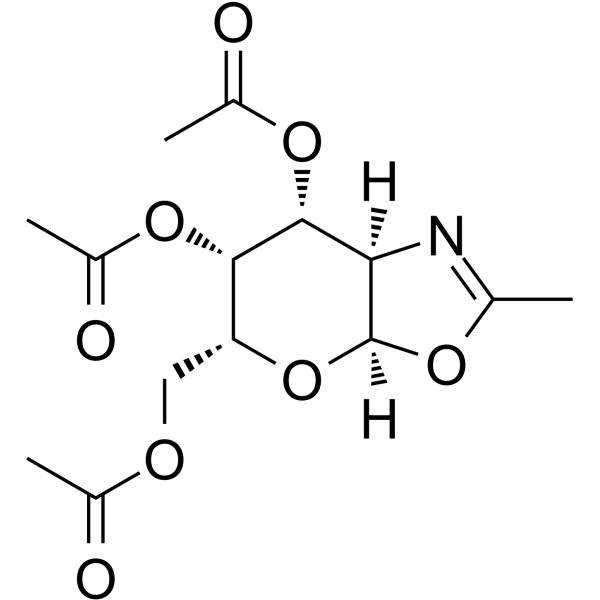
Physicochemical Properties
| Molecular Formula | C14H19NO8 |
| Molecular Weight | 329.31 |
| Exact Mass | 329.111 |
| Elemental Analysis | C, 51.06; H, 5.82; N, 4.25; O, 38.87 |
| CAS # | 35954-65-5 |
| Related CAS # | (6R)-FR054;10378-06-0 |
| PubChem CID | 9883925 |
| Appearance | Colorless to light yellow Viscouse waxy semi-solid |
| Density | 1.45±0.1 g/cm3(Predicted) |
| Boiling Point | 416.7±45.0 °C(Predicted) |
| LogP | -0.5 |
| Hydrogen Bond Donor Count | 0 |
| Hydrogen Bond Acceptor Count | 9 |
| Rotatable Bond Count | 7 |
| Heavy Atom Count | 23 |
| Complexity | 531 |
| Defined Atom Stereocenter Count | 5 |
| SMILES | CC1=NC2C(C(C(OC2O1)COC(=O)C)OC(=O)C)OC(=O)C |
| InChi Key | WZFQZRLQMXZMJA-KSTCHIGDSA-N |
| InChi Code | InChI=1S/C14H19NO8/c1-6-15-11-13(22-9(4)18)12(21-8(3)17)10(5-19-7(2)16)23-14(11)20-6/h10-14H,5H2,1-4H3/t10-,11-,12-,13-,14+/m1/s1 |
| Chemical Name | 5H-Pyrano[3,2-d]oxazole-6,7-diol, 5-[(acetyloxy)methyl]-3a,6,7,7a-tetrahydro-2-methyl-, diacetate (ester), (3aR,5R,6S,7R,7aR)- |
| Synonyms | FR054; FR-054; FR 054 |
| HS Tariff Code | 2934.99.03.00 |
| Storage |
Powder-20°C 3 years 4°C 2 years In solvent -80°C 6 months -20°C 1 month |
| Shipping Condition | Room temperature (This product is stable at ambient temperature for a few days during ordinary shipping and time spent in Customs) |
Biological Activity
| ln Vitro | In breast cancer cells, FR054 (0.5–1 mM, 24-48 h) causes an early rise in proliferation, which is followed by a notable decrease in cell viability and an induction of cell display. FR054 inhibits PGM3 instead of having other unintended consequences [1]. (250 μM, 24 hours) therapy has a significant impact on MDA-MB-231 cells' levels of N- and O-glycosylation [1]. ROS-dependent cells and endoplasmic reticulum (ER) mesenchymal cells are induced in cells by FR054 [1]. |
| ln Vivo | FR054 (1000 mg/kg, intraperitoneal injection) inhibits cancer growth in MDA-MB-231 xenograft mice [1]. |
| Cell Assay |
Cell viability assay [1] Cell Types: MDA-MB-231 cells. Tested Concentrations: 0.5-1 mM. Incubation Duration: 48 hrs (hours). Experimental Results: Viability was diminished and apoptosis was Dramatically increased compared to control clones. |
| Animal Protocol |
Animal/Disease Models: Mice are injected subcutaneously (sc) (sc) with MDA-MB-231 cells [1]. Doses: 1000 mg/kg. Route of Administration: IP, single or divided doses (500 mg/kg/dose twice (two times) daily). Experimental Results: Twice-daily dosing appeared to have greater in vivo antitumor efficacy compared with single dosing. |
| References |
[1]. Inhibition of the Hexosamine Biosynthetic Pathway by targeting PGM3 causes breast cancer growth arrest and apoptosis. Cell Death Dis. 2018 Mar 7;9(3):377. |
Solubility Data
| Solubility (In Vitro) | DMSO : ~100 mg/mL (~303.67 mM) |
| Solubility (In Vivo) |
Solubility in Formulation 1: ≥ 2.5 mg/mL (7.59 mM) (saturation unknown) in 10% DMSO + 40% PEG300 + 5% Tween80 + 45% Saline (add these co-solvents sequentially from left to right, and one by one), clear solution. For example, if 1 mL of working solution is to be prepared, you can add 100 μL of 25.0 mg/mL clear DMSO stock solution to 400 μL PEG300 and mix evenly; then add 50 μL Tween-80 to the above solution and mix evenly; then add 450 μL normal saline to adjust the volume to 1 mL. Preparation of saline: Dissolve 0.9 g of sodium chloride in 100 mL ddH₂ O to obtain a clear solution. Solubility in Formulation 2: ≥ 2.5 mg/mL (7.59 mM) (saturation unknown) in 10% DMSO + 90% Corn Oil (add these co-solvents sequentially from left to right, and one by one), clear solution. For example, if 1 mL of working solution is to be prepared, you can add 100 μL of 25.0 mg/mL clear DMSO stock solution to 900 μL of corn oil and mix evenly. (Please use freshly prepared in vivo formulations for optimal results.) |
| Preparing Stock Solutions | 1 mg | 5 mg | 10 mg | |
| 1 mM | 3.0367 mL | 15.1833 mL | 30.3665 mL | |
| 5 mM | 0.6073 mL | 3.0367 mL | 6.0733 mL | |
| 10 mM | 0.3037 mL | 1.5183 mL | 3.0367 mL |