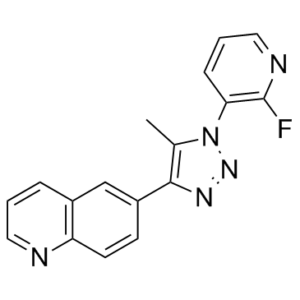
FPTQ is novel and potent antagonist of mGluR1 (metabotropic glutamate receptor subtype 1) with IC50 of 6 nM and 1.4 nM for human and mouse mGluR1 respectively. It may be applied as a ligand for positron emission tomography to visualize the rat brain's metabotropic glutamate receptor type 1 (mGluR1). FPTQ exhibited high specific binding with mGluR1 in the rat brain, according to in vitro autoradiography. FPTQ had a high uptake in the rat brain, according to a biodistribution study that used small-animal PET and the dissection method. Unlabeled FPTQ and mGluR1-selective ligand JNJ-16259685 decreased the uptake of radioactivity in the cerebellum, suggesting that FPTQ had mGluR1-specific binding in vivo. Due to the brain's low concentration of radiolabeled metabolites, FPTQ may have limited use in mGluR1 in vivo PET imaging.
Physicochemical Properties
| Molecular Formula | C17H12FN5 |
| Molecular Weight | 305.309085845947 |
| Exact Mass | 305.107 |
| CAS # | 864863-72-9 |
| Related CAS # | 1025802-62-3; or 864863-72-9 |
| PubChem CID | 11301185 |
| Appearance | Light yellow to yellow solid powder |
| Density | 1.4±0.1 g/cm3 |
| Boiling Point | 523.8±60.0 °C at 760 mmHg |
| Flash Point | 270.6±32.9 °C |
| Vapour Pressure | 0.0±1.4 mmHg at 25°C |
| Index of Refraction | 1.700 |
| LogP | 2.55 |
| Hydrogen Bond Donor Count | 0 |
| Hydrogen Bond Acceptor Count | 5 |
| Rotatable Bond Count | 2 |
| Heavy Atom Count | 23 |
| Complexity | 408 |
| Defined Atom Stereocenter Count | 0 |
| SMILES | FC1C(N2C(C)=C(C3C=C4C(N=CC=C4)=CC=3)N=N2)=CC=CN=1 |
| InChi Key | RTUBNVSZHGWRCV-UHFFFAOYSA-N |
| InChi Code | InChI=1S/C17H12FN5/c1-11-16(13-6-7-14-12(10-13)4-2-8-19-14)21-22-23(11)15-5-3-9-20-17(15)18/h2-10H,1H3 |
| Chemical Name | 6-[1-(2-fluoropyridin-3-yl)-5-methyltriazol-4-yl]quinoline |
| Synonyms | FPTQ |
| HS Tariff Code | 2934.99.9001 |
| Storage |
Powder-20°C 3 years 4°C 2 years In solvent -80°C 6 months -20°C 1 month |
| Shipping Condition | Room temperature (This product is stable at ambient temperature for a few days during ordinary shipping and time spent in Customs) |
Biological Activity
| Targets | Human mGluR1 ( IC50 = 6 nM ); Mouse mGluR1 ( IC50 = 1.4 nM ) |
| ln Vitro |
FPTQ (0.5–10 μM) did not exhibit any cytotoxicity at 0.5, 1, 5, or 10 μM in RAW264.7 macrophage cells[2]. FPTQ (1–20 μM; 24 hours) decreases LPS-induced NO production at > 1 μM, and at 10 μM, FPTQ treatment has a 31% anti-oxidant effect in RAW264.7 macrophage cells[2]. FPTQ (1–20 μM; 24 hours) significantly reduces the levels of IL-1β and IL-6 expression induced by LPS. When FPTQ is added to RAW264.7 macrophage cells at a concentration of 10 μM, the mRNA expression of IL-1β and Il-6 is reduced by 27% and 44%, respectively[2]. |
| ln Vivo | FPTQ (5-20 μM) reduces the quantity of neutrophils that migrate to the site of amputation in zebrafish larvae by tail amputation. The quantity of neutrophils aggregating at the wound site in zebrafish using the tailfin wound method likewise declines in a dose-dependent manner[2]. The Tg(mpx:EGFP)i114 zebrafish larvae are used in an LPS-induced inflammation zebrafish model. The larvae are introduced to FPTQ treatment right away after an injection of LPS solution into their yolks. FPTQ (20 μM; 4 hours) has an anti-inflammatory effect in the early stages of inflammation and dramatically reduces fluorescent neutrophils following yolk injection[2]. |
| Cell Assay |
Cell Line: RAW264.7 macrophage cells Concentration: 1, 10, or 20 μM Incubation Time: 24 hours Result: Decreased IL-1β and IL-6 mRNA expression |
| References |
[1]. Synthesis and evaluation of 6-[1-(2-[(18)F]fluoro-3-pyridyl)-5-methyl-1H-1,2,3-triazol-4-yl]quinoline for positron emission tomography imaging of the metabotropic glutamate receptor type 1 in brain. Bioorg Med Chem. 2011 Jan 1;19(1):102-10. [2]. Anti-inflammatory effect of a novel synthetic compound 1-((4-fluorophenyl)thio)isoquinoline in RAW264.7 macrophages and a zebrafish model. Fish Shellfish Immunol. 2019 Apr;87:395-400. |
Solubility Data
| Solubility (In Vitro) |
|
|||
| Solubility (In Vivo) |
Solubility in Formulation 1: ≥ 2.5 mg/mL (8.19 mM) (saturation unknown) in 10% DMSO + 40% PEG300 +5% Tween-80 + 45% Saline (add these co-solvents sequentially from left to right, and one by one), clear solution. For example, if 1 mL of working solution is to be prepared, you can add 100 μL of 25.0 mg/mL clear DMSO stock solution to 400 μL PEG300 and mix evenly; then add 50 μL Tween-80 + to the above solution and mix evenly; then add 450 μL normal saline to adjust the volume to 1 mL. Preparation of saline: Dissolve 0.9 g of sodium chloride in 100 mL ddH₂ O to obtain a clear solution. (Please use freshly prepared in vivo formulations for optimal results.) |
| Preparing Stock Solutions | 1 mg | 5 mg | 10 mg | |
| 1 mM | 3.2754 mL | 16.3768 mL | 32.7536 mL | |
| 5 mM | 0.6551 mL | 3.2754 mL | 6.5507 mL | |
| 10 mM | 0.3275 mL | 1.6377 mL | 3.2754 mL |