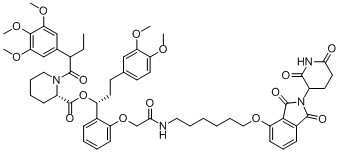
FKBP12 PROTAC dTAG-13 (dTAG-13) is a novel and potent PROTAC degrader for degradation of FKBP12F36V fusion chimeras. FKBP12 PROTAC dTAG-13 (dTAG-13) is a degrader of FKBP12F36V with expression of FKBP12F36V in-frame with a protein of interest. FKBP12 PROTAC dTAG-13 (dTAG-13) also is a specific degrader of BET bromodomain transcriptional co-activator BRD4 by bridging BET bromodomains to an E3 ubiquitin ligase CRBN.
Physicochemical Properties
| Molecular Formula | C₅₇H₆₈N₄O₁₅ |
| Molecular Weight | 1049.16763687134 |
| Exact Mass | 1048.468 |
| CAS # | 2064175-41-1 |
| Related CAS # | 2064175-41-1; |
| PubChem CID | 124187630 |
| Appearance | White to light yellow solid powder |
| Density | 1.3±0.1 g/cm3 |
| Boiling Point | 1134.0±65.0 °C at 760 mmHg |
| Flash Point | 639.6±34.3 °C |
| Vapour Pressure | 0.0±0.3 mmHg at 25°C |
| Index of Refraction | 1.581 |
| LogP | 6.98 |
| Hydrogen Bond Donor Count | 2 |
| Hydrogen Bond Acceptor Count | 15 |
| Rotatable Bond Count | 27 |
| Heavy Atom Count | 76 |
| Complexity | 1930 |
| Defined Atom Stereocenter Count | 3 |
| SMILES | CC[C@@H](C1=CC(=C(C(=C1)OC)OC)OC)C(=O)N2CCCC[C@H]2C(=O)O[C@H](CCC3=CC(=C(C=C3)OC)OC)C4=CC=CC=C4OCC(=O)NCCCCCCOC5=CC=CC6=C5C(=O)N(C6=O)C7CCC(=O)NC7=O |
| InChi Key | BJFBRLAWLPZOMJ-VOSOTEEESA-N |
| InChi Code | InChI=1S/C57H68N4O15/c1-7-37(36-32-47(71-4)52(73-6)48(33-36)72-5)54(65)60-29-14-12-19-41(60)57(68)76-43(25-22-35-23-26-44(69-2)46(31-35)70-3)38-17-10-11-20-42(38)75-34-50(63)58-28-13-8-9-15-30-74-45-21-16-18-39-51(45)56(67)61(55(39)66)40-24-27-49(62)59-53(40)64/h10-11,16-18,20-21,23,26,31-33,37,40-41,43H,7-9,12-15,19,22,24-25,27-30,34H2,1-6H3,(H,58,63)(H,59,62,64)/t37?,40?,41-,43+/m0/s1 |
| Chemical Name | (1R)-3-(3,4-dimethoxyphenyl)-1-(2-(2-((6-((2-(2,6-dioxopiperidin-3-yl)-1,3-dioxoisoindolin-4-yl)oxy)hexyl)amino)-2-oxoethoxy)phenyl)propyl (2S)-1-(2-(3,4,5-trimethoxyphenyl)butanoyl)piperidine-2-carboxylate |
| Synonyms | FKBP12 PROTAC dTAG-13 dTAG-13 dTAG13 dTAG 13 |
| HS Tariff Code | 2934.99.9001 |
| Storage |
Powder-20°C 3 years 4°C 2 years In solvent -80°C 6 months -20°C 1 month |
| Shipping Condition | Room temperature (This product is stable at ambient temperature for a few days during ordinary shipping and time spent in Customs) |
Biological Activity
| ln Vitro | FKBP12F36V-Nluc levels in 293FTWT cells were successfully decreased by TAG-13 (1-1000 nM; 4 hours; 293FTWT cells) treatment, suggesting that CRBN is necessary for the observed results [1]. When dTAG-13 was applied to MV4;11 cells that expressed BRD4(short)-FKBP12F36V, BRD4 was severely degraded. BRD4 rapidly degraded after receiving dTAG-13 treatment in less than an hour. In heterozygous and homozygous knock-in clones, dTAG-13 treatment causes BRD4 fusion chimeras to degrade quickly and effectively, but it has no effect on endogenous FKBP12WT [1]. |
| ln Vivo | After transplantation of luc-FKBP12F36V-expressing MV4;11 cells into mouse bone marrow, the bioluminescence signal after vector or dTAG-13 administration was evaluated. A strong, quick, and long-lasting influence on the bioluminescence signal was seen four hours after dTAG-13 injection, demonstrating effective degradation of luc-FKBP12F36V. Twenty-eight hours following final treatment, cell bioluminescence was shown to rebound to levels comparable to vehicle and dTAG-13 treated groups [1]. |
| Cell Assay |
Western blot analysis[1] Cell Types: 293FTWT cells Tested Concentrations: 1 nM, 10 nM, 100 nM, 1000 nM Incubation Duration: 4 hrs (hours) Experimental Results: FKBP12F36V-Nluc levels were Dramatically diminished in 293FTWT cells. |
| References |
[1]. The dTAG system for immediate and target-specific protein degradation. Nat Chem Biol. 2018 May;14(5):431-441. |
Solubility Data
| Solubility (In Vitro) | DMSO : ~180 mg/mL (~171.56 mM) |
| Solubility (In Vivo) |
Note: Listed below are some common formulations that may be used to formulate products with low water solubility (e.g. < 1 mg/mL), you may test these formulations using a minute amount of products to avoid loss of samples. Injection Formulations (e.g. IP/IV/IM/SC) Injection Formulation 1: DMSO : Tween 80: Saline = 10 : 5 : 85 (i.e. 100 μL DMSO stock solution → 50 μL Tween 80 → 850 μL Saline) *Preparation of saline: Dissolve 0.9 g of sodium chloride in 100 mL ddH ₂ O to obtain a clear solution. Injection Formulation 2: DMSO : PEG300 :Tween 80 : Saline = 10 : 40 : 5 : 45 (i.e. 100 μL DMSO → 400 μLPEG300 → 50 μL Tween 80 → 450 μL Saline) Injection Formulation 3: DMSO : Corn oil = 10 : 90 (i.e. 100 μL DMSO → 900 μL Corn oil) Example: Take the Injection Formulation 3 (DMSO : Corn oil = 10 : 90) as an example, if 1 mL of 2.5 mg/mL working solution is to be prepared, you can take 100 μL 25 mg/mL DMSO stock solution and add to 900 μL corn oil, mix well to obtain a clear or suspension solution (2.5 mg/mL, ready for use in animals). Injection Formulation 4: DMSO : 20% SBE-β-CD in saline = 10 : 90 [i.e. 100 μL DMSO → 900 μL (20% SBE-β-CD in saline)] *Preparation of 20% SBE-β-CD in Saline (4°C,1 week): Dissolve 2 g SBE-β-CD in 10 mL saline to obtain a clear solution. Injection Formulation 5: 2-Hydroxypropyl-β-cyclodextrin : Saline = 50 : 50 (i.e. 500 μL 2-Hydroxypropyl-β-cyclodextrin → 500 μL Saline) Injection Formulation 6: DMSO : PEG300 : castor oil : Saline = 5 : 10 : 20 : 65 (i.e. 50 μL DMSO → 100 μLPEG300 → 200 μL castor oil → 650 μL Saline) Injection Formulation 7: Ethanol : Cremophor : Saline = 10: 10 : 80 (i.e. 100 μL Ethanol → 100 μL Cremophor → 800 μL Saline) Injection Formulation 8: Dissolve in Cremophor/Ethanol (50 : 50), then diluted by Saline Injection Formulation 9: EtOH : Corn oil = 10 : 90 (i.e. 100 μL EtOH → 900 μL Corn oil) Injection Formulation 10: EtOH : PEG300:Tween 80 : Saline = 10 : 40 : 5 : 45 (i.e. 100 μL EtOH → 400 μLPEG300 → 50 μL Tween 80 → 450 μL Saline) Oral Formulations Oral Formulation 1: Suspend in 0.5% CMC Na (carboxymethylcellulose sodium) Oral Formulation 2: Suspend in 0.5% Carboxymethyl cellulose Example: Take the Oral Formulation 1 (Suspend in 0.5% CMC Na) as an example, if 100 mL of 2.5 mg/mL working solution is to be prepared, you can first prepare 0.5% CMC Na solution by measuring 0.5 g CMC Na and dissolve it in 100 mL ddH2O to obtain a clear solution; then add 250 mg of the product to 100 mL 0.5% CMC Na solution, to make the suspension solution (2.5 mg/mL, ready for use in animals). Oral Formulation 3: Dissolved in PEG400 Oral Formulation 4: Suspend in 0.2% Carboxymethyl cellulose Oral Formulation 5: Dissolve in 0.25% Tween 80 and 0.5% Carboxymethyl cellulose Oral Formulation 6: Mixing with food powders Note: Please be aware that the above formulations are for reference only. InvivoChem strongly recommends customers to read literature methods/protocols carefully before determining which formulation you should use for in vivo studies, as different compounds have different solubility properties and have to be formulated differently. (Please use freshly prepared in vivo formulations for optimal results.) |
| Preparing Stock Solutions | 1 mg | 5 mg | 10 mg | |
| 1 mM | 0.9531 mL | 4.7657 mL | 9.5313 mL | |
| 5 mM | 0.1906 mL | 0.9531 mL | 1.9063 mL | |
| 10 mM | 0.0953 mL | 0.4766 mL | 0.9531 mL |