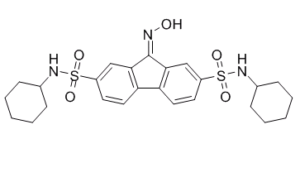
FIN56 (FIN-56), a specific inducer of ferroptosis, causes the loss of GPX4 activity in cell lysates. Squalene synthase is additionally bound to and activated. It has been discovered that inhibiting the lipid-repair enzyme GPX4 causes ferroptosis. GPX4 was made to degrade faster by FIN56. Independent of the GPX4 degradation, FIN56 also binds to and activates the isoprenoid biosynthesis enzyme squalene synthase. Through a mechanism involving the control of GPX4 protein abundance, FIN56 causes ferroptosis. Overexpression of the GFP-GPX4 fusion protein prevents the cell death caused by FIN56. It binds to and activates squalene synthase, an enzyme involved in the synthesis of cholesterol, to suppress non-steroidogenic metabolites—likely coenzyme Q10—in the mevalonate pathway, increasing sensitivity to FIN56-induced ferroptosis.
Physicochemical Properties
| Molecular Formula | C25H31N3O5S2 | |
| Molecular Weight | 517.6607 | |
| Exact Mass | 517.17 | |
| Elemental Analysis | C, 58.01; H, 6.04; N, 8.12; O, 15.45; S, 12.39 | |
| CAS # | 1083162-61-1 | |
| Related CAS # |
|
|
| PubChem CID | 118986699 | |
| Appearance | White to off-white solid powder | |
| LogP | 4.9 | |
| Hydrogen Bond Donor Count | 3 | |
| Hydrogen Bond Acceptor Count | 8 | |
| Rotatable Bond Count | 6 | |
| Heavy Atom Count | 35 | |
| Complexity | 900 | |
| Defined Atom Stereocenter Count | 0 | |
| InChi Key | JLCFMMIWBSZOIS-UHFFFAOYSA-N | |
| InChi Code | InChI=1S/C25H31N3O5S2/c29-26-25-23-15-19(34(30,31)27-17-7-3-1-4-8-17)11-13-21(23)22-14-12-20(16-24(22)25)35(32,33)28-18-9-5-2-6-10-18/h11-18,27-29H,1-10H2 | |
| Chemical Name | 2-N,7-N-dicyclohexyl-9-hydroxyiminofluorene-2,7-disulfonamide | |
| Synonyms |
|
|
| HS Tariff Code | 2934.99.9001 | |
| Storage |
Powder-20°C 3 years 4°C 2 years In solvent -80°C 6 months -20°C 1 month |
|
| Shipping Condition | Room temperature (This product is stable at ambient temperature for a few days during ordinary shipping and time spent in Customs) |
Biological Activity
| Targets | Ferroptosis | ||
| ln Vitro | FIN56 is a specific inducer of ferroptosis. The mechanism involves two distinct pathways: one leads to the degradation of GPX4, which necessitates the enzymatic activity of acetyl-CoA carboxylase, and the other activates squalene synthase, which depletes coenzyme Q10 without relying on the degradation of GPX4[1]. | ||
| ln Vivo |
|
||
| Enzyme Assay | FIN56 causes the loss of GPX4 activity in cell lysates. FIN56-induced cell death is suppressed by GFP-GPX4 fusion protein overexpression. FIN56 triggers ferroptosis through a mechanism involving the regulation of GPX4 protein abundance. | ||
| Cell Assay | In a 10-cm dish, 500,000 HT-1080 cells are seeded. For 16 hours, cells are grown at 37 °C. Cells are cotreated with 100 μM -tocopherol and either a vehicle (DMSO) or a ferroptosis inducer (10 μM erastin, 0.5 μM (1S, 3R)-RSL3, or 5 μM FIN56) on the day of the analysis, and then incubated for 10 h. Next, cells are trypsinized, pelleted, and given a single wash in 400 L of ice-cold PBS containing 1 mM EDTA. Both oxidized and reduced glutathione are quantified in technical triplicates in 120 μL of sample after the cell debris has been pelleted and eliminated. The protein concentration as determined by the Bradford assay is used to normalize the glutathione quantity. | ||
| Animal Protocol |
|
||
| References |
[1]. Global survey of cell death mechanisms reveals metabolic regulation of ferroptosis. Nat Chem Biol. 2016 Jul;12(7):497-503. [2]. The Tumor Suppressor p53 Limits Ferroptosis by Blocking DPP4 Activity. Cell Rep. 2017 Aug 15;20(7):1692-1704. [3]. FINO2 initiates ferroptosis through GPX4 inactivation and iron oxidation. Nat Chem Biol. 2018 May;14(5):507-515. |
||
| Additional Infomation | FIN56 is a fluorene that is N-9H-fluoren-9-ylidenehydroxylamine substituted by N-cyclohexylsulfonyl groups at positions 2 and 7. It induces ferroptosis via degradation of GPX4 and also binds and activates squalene synthase. It has a role as a ferroptosis inducer and an EC 1.11.1.9 (glutathione peroxidase) inhibitor. It is a member of fluorenes, a ketoxime and a sulfonamide. It is functionally related to a 9-hydroxyiminofluorene-2,7-disulfonamide. |
Solubility Data
| Solubility (In Vitro) |
|
|||
| Solubility (In Vivo) |
Solubility in Formulation 1: 2.5 mg/mL (4.83 mM) in 10% DMSO + 40% PEG300 + 5% Tween80 + 45% Saline (add these co-solvents sequentially from left to right, and one by one), suspension solution; with sonication. For example, if 1 mL of working solution is to be prepared, you can add 100 μL of 25.0 mg/mL clear DMSO stock solution to 400 μL PEG300 and mix evenly; then add 50 μL Tween-80 to the above solution and mix evenly; then add 450 μL normal saline to adjust the volume to 1 mL. Preparation of saline: Dissolve 0.9 g of sodium chloride in 100 mL ddH₂ O to obtain a clear solution. Solubility in Formulation 2: 2.5 mg/mL (4.83 mM) in 10% DMSO + 90% (20% SBE-β-CD in Saline) (add these co-solvents sequentially from left to right, and one by one), suspension solution; with ultrasonication. For example, if 1 mL of working solution is to be prepared, you can add 100 μL of 25.0 mg/mL clear DMSO stock solution to 900 μL of 20% SBE-β-CD physiological saline solution and mix evenly. Preparation of 20% SBE-β-CD in Saline (4°C,1 week): Dissolve 2 g SBE-β-CD in 10 mL saline to obtain a clear solution. Solubility in Formulation 3: ≥ 2.5 mg/mL (4.83 mM) (saturation unknown) in 10% DMSO + 90% Corn Oil (add these co-solvents sequentially from left to right, and one by one), clear solution. For example, if 1 mL of working solution is to be prepared, you can add 100 μL of 25.0 mg/mL clear DMSO stock solution to 900 μL of corn oil and mix evenly. (Please use freshly prepared in vivo formulations for optimal results.) |
| Preparing Stock Solutions | 1 mg | 5 mg | 10 mg | |
| 1 mM | 1.9318 mL | 9.6588 mL | 19.3177 mL | |
| 5 mM | 0.3864 mL | 1.9318 mL | 3.8635 mL | |
| 10 mM | 0.1932 mL | 0.9659 mL | 1.9318 mL |