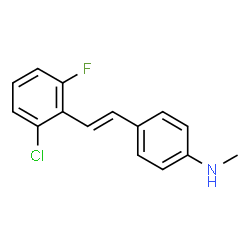
Physicochemical Properties
| Molecular Formula | C15H13CLFN |
| Molecular Weight | 261.721826314926 |
| CAS # | 1391934-98-7 |
| PubChem CID | 57521314 |
| Appearance | Light yellow to yellow solid |
| Hydrogen Bond Donor Count | 1 |
| Hydrogen Bond Acceptor Count | 2 |
| Rotatable Bond Count | 3 |
| Heavy Atom Count | 18 |
| Complexity | 274 |
| Defined Atom Stereocenter Count | 0 |
| SMILES | ClC1C=CC=C(C=1/C=C/C1C=CC(=CC=1)NC)F |
| Synonyms | FIDAS5; FIDAS 5 |
| HS Tariff Code | 2934.99.9001 |
| Storage |
Powder-20°C 3 years 4°C 2 years In solvent -80°C 6 months -20°C 1 month Note: This product is not stable in solution, please use freshly prepared working solution for optimal results. |
| Shipping Condition | Room temperature (This product is stable at ambient temperature for a few days during ordinary shipping and time spent in Customs) |
Biological Activity
| Targets | MAT2A (Methionine S-adenosyltransferase 2A) (IC50 = 2.1 μM) |
| ln Vitro | Treatment of LS174T cells with FIDAS-5 (3 μM; 7 days) dramatically reduced their ability to proliferate [1]. Myc and cyclin D1 are inhibited in c-LS174T CRC cells by FIDAS-5 (3 μM). The FIDAS-5 FIDAS-5 (3 μM; 36 h) treatment decreases cell cycle expression across p21WAF1/CIP1 in LS174T cells stimulated by S-adenosylmethionine (SAM) and S-adenosylhomocysteine [1]. |
| ln Vivo | Treatment with FIDAS-5 (20 mg/kg; oral gavage; daily; for two weeks; athymic nude mice) dramatically reduces the growth of xenograft tumors while causing little change in body weight[1]. FIDAS-5 (20 mg/kg) is administered to mice for one week. Significantly lower liver SAM levels are observed[1]. |
| Enzyme Assay |
Affinity binding assays [1] a) LS174T cell lysates To purify the FIDAS target, LS174T cell lysates were incubated with streptavidin beads and biotinylated FIDAS-8 at 4°C overnight. The beads were washed three times with cell lysis buffer. Binding proteins were elution with 2.5 mM D-Biotin. The purified samples were separated by 4.12% gradient SDS-PAGE and analyzed by silver staining or Sypro Ruby fluorescent staining. The protein bands specifically presented in the samples of FIDAS-8 were excised and analyzed by MALDI-TOF/TOF and LC-MS/MS as previously described. b) recombinant MAT2A MAT2A and MAT2B were cloned into pGEX-6P-3 vector. The constructs were transfected into E-coli BL21. The GST-fusion proteins were induced by IPTG and purified by glutathione beads as described previously. For the binding assay, purified proteins were incubated with streptavidin beads and the biotinylated FIDAS-8 compound described above. Eluted proteins were analyzed by Western blotting with antibodies against GST, MAT2A or MAT2B. His-tagged MAT2A was expressed from the pETDuet vector for use in SAM synthesis and mutagenesis studies. Protein was purified using HIS-Select resin according to manufactures instructions and eluted using buffer supplemented with 300 mM imidazole. Anisotropy analysis[1] FIDAS-3 (2.5 μM) was mixed with DMSO or MAT2A in 100 μL PBS buffer in a 96-well plate. For competition assay, SAM or L-methionine was added to the mixture. Fluorescence anisotropy was measured at 23 °C using a SpectraMax M5 with excitation at 358 nm, emission at 454 nm, and an emission filter at 420 nm. Samples were measured in a colored 96-well plate with 100 μL total volume.[1] Malachite Green Phosphate (Pi) Assay[1] L-Methionine (1 mM) and ATP (1 mM) were incubated with purified His-tagged MAT2A (5 μg) in 0.5 mL reaction buffer (50 mM Tris pH8.0, 50 mM KCl, 10 mL MgCl2) for 30 min. The inorganic phosphate released from the reaction was measured with SensoLyte MG phosphate Assay kit. The absorbance was measured at 620 nm on a microplate reader. For inhibition assay, MAT2A was incubated with FIDAS agents at room temperature for 20 min and then mixed with L-methionine and ATP in 0.5 mL reaction buffer. Cold deionized water (2 mL) was added to stop the reaction and dilute the samples. |
| Cell Assay |
Cell viability assay [1] Cell Types: LS174T colorectal cancer (CRC) cell Tested Concentrations: 3 μM Incubation Duration: 7 days Experimental Results: Dramatically inhibited the proliferation of LS174T cells. (SAH) levels[1]. |
| Animal Protocol |
Animal/Disease Models: 16 athymic nude mice were injected with HT29 CRC cells [1]. Doses: 20 mg/kg. Route of Administration: po (oral gavage); kg). The liver SAM levels were Dramatically higher. Dramatically diminished [1]. Routine; two-week Experimental Results: Significant inhibition of xenograft tumor growth. |
| References |
[1]. Fluorinated N,N-dialkylaminostilbenes repress colon cancer by targeting methionine S-adenosyltransferase 2A. ACS Chem Biol. 2013 Apr 19;8(4):796-803. |
Solubility Data
| Solubility (In Vitro) | DMSO : ~125 mg/mL (~477.61 mM) |
| Solubility (In Vivo) |
Solubility in Formulation 1: ≥ 2.08 mg/mL (7.95 mM) (saturation unknown) in 10% DMSO + 40% PEG300 + 5% Tween80 + 45% Saline (add these co-solvents sequentially from left to right, and one by one), clear solution. For example, if 1 mL of working solution is to be prepared, you can add 100 μL of 20.8 mg/mL clear DMSO stock solution to 400 μL PEG300 and mix evenly; then add 50 μL Tween-80 to the above solution and mix evenly; then add 450 μL normal saline to adjust the volume to 1 mL. Preparation of saline: Dissolve 0.9 g of sodium chloride in 100 mL ddH₂ O to obtain a clear solution. Solubility in Formulation 2: ≥ 2.08 mg/mL (7.95 mM) (saturation unknown) in 10% DMSO + 90% (20% SBE-β-CD in Saline) (add these co-solvents sequentially from left to right, and one by one), clear solution. For example, if 1 mL of working solution is to be prepared, you can add 100 μL of 20.8 mg/mL clear DMSO stock solution to 900 μL of 20% SBE-β-CD physiological saline solution and mix evenly. Preparation of 20% SBE-β-CD in Saline (4°C,1 week): Dissolve 2 g SBE-β-CD in 10 mL saline to obtain a clear solution. (Please use freshly prepared in vivo formulations for optimal results.) |
| Preparing Stock Solutions | 1 mg | 5 mg | 10 mg | |
| 1 mM | 3.8209 mL | 19.1044 mL | 38.2088 mL | |
| 5 mM | 0.7642 mL | 3.8209 mL | 7.6418 mL | |
| 10 mM | 0.3821 mL | 1.9104 mL | 3.8209 mL |