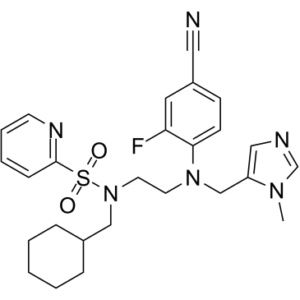
FGTI-2734 (FGTI2734) is a novel and potent RAS C-terminal mimetic, acting as a dual farnesyl transferase (FT) and geranylgeranyl transferase-1 (GGT) inhibitor that thwarts Mutant KRAS-Driven Patient-Derived Pancreatic Tumors with IC50s of 250 nM and 520 nM for FT and GGT, respectively. FGTI-2734 can prevent membrane localization of KRAS, hence solving KRAS resistance problem and thwarting mutant KRAS patient-derived pancreatic tumors. Mutant KRAS is a major driver of pancreatic oncogenesis and therapy resistance, yet KRAS inhibitors are lacking in the clinic. KRAS requires farnesylation for membrane localization and cancer-causing activity prompting the development of farnesyltransferase inhibitors (FTIs) as anticancer agents. However, KRAS becomes geranylgeranylated and active when cancer cells are treated with FTIs. To overcome this geranylgeranylation-dependent resistance to FTIs, we designed FGTI-2734, a RAS C-terminal mimetic dual FT and geranylgeranyltransferase-1 inhibitor (GGTI)
Physicochemical Properties
| Molecular Formula | C26H31FN6O2S |
| Molecular Weight | 510.626747369766 |
| Exact Mass | 510.22 |
| Elemental Analysis | C, 61.16; H, 6.12; F, 3.72; N, 16.46; O, 6.27; S, 6.28 |
| CAS # | 1247018-19-4 |
| Related CAS # | FGTI-2734 mesylate;2702297-24-1 |
| PubChem CID | 49783195 |
| Appearance | White to off-white solid powder |
| LogP | 4 |
| Hydrogen Bond Donor Count | 0 |
| Hydrogen Bond Acceptor Count | 8 |
| Rotatable Bond Count | 10 |
| Heavy Atom Count | 36 |
| Complexity | 839 |
| Defined Atom Stereocenter Count | 0 |
| InChi Key | BXNRVJLIEMQDOL-UHFFFAOYSA-N |
| InChi Code | InChI=1S/C26H31FN6O2S/c1-31-20-29-17-23(31)19-32(25-11-10-22(16-28)15-24(25)27)13-14-33(18-21-7-3-2-4-8-21)36(34,35)26-9-5-6-12-30-26/h5-6,9-12,15,17,20-21H,2-4,7-8,13-14,18-19H2,1H3 |
| Chemical Name | N-[2-[4-cyano-2-fluoro-N-[(3-methylimidazol-4-yl)methyl]anilino]ethyl]-N-(cyclohexylmethyl)pyridine-2-sulfonamide |
| Synonyms | FGTI2734; FGTI-2734; FGTI 2734 |
| HS Tariff Code | 2934.99.9001 |
| Storage |
Powder-20°C 3 years 4°C 2 years In solvent -80°C 6 months -20°C 1 month Note: Please store this product in a sealed and protected environment (e.g. under nitrogen), avoid exposure to moisture. |
| Shipping Condition | Room temperature (This product is stable at ambient temperature for a few days during ordinary shipping and time spent in Customs) |
Biological Activity
| Targets |
FGTI-2734 is a dual inhibitor of farnesyltransferase (FT) and geranylgeranyltransferase-1 (GGT-1). In vitro enzyme activity assays using human Burkitt lymphoma (Daudi) cell supernatants showed it inhibits FT with an IC50 of 250 ± 190 nM and GGT-1 with an IC50 of 520 ± 90 nM. The 2-fold difference was not statistically significant, indicating it is an equipotent dual inhibitor [1] . |
| ln Vitro |
CASPASE-3 and PARP cleavage are induced in MiaPaCa2, L3.6pl, and Calu6 cells by FGTI-2734 (1-30 μM; 72 hours) [1]. HDJ2, RAP1A, KRAS, and NRAS protein prenylation is inhibited by FGTI-2734 (3-30 μM; 72 hours). In RAS-transformed murine NIH3T3 cells and mutant KRAS human cancer cells, FGTI-2734 suppresses KRAS membrane localization [1]. FGTI-2734 (3-30 µM) inhibited the farnesylation of HDJ2 and the geranylgeranylation of RAP1A in HRAS-, NRAS-, and KRAS-transformed NIH3T3 cells, as well as in human pancreatic (MiaPaCa2) and lung (H460, Calu6, A549) cancer cells, confirming its dual inhibitory activity in cells [1]. FGTI-2734 (10-30 µM), but not the selective FTI-2148 or GGTI-2418, inhibited membrane localization and induced cytosolic accumulation of KRAS and NRAS in MiaPaCa2 and H460 cells, as demonstrated by cellular fractionation and Western blotting [1]. Immunofluorescence analysis in MiaPaCa2, H460, Calu6, A549, and DLD1 cells showed that treatment with FGTI-2734 (30 µM) prevented membrane localization of a GFP-tagged mutant KRASG12V (with wild-type CAAX box), resulting in a diffuse cytoplasmic pattern similar to a non-prenylable CAAX mutant (SVIM). Selective inhibitors FTI-2148 and GGTI-2418 did not prevent membrane localization [1]. FGTI-2734 (30 µM) treatment in MiaPaCa2 cells inhibited RAF-1 kinase activity (assessed by phosphorylation of MEK1) and disrupted the binding of RAF-1 to the scaffolding protein KSR, although cytosolic KRAS still bound to RAF-1 [1]. FGTI-2734 (1-30 µM) induced apoptosis (as indicated by cleavage of CASPASE-3 and PARP) in mutant KRAS-dependent human cancer cell lines (MiaPaCa2, L3.6pl pancreatic; Calu6 lung) but not in mutant KRAS-independent lines (A549, H460 lung; DLD1 colon) or in wild-type RAS lung cancer cells (H2126, H522, H661, H322) or normal lung fibroblasts (WI-38, MRC-5) [1]. Cell viability assays (CellTiter-Glo) showed that FGTI-2734 inhibited the growth of eight low-passage (<20) primary and metastatic mutant KRAS pancreatic adenocarcinoma cell lines derived from patients, with IC50 values ranging from 6.33 to 28.85 µM in standard 2D culture. Potency increased (IC50 5-9 µM) when cells were cultured in 3D conditions alone or in 3D co-culture with chemoresistance-promoting pancreatic stellate cells (PSCs) [1] . |
| ln Vivo |
Only mutant KRAS-dependent tumors are inhibited by FGTI-2734 (intraperitoneal injection; 100 mg/kg daily for 18 to 25 days)—mutant KRAS-independent tumors are not [1]. In subcutaneous xenograft models using immunodeficient mice, daily intraperitoneal administration of FGTI-2734 (100 mg/kg) significantly inhibited tumor growth of mutant KRAS-dependent human cancer cell lines (MiaPaCa2, L3.6pl pancreatic; Calu6 lung) but had no significant effect on the growth of mutant KRAS-independent lines (A549, H460 lung; DLD1 colon) [1]. FGTI-2734 (50 or 100 mg/kg/day, i.p.) significantly inhibited the growth of patient-derived xenograft (PDX) tumors established from fresh resected tumors of four pancreatic cancer patients harboring mutant KRAS (G12D or G12V) [1]. Pharmacodynamic analysis of PDX tumors (from Patient 2) after 21 days of treatment with FGTI-2734 (100 mg/kg/day) showed inhibition of HDJ2 farnesylation and RAP1A geranylgeranylation. It also suppressed phosphorylation of AKT (by 75±4%) and S6 ribosomal protein (by 82±15%), indicating inhibition of the PI3K/AKT/mTOR pathway. Phosphorylation of ERK1/2 was minimally affected (inhibited by 18±6%). Furthermore, FGTI-2734 suppressed cMYC protein levels (by 71±4%), upregulated p53 levels (2.9±0.6-fold), and induced CASPASE-3 cleavage (1.71±0.04-fold) [1] . |
| Enzyme Assay |
Farnesyltransferase (FT) and geranylgeranyltransferase-1 (GGT-1) enzyme activities were assayed using supernatants from human Burkitt lymphoma cells. The assays measured the ability of the inhibitors to block the transfer of tritiated farnesyl or geranylgeranyl groups from corresponding pyrophosphate donors to recombinant HRAS-CVLS (for FT) or HRAS-CVLL (for GGT-1) peptide substrates. Inhibition curves were generated, and IC50 values were calculated [1] . |
| Cell Assay |
Apoptosis analysis[1] Cell Types: MiaPaCa2, L3.6pl and Calu6 Cell Tested Concentrations: 1, 3, 10, 30 μM Incubation Duration: 72 hrs (hours) Experimental Results: Induction of CASPASE-3 and PARP cleavage. Western Blot Analysis[1] Cell Types: NIH3T3 cells transformed with KRAS, HRAS and NRAS Tested Concentrations: 3, 10, 30 μM Incubation Duration: 72 hrs (hours) Experimental Results: Inhibition of protein prenylation of HDJ2, RAP1A, KRAS and NRAS. Cell viability was determined using the CellTiter-Glo luminescent assay. Cells were seeded in 384-well or 96-well plates, allowed to adhere, treated with FGTI-2734 or vehicle for 72 hours, and then processed with the reagent according to the manufacturer's protocol. Luminescence was measured, data were normalized to control, and IC50 values were determined [1]. For Western blot analysis, cells or homogenized tumor tissues were lysed in appropriate extraction reagents supplemented with protease and phosphatase inhibitors. Lysates were centrifuged, and protein concentration in the supernatant was determined. Proteins were separated by SDS-PAGE, transferred to nitrocellulose membranes, blocked, and probed with specific primary antibodies (e.g., against unprenylated RAP1A, HDJ-2, KRAS, cleaved CASPASE-3, PARP, phosphorylated and total AKT, ERK, S6, cMYC, p53). After incubation with appropriate secondary antibodies, bands were visualized using chemiluminescence [1]. Membrane and cytosolic fractionation was performed. Cells treated with drugs were scraped into fractionation buffer, incubated on ice, and lysed by passing through a needle. Lysates were centrifuged at low speed to remove nuclei, and the supernatant was then ultracentrifuged at high speed to pellet crude membranes. The supernatant (cytosolic fraction, S100) and the resuspended pellet (membrane fraction, P100) were analyzed by Western blot [1]. For immunofluorescence, cells plated on coverslips were infected with lentiviruses encoding GFP-tagged KRAS constructs. After drug treatment, cells were fixed with paraformaldehyde, washed, and mounted with mounting medium containing DAPI. Localization of GFP was visualized using a confocal microscope [1]. For 3D cultures, cold Matrigel was added to wells and allowed to solidify. Pancreatic cancer cells were resuspended in medium containing a low percentage of Matrigel and overlaid on the gel. For co-culture with pancreatic stellate cells (PSCs), cancer cells and PSCs were mixed at a 1:1 ratio in the Matrigel-containing medium and overlaid. Cells were cultured for 24 hours before drug treatment [1]. Live-cell imaging was performed using an IncuCyte ZOOM system. Wells were scanned at day 0 and after 72 hours of treatment. Cell number was quantified using the associated software [1] |
| Animal Protocol |
Animal/Disease Models: Male SCID-bg mice injected with MiaPaCa2, L3.6pl, Calu6, A549, H460 and DLD1 cancer cells [1] Doses: 100 mg/kg Route of Administration: intraperitoneal (ip) injection; daily; continued for 18 to 25-day Experimental Results: Inhibition of tumor growth in tumors with KRAS-dependent mutations. For xenograft models using established cancer cell lines (e.g., MiaPaCa2, L3.6pl, Calu6, A549, H460, DLD1), exponentially growing cells were harvested, resuspended in PBS, and injected subcutaneously into the flank of SCID-bg mice. When tumors reached approximately 200 mm³, mice were randomized into treatment groups. FGTI-2734 was dissolved in 40% (wt/vol) 2-hydroxypropyl-β-cyclodextrin in sterile water. The treatment group received FGTI-2734 at 100 mg/kg body weight via daily intraperitoneal injection. The control group received the vehicle alone. Tumor dimensions were measured regularly, and volume was calculated. Treatments continued for 18-25 days [1]. For patient-derived xenograft (PDX) models, fresh tumor pieces from pancreatic cancer patients were subcutaneously implanted into NOD.Cg-Prkdcscid II2rgtm1Wjl/SzJ (NSG) mice. After engraftment and expansion through passages, when tumors reached 100-200 mm³, mice were randomized. FGTI-2734 was administered intraperitoneally daily at 50 mg/kg or 100 mg/kg body weight, dissolved in 40% 2-hydroxypropyl-β-cyclodextrin. Control mice received the vehicle. Tumor growth was monitored [1] |
| Toxicity/Toxicokinetics |
In mice treated with FGTI-2734 at 100 mg/kg/day intraperitoneally for up to 25 days, no evidence of gross toxicity (weight loss, changes in food intake, or activity) was observed. FGTI-2734 did not induce apoptosis in normal human lung fibroblast cell lines (WI-38, MRC-5) in vitro.[1] |
| References |
[1]. Dual farnesyl and geranylgeranyl transferase inhibitor thwarts mutant KRAS-driven patient-derived pancreatic tumors. Clin Cancer Res. 2019 Jun 21. |
| Additional Infomation |
FGTI-2734 is a RAS C-terminal (CAAX) mimetic peptidomimetic dual inhibitor designed to overcome geranylgeranylation-dependent resistance that limits the efficacy of selective farnesyltransferase inhibitors (FTIs) against KRAS [1]. By inhibiting both FT and GGT-1, FGTI-2734 prevents the membrane localization of KRAS (and NRAS), a critical step for its oncogenic signaling. Cytosolic KRAS can still bind its effector RAF-1 but fails to activate it efficiently, likely due to impaired recruitment of the scaffolding protein KSR [1]. The study suggests FGTI-2734 has potential for treating mutant KRAS-driven cancers, particularly pancreatic ductal adenocarcinoma where mutant KRAS prevalence is over 90%. It was effective against patient-derived models with various KRAS mutations (G12D, G12V, G13D) [1]. FGTI-2734 demonstrated activity in more clinically relevant models, including 3D co-cultures with pancreatic stellate cells (which promote chemoresistance) and patient-derived xenografts from chemotherapy-refractory tumors [1] . |
Solubility Data
| Solubility (In Vitro) | DMSO : ~50 mg/mL (~97.92 mM) |
| Solubility (In Vivo) |
Solubility in Formulation 1: ≥ 7.5 mg/mL (14.69 mM) (saturation unknown) in 10% DMSO + 90% Corn Oil (add these co-solvents sequentially from left to right, and one by one), clear solution. For example, if 1 mL of working solution is to be prepared, you can add 100 μL of 75.0 mg/mL clear DMSO stock solution to 900 μL of corn oil and mix evenly. (Please use freshly prepared in vivo formulations for optimal results.) |
| Preparing Stock Solutions | 1 mg | 5 mg | 10 mg | |
| 1 mM | 1.9584 mL | 9.7918 mL | 19.5837 mL | |
| 5 mM | 0.3917 mL | 1.9584 mL | 3.9167 mL | |
| 10 mM | 0.1958 mL | 0.9792 mL | 1.9584 mL |