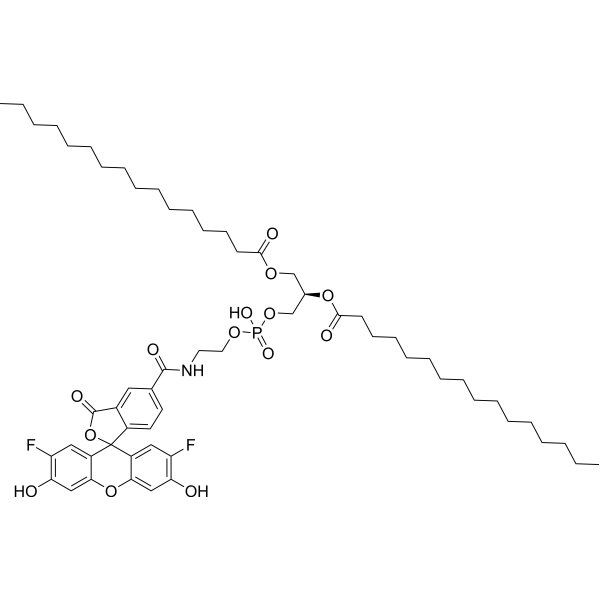
Physicochemical Properties
| CAS # | 438476-80-3 |
| Appearance | Typically exists as solid at room temperature |
| HS Tariff Code | 2934.99.9001 |
| Storage |
Powder-20°C 3 years 4°C 2 years In solvent -80°C 6 months -20°C 1 month |
| Shipping Condition | Room temperature (This product is stable at ambient temperature for a few days during ordinary shipping and time spent in Customs) |
Biological Activity
| ln Vitro | Fluorescence emission characteristics of FG 488 DHPE are depending on pH [1]. Tracking the acidity in the bulk vesicle assa [1]: 1. Tool: Jasco FP6500 fluorescence spectrometer, 37°C; detect emission at λem=534 nm, and stimulate fluorescence at λex=508 nm. To bring the transferred protons' charge balance to a balanced 680 μL of ATPase buffer containing the K+-ionophore valinomycin (5 nM), add 100 μL of proteoliposomes (c phospholipids, about 60 μM). 3. To cause proton pumping, add 1.2 mM of ATP. To facilitate ATP hydrolysis, add 1 mM NaN3. The proton gradient can be depleted by adding 0.4 μM of CCCP (carbonyl cyanide 3-chlorophenylhydrazine). 6. After being converted to pH, the fluorescence intensity was standardized to the intensity that was attained as soon as ATP was added. The voltage-dependent proton channel Hv1 is responsible for changes in pH, which are measured by FG 488 DHPE.Reference [2]. Calculating the concentration of phospholipids [2]: 1. Add 200 μL of 70% perchloric acid to the sample of unilamellar vesicles that contains 30 μL of OG488-DHPE. 2. For 60 minutes, heat to 220°C and hold it there to produce inorganic phosphate. 3. Once the mixture has cooled to room temperature, add 700 μL of the solutions of NH4MoO4 (0.45% (w/v)) and perchloric acid (12.6% (w/v)), as well as 700 μL of 1.7% (w/v) acetic acid. 4. To determine the NaH2PO4 concentration, obtain a calibration curve. 5. After 10 minutes of incubation at 80°C, measure the sample's absorbance at 820 nm. 6. Determine the vesicles' phospholipid concentration using the calibration curve. Translocation of protons experiment [2]: 1. Tool: Jasco FP6500 fluorescence spectrometer, 37°C; light emission at λem=534 nm (3 nm bandwidth), excitation of fluorescence at λex=508 nm (3 nm bandwidth). 2. To establish a 14-fold K+ gradient across the vesicle membrane in buffer A, dilute proteoliposomes made of POPC/POPG/Chol/OG488-DHPE (54.5:25:20:0.5) in flow buffer. 3. If the Hv1 channel is active, add 13 nM of valinomycin to cause OG488-DHPE to protonate and reduce the intensity of its fluorescence, as previously mentioned. 4. Use CCCP (6 nM) to make every vesicle proton permeabilized. 5. Show how the normalized fluorescence intensity (Fnorm) changes with time. Instead of using proteoliposomes as a control for proton leak, protein-free vesicles were employed. If the potential inhibitor 2GBI is present in the experiment, dissolve the inhibitor (15 mM) in flux buffer and add 0.5-8.0 μL to the proteoliposomes. This should be done before adding valinomycin to cause proton translocation. |
| References |
[1]. Monitoring ATPase induced pH changes in single proteoliposomes with the lipid-coupled fluorophore Oregon Green 488. Analyst. 2017 Jul 10;142(14):2670-2677. [2]. Quantification of Hv1-induced proton translocation by a lipid-coupled Oregon Green 488-based assay. Anal Bioanal Chem. 2018 Oct;410(25):6497-6505. |
Solubility Data
| Solubility (In Vitro) | May dissolve in DMSO (in most cases), if not, try other solvents such as H2O, Ethanol, or DMF with a minute amount of products to avoid loss of samples |
| Solubility (In Vivo) |
Note: Listed below are some common formulations that may be used to formulate products with low water solubility (e.g. < 1 mg/mL), you may test these formulations using a minute amount of products to avoid loss of samples. Injection Formulations (e.g. IP/IV/IM/SC) Injection Formulation 1: DMSO : Tween 80: Saline = 10 : 5 : 85 (i.e. 100 μL DMSO stock solution → 50 μL Tween 80 → 850 μL Saline) *Preparation of saline: Dissolve 0.9 g of sodium chloride in 100 mL ddH ₂ O to obtain a clear solution. Injection Formulation 2: DMSO : PEG300 :Tween 80 : Saline = 10 : 40 : 5 : 45 (i.e. 100 μL DMSO → 400 μLPEG300 → 50 μL Tween 80 → 450 μL Saline) Injection Formulation 3: DMSO : Corn oil = 10 : 90 (i.e. 100 μL DMSO → 900 μL Corn oil) Example: Take the Injection Formulation 3 (DMSO : Corn oil = 10 : 90) as an example, if 1 mL of 2.5 mg/mL working solution is to be prepared, you can take 100 μL 25 mg/mL DMSO stock solution and add to 900 μL corn oil, mix well to obtain a clear or suspension solution (2.5 mg/mL, ready for use in animals). Injection Formulation 4: DMSO : 20% SBE-β-CD in saline = 10 : 90 [i.e. 100 μL DMSO → 900 μL (20% SBE-β-CD in saline)] *Preparation of 20% SBE-β-CD in Saline (4°C,1 week): Dissolve 2 g SBE-β-CD in 10 mL saline to obtain a clear solution. Injection Formulation 5: 2-Hydroxypropyl-β-cyclodextrin : Saline = 50 : 50 (i.e. 500 μL 2-Hydroxypropyl-β-cyclodextrin → 500 μL Saline) Injection Formulation 6: DMSO : PEG300 : castor oil : Saline = 5 : 10 : 20 : 65 (i.e. 50 μL DMSO → 100 μLPEG300 → 200 μL castor oil → 650 μL Saline) Injection Formulation 7: Ethanol : Cremophor : Saline = 10: 10 : 80 (i.e. 100 μL Ethanol → 100 μL Cremophor → 800 μL Saline) Injection Formulation 8: Dissolve in Cremophor/Ethanol (50 : 50), then diluted by Saline Injection Formulation 9: EtOH : Corn oil = 10 : 90 (i.e. 100 μL EtOH → 900 μL Corn oil) Injection Formulation 10: EtOH : PEG300:Tween 80 : Saline = 10 : 40 : 5 : 45 (i.e. 100 μL EtOH → 400 μLPEG300 → 50 μL Tween 80 → 450 μL Saline) Oral Formulations Oral Formulation 1: Suspend in 0.5% CMC Na (carboxymethylcellulose sodium) Oral Formulation 2: Suspend in 0.5% Carboxymethyl cellulose Example: Take the Oral Formulation 1 (Suspend in 0.5% CMC Na) as an example, if 100 mL of 2.5 mg/mL working solution is to be prepared, you can first prepare 0.5% CMC Na solution by measuring 0.5 g CMC Na and dissolve it in 100 mL ddH2O to obtain a clear solution; then add 250 mg of the product to 100 mL 0.5% CMC Na solution, to make the suspension solution (2.5 mg/mL, ready for use in animals). Oral Formulation 3: Dissolved in PEG400 Oral Formulation 4: Suspend in 0.2% Carboxymethyl cellulose Oral Formulation 5: Dissolve in 0.25% Tween 80 and 0.5% Carboxymethyl cellulose Oral Formulation 6: Mixing with food powders Note: Please be aware that the above formulations are for reference only. InvivoChem strongly recommends customers to read literature methods/protocols carefully before determining which formulation you should use for in vivo studies, as different compounds have different solubility properties and have to be formulated differently. (Please use freshly prepared in vivo formulations for optimal results.) |