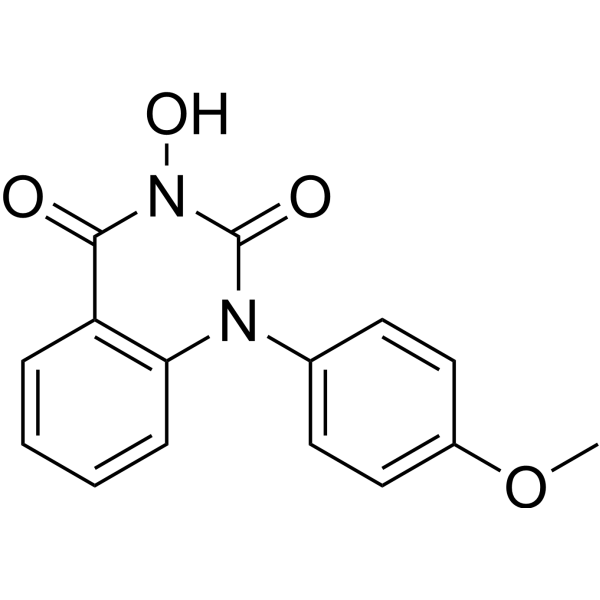
Physicochemical Properties
| Molecular Formula | C15H12N2O4 |
| Molecular Weight | 284.266783714294 |
| Exact Mass | 284.079 |
| CAS # | 2109805-87-8 |
| PubChem CID | 132585224 |
| Appearance | Light yellow to yellow solid powder |
| LogP | 1.8 |
| Hydrogen Bond Donor Count | 1 |
| Hydrogen Bond Acceptor Count | 4 |
| Rotatable Bond Count | 2 |
| Heavy Atom Count | 21 |
| Complexity | 420 |
| Defined Atom Stereocenter Count | 0 |
| SMILES | ON1C(C2C=CC=CC=2N(C1=O)C1C=CC(=CC=1)OC)=O |
| InChi Key | BBJIIPZSHQTBLW-UHFFFAOYSA-N |
| InChi Code | InChI=1S/C15H12N2O4/c1-21-11-8-6-10(7-9-11)16-13-5-3-2-4-12(13)14(18)17(20)15(16)19/h2-9,20H,1H3 |
| Chemical Name | 3-hydroxy-1-(4-methoxyphenyl)quinazoline-2,4-dione |
| HS Tariff Code | 2934.99.9001 |
| Storage |
Powder-20°C 3 years 4°C 2 years In solvent -80°C 6 months -20°C 1 month |
| Shipping Condition | Room temperature (This product is stable at ambient temperature for a few days during ordinary shipping and time spent in Customs) |
Biological Activity
| ln Vitro | The growth of colon cancer cells lacking Mre11a and Cdc4, both of which are often mutated in colorectal cancer, is selectively impaired by FEN1 suppression. Due to its involvement in LP-BER, FEN1 has also become a promising target for chemosensitization. FEN1 is essential for healing alkylation damage caused by methyl mesylate, and its suppression or knockdown promotes glioblastoma. The sensitivity of colorectal cancer cell lines and temozolomide to each other [1]. |
| References |
[1]. Cellularly Active N-hydroxyurea FEN1 Inhibitors Block Substrate Entry to the Active Site. Nat Chem Biol. 2016 Oct;12(10):815-21. |
Solubility Data
| Solubility (In Vitro) | DMSO: 250 mg/mL (879.45 mM) |
| Solubility (In Vivo) |
Solubility in Formulation 1: ≥ 2.08 mg/mL (7.32 mM) (saturation unknown) in 10% DMSO + 40% PEG300 + 5% Tween80 + 45% Saline (add these co-solvents sequentially from left to right, and one by one), clear solution. For example, if 1 mL of working solution is to be prepared, you can add 100 μL of 20.8 mg/mL clear DMSO stock solution to 400 μL PEG300 and mix evenly; then add 50 μL Tween-80 to the above solution and mix evenly; then add 450 μL normal saline to adjust the volume to 1 mL. Preparation of saline: Dissolve 0.9 g of sodium chloride in 100 mL ddH₂ O to obtain a clear solution. Solubility in Formulation 2: ≥ 2.08 mg/mL (7.32 mM) (saturation unknown) in 10% DMSO + 90% (20% SBE-β-CD in Saline) (add these co-solvents sequentially from left to right, and one by one), clear solution. For example, if 1 mL of working solution is to be prepared, you can add 100 μL of 20.8 mg/mL clear DMSO stock solution to 900 μL of 20% SBE-β-CD physiological saline solution and mix evenly. Preparation of 20% SBE-β-CD in Saline (4°C,1 week): Dissolve 2 g SBE-β-CD in 10 mL saline to obtain a clear solution. Solubility in Formulation 3: ≥ 2.08 mg/mL (7.32 mM) (saturation unknown) in 10% DMSO + 90% Corn Oil (add these co-solvents sequentially from left to right, and one by one), clear solution. For example, if 1 mL of working solution is to be prepared, you can add 100 μL of 20.8 mg/mL clear DMSO stock solution to 900 μL of corn oil and mix evenly. (Please use freshly prepared in vivo formulations for optimal results.) |
| Preparing Stock Solutions | 1 mg | 5 mg | 10 mg | |
| 1 mM | 3.5178 mL | 17.5889 mL | 35.1778 mL | |
| 5 mM | 0.7036 mL | 3.5178 mL | 7.0356 mL | |
| 10 mM | 0.3518 mL | 1.7589 mL | 3.5178 mL |