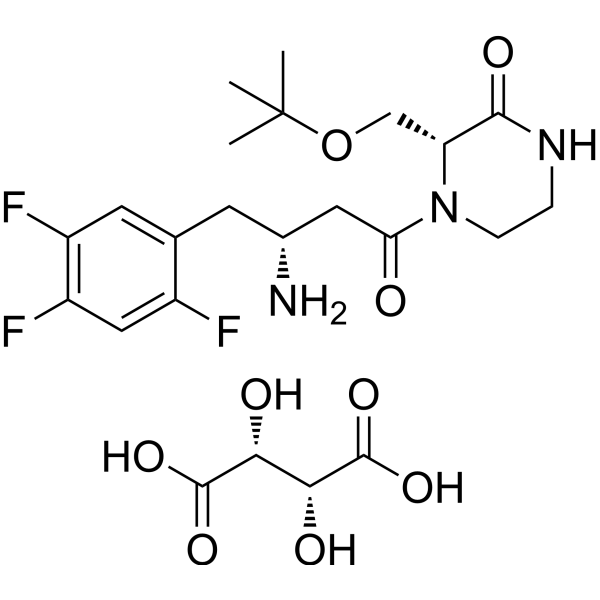
Physicochemical Properties
| Molecular Formula | C23H32F3N3O9 |
| Molecular Weight | 551.510097503662 |
| Exact Mass | 551.209 |
| CAS # | 1222102-51-3 |
| Related CAS # | Evogliptin;1222102-29-5 |
| PubChem CID | 135395528 |
| Appearance | White to off-white solid powder |
| Hydrogen Bond Donor Count | 6 |
| Hydrogen Bond Acceptor Count | 13 |
| Rotatable Bond Count | 10 |
| Heavy Atom Count | 38 |
| Complexity | 692 |
| Defined Atom Stereocenter Count | 4 |
| SMILES | FC1C=C(C(=CC=1C[C@H](CC(N1CCNC([C@H]1COC(C)(C)C)=O)=O)N)F)F.O[C@@H](C(=O)O)[C@H](C(=O)O)O |
| InChi Key | RBBXDAJRSNHIJZ-DLDKMZOSSA-N |
| InChi Code | InChI=1S/C19H26F3N3O3.C4H6O6/c1-19(2,3)28-10-16-18(27)24-4-5-25(16)17(26)8-12(23)6-11-7-14(21)15(22)9-13(11)20;5-1(3(7)8)2(6)4(9)10/h7,9,12,16H,4-6,8,10,23H2,1-3H3,(H,24,27);1-2,5-6H,(H,7,8)(H,9,10)/t12-,16-;1-,2-/m11/s1 |
| Chemical Name | (3R)-4-[(3R)-3-amino-4-(2,4,5-trifluorophenyl)butanoyl]-3-[(2-methylpropan-2-yl)oxymethyl]piperazin-2-one;(2R,3R)-2,3-dihydroxybutanedioic acid |
| HS Tariff Code | 2934.99.9001 |
| Storage |
Powder-20°C 3 years 4°C 2 years In solvent -80°C 6 months -20°C 1 month Note: Please store this product in a sealed and protected environment, avoid exposure to moisture. |
| Shipping Condition | Room temperature (This product is stable at ambient temperature for a few days during ordinary shipping and time spent in Customs) |
Biological Activity
| ln Vitro | In PWM-induced H9 Th1 cells, evogliptin tartrate (2.49 mM; 12 h) can efficiently decrease the activity of the mDPP4 (membrane DPP4) enzyme [1]. In primary hepatocytes of ATG7f/f-Cre+ mice, evogliptin tartrate induces autophagy, which inhibits inflammatory and fibrotic signaling [2]. |
| ln Vivo | In HFD/STZ mice, evogliptin tartrate (100, 300 mg/kg; animal feed; once daily for 10 weeks) reduces insulin resistance and glucose intolerance [3]. |
| Cell Assay |
Cell Viability Assay[1] Cell Types: H9 Th1 cells (Pokeweed mitogen (PWM) induced) Tested Concentrations: 2.49 mM (1 µg/mL) Incubation Duration: 12 hrs (hours) Experimental Results: Effective inhibition of mDPP4 (membrane DPP4) at a certain dose ) activity-dependent manner, but did not affect the cytokine profile or cell viability in PWM-activated CD4+CD26+ H9 Th1 cells. |
| Animal Protocol |
Animal/Disease Models: Male ICR mouse (4 weeks old; HFD/STZ mouse model) [3]. Doses: 100, 300 mg/kg Route of Administration: Animal feed; one time/day for 10 weeks Experimental Results: Blood glucose levels diminished starting from the second week and continued during the 300 mg/kg treatment period until 10 weeks. HbA1c levels were Dramatically diminished at a dose of 300 mg/kg. Dramatically diminished 6-hour fasting blood glucose levels in a dose-dependent manner. |
| References |
[1]. Effects of the Antidiabetic Drugs Evogliptin and Sitagliptin on the Immune Function of CD26/DPP4 in Th1 Cells. Biomol Ther (Seoul). 2021 Mar 1;29(2):154-165. [2]. Evogliptin Directly Inhibits Inflammatory and Fibrotic Signaling in Isolated Liver Cells. International Journal of Molecular Sciences, 2022, 23(19): 11636. [3]. Hepatic role in an early glucose-lowering effect by a novel dipeptidyl peptidase 4 inhibitor, evogliptin, in a rodent model of type 2 diabetes. Eur J Pharmacol. 2016 Jan 15;771:65-76. [4]. Evogliptin: a new dipeptidyl peptidase inhibitor for the treatment of type 2 diabetes. Expert Opin Pharmacother. 2016 Jun;17(9):1285-93. |
Solubility Data
| Solubility (In Vitro) | DMSO : ~100 mg/mL (~181.32 mM) |
| Solubility (In Vivo) |
Solubility in Formulation 1: ≥ 2.5 mg/mL (4.53 mM) (saturation unknown) in 10% DMSO + 40% PEG300 + 5% Tween80 + 45% Saline (add these co-solvents sequentially from left to right, and one by one), clear solution. For example, if 1 mL of working solution is to be prepared, you can add 100 μL of 25.0 mg/mL clear DMSO stock solution to 400 μL PEG300 and mix evenly; then add 50 μL Tween-80 to the above solution and mix evenly; then add 450 μL normal saline to adjust the volume to 1 mL. Preparation of saline: Dissolve 0.9 g of sodium chloride in 100 mL ddH₂ O to obtain a clear solution. Solubility in Formulation 2: ≥ 2.5 mg/mL (4.53 mM) (saturation unknown) in 10% DMSO + 90% (20% SBE-β-CD in Saline) (add these co-solvents sequentially from left to right, and one by one), clear solution. For example, if 1 mL of working solution is to be prepared, you can add 100 μL of 25.0 mg/mL clear DMSO stock solution to 900 μL of 20% SBE-β-CD physiological saline solution and mix evenly. Preparation of 20% SBE-β-CD in Saline (4°C,1 week): Dissolve 2 g SBE-β-CD in 10 mL saline to obtain a clear solution. Solubility in Formulation 3: ≥ 2.5 mg/mL (4.53 mM) (saturation unknown) in 10% DMSO + 90% Corn Oil (add these co-solvents sequentially from left to right, and one by one), clear solution. For example, if 1 mL of working solution is to be prepared, you can add 100 μL of 25.0 mg/mL clear DMSO stock solution to 900 μL of corn oil and mix evenly. (Please use freshly prepared in vivo formulations for optimal results.) |
| Preparing Stock Solutions | 1 mg | 5 mg | 10 mg | |
| 1 mM | 1.8132 mL | 9.0660 mL | 18.1320 mL | |
| 5 mM | 0.3626 mL | 1.8132 mL | 3.6264 mL | |
| 10 mM | 0.1813 mL | 0.9066 mL | 1.8132 mL |