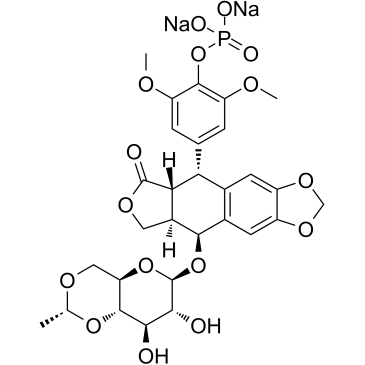
Etoposide phosphate disodium (BMY-40481 disodium), the phosphate ester prodrug of etoposide, is a potent anti-cancer chemotherapeutic drug, acting as a topoisomerase II inhibitorthat prevents re-ligation of DNA strands. Etoposide (Vepesid) is a widely used drug in a variety of neoplasms. To improve the pharmaceutical characteristics of etoposide, etoposide phosphate (Etopophos, Bristol-Myers Squibb) has been developed as a prodrug. Etoposide phosphate is the phosphate ester derivative of etoposide. In comparison to the parent compound, etoposide phosphate is highly soluble in water and can be readily formulated for intravenous use, resulting in higher clinical application. This paper presents information on the pharmaceutical properties and the current status of etoposide phosphate in clinical trials.
Physicochemical Properties
| Molecular Formula | C29H34NAO16P |
| Molecular Weight | 692.534202098846 |
| Exact Mass | 691.14 |
| CAS # | 122405-33-8 |
| Related CAS # | Etoposide phosphate;117091-64-2 |
| PubChem CID | 168013075 |
| Appearance | Typically exists as solid at room temperature |
| Hydrogen Bond Donor Count | 4 |
| Hydrogen Bond Acceptor Count | 16 |
| Rotatable Bond Count | 7 |
| Heavy Atom Count | 47 |
| Complexity | 1140 |
| Defined Atom Stereocenter Count | 10 |
| SMILES | C[C@@H]1OC[C@@H]2[C@@H](O1)[C@@H]([C@H]([C@@H](O2)O[C@H]3[C@H]4COC(=O)[C@@H]4[C@@H](C5=CC6=C(C=C35)OCO6)C7=CC(=C(C(=C7)OC)OP(=O)(O)O)OC)O)O.[Na] |
| InChi Key | DHNSYXRVPMCTTP-CFIJAROYSA-N |
| InChi Code | InChI=1S/C29H33O16P.Na/c1-11-38-9-20-27(42-11)23(30)24(31)29(43-20)44-25-14-7-17-16(40-10-41-17)6-13(14)21(22-15(25)8-39-28(22)32)12-4-18(36-2)26(19(5-12)37-3)45-46(33,34)35;/h4-7,11,15,20-25,27,29-31H,8-10H2,1-3H3,(H2,33,34,35);/t11-,15+,20-,21-,22+,23-,24-,25-,27-,29+;/m1./s1 |
| Synonyms | Etoposide phosphate disodium; 122405-33-8; Etoposide phosphate disodium |
| HS Tariff Code | 2934.99.9001 |
| Storage |
Powder-20°C 3 years 4°C 2 years In solvent -80°C 6 months -20°C 1 month |
| Shipping Condition | Room temperature (This product is stable at ambient temperature for a few days during ordinary shipping and time spent in Customs) |
Biological Activity
| Targets | Topoisomerase II |
| ln Vitro | Position 4' of the etoposide molecule's E ring has a phosphate group, which makes etoposide phosphate disodium a water-soluble derivative and likely prodrug of etoposide[1]. Etoposide phosphate disodium (0-1 μM; 72 hours) has dose-dependent inhibitory effects on HCT116 FBXW+/+, FBXW-/-, and p53-/-, with IC50 values of 0.945 μM, 0.375 μM, and 1.437 μM, respectively[2]. In cells lacking FBXW7, p53 recovery is delayed by etoposide phosphate disodium (25 μM; 6 hours). Furthermore, in FBXW7-/-cells, FBXW7 expression is absent[2]. |
| ln Vivo |
On day 8, female CD-1 mice administered with etoposide phosphate (50, 100, or 150 mg/kg in a single dosage) exhibit increasing ataxia, decreased righting reflex, and splaying and paresis of the fore- and hindlimbs[3]. The effects of high toxic doses of the anticancer drugs, etoposide and its phosphate derivative, BMY-40481, on the nervous system of female CD-1 mice were examined by light microscopy (LM) and transmission electron microscopy. Mice were euthanatized 4 wk following a single iv injection of either 0, 50, 100, or 150 mg/kg of BMY-40481 or 44 or 88 mg/kg of etoposide. Mice treated with 100 or 150 mg/kg of BMY-40481 or 88 mg/kg of etoposide had clinical symptomology of progressive ataxia, impaired righting reflex, and splaying and paresis of fore- and hindlimbs at day 8. Similar, dose-related LM changes were observed with both drugs at all doses and consisted of degeneration of dorsal root ganglion cells and axonal degeneration of their distal and proximal processes in peripheral nerves, dorsal spinal roots, and dorsal funiculi of spinal cord. Axonal degeneration was characterized by LM as shrinkage, swelling, and fragmentation of axon cylinders accompanied by secondary demyelination. Degenerative changes in ganglion cell bodies included eccentric nuclei, cytoplasmic vacuolation, central chromatolysis, and peripheral clumping of Nissl's bodies. Ultrastructurally, ganglion cell bodies had focally extensive dilation of the rough endoplasmic reticulum, mitochondrial swelling, increased numbers of phagolysosomes and prominent aggregations of microfilaments (globular filamentous bodies). Ultrastructural axonal changes occurred primarily in large, myelinated fibers and consisted of axonal swelling or loss, thinning of myelin sheaths, and a decrease in the number of organelles. This is the first report of etoposide-related sensory neuropathy in laboratory rats, a model that my be useful for the study of etoposide-related peripheral neuropathy in humans.[3] |
| Cell Assay |
Cell Viability Assay[2] Cell Types: FBXW+/+, FBXW-/- and p53-/- cell Tested Concentrations: 0.025 μM, 0.05 μM, 0.075 μM, 0.1 μM, 0.2 μM, 0.4 μM, 0.6 μM, 0.8 μM, 1 μM Incubation Duration: 72 hrs (hours) Experimental Results: Inhibited HCT116 FBXW+/+, FBXW-/- and p53-/- cell growth as a concentration manner. Western Blot Analysis[2] Cell Types: HCT116 FBXW7+/+ or FBXW7-/- cells Tested Concentrations: 25 μM Incubation Duration: 6 hrs (hours) Experimental Results: demonstrated that the recovery of p53 levels after DNA damage is mediated by FBXW7. |
| Animal Protocol |
Animal/Disease Models: Female CD-1 mice[3] Doses: 50, 100, or 150 mg/kg Route of Administration: intravenous (iv) injection; single dose Experimental Results: Observed degeneration of dorsal root ganglion cells and axonal degeneration of their distal and proximal processes in peripheral nerves, dorsal spinal roots, and dorsal funiculi of the spinal cord at all doses under light microscopy (LM). |
| References |
[1]. Etoposide phosphate, the water soluble prodrug of etoposide. Pharm World Sci. 1996 Oct;18(5):163-70. [2]. FBXW7 Confers Radiation Survival by Targeting p53 for Degradation.Cell Rep. 2020 Jan 14;30(2):497-509.e4. [3]. Etoposide- and BMY-40481-induced sensory neuropathy in mice.Toxicol Pathol. 1994 Sep-Oct;22(5):528-35. [4]. SUMMARY OF PRODUCT CHARACTERISTICS. |
| Additional Infomation | Etoposide phosphate is a furonaphthodioxole. ChEBI Etoposide Phosphate is a phosphate salt of a semisynthetic derivative of podophyllotoxin. Etoposide binds to the enzyme topoisomerase II, inducing double-strand DNA breaks, inhibiting DNA repair, and resulting in decreased DNA synthesis and tumor cell proliferation. Cells in the S and G2 phases of the cell cycle are most sensitive to this agent. |
Solubility Data
| Solubility (In Vitro) | May dissolve in DMSO (in most cases), if not, try other solvents such as H2O, Ethanol, or DMF with a minute amount of products to avoid loss of samples |
| Solubility (In Vivo) |
Note: Listed below are some common formulations that may be used to formulate products with low water solubility (e.g. < 1 mg/mL), you may test these formulations using a minute amount of products to avoid loss of samples. Injection Formulations (e.g. IP/IV/IM/SC) Injection Formulation 1: DMSO : Tween 80: Saline = 10 : 5 : 85 (i.e. 100 μL DMSO stock solution → 50 μL Tween 80 → 850 μL Saline) *Preparation of saline: Dissolve 0.9 g of sodium chloride in 100 mL ddH ₂ O to obtain a clear solution. Injection Formulation 2: DMSO : PEG300 :Tween 80 : Saline = 10 : 40 : 5 : 45 (i.e. 100 μL DMSO → 400 μLPEG300 → 50 μL Tween 80 → 450 μL Saline) Injection Formulation 3: DMSO : Corn oil = 10 : 90 (i.e. 100 μL DMSO → 900 μL Corn oil) Example: Take the Injection Formulation 3 (DMSO : Corn oil = 10 : 90) as an example, if 1 mL of 2.5 mg/mL working solution is to be prepared, you can take 100 μL 25 mg/mL DMSO stock solution and add to 900 μL corn oil, mix well to obtain a clear or suspension solution (2.5 mg/mL, ready for use in animals). Injection Formulation 4: DMSO : 20% SBE-β-CD in saline = 10 : 90 [i.e. 100 μL DMSO → 900 μL (20% SBE-β-CD in saline)] *Preparation of 20% SBE-β-CD in Saline (4°C,1 week): Dissolve 2 g SBE-β-CD in 10 mL saline to obtain a clear solution. Injection Formulation 5: 2-Hydroxypropyl-β-cyclodextrin : Saline = 50 : 50 (i.e. 500 μL 2-Hydroxypropyl-β-cyclodextrin → 500 μL Saline) Injection Formulation 6: DMSO : PEG300 : castor oil : Saline = 5 : 10 : 20 : 65 (i.e. 50 μL DMSO → 100 μLPEG300 → 200 μL castor oil → 650 μL Saline) Injection Formulation 7: Ethanol : Cremophor : Saline = 10: 10 : 80 (i.e. 100 μL Ethanol → 100 μL Cremophor → 800 μL Saline) Injection Formulation 8: Dissolve in Cremophor/Ethanol (50 : 50), then diluted by Saline Injection Formulation 9: EtOH : Corn oil = 10 : 90 (i.e. 100 μL EtOH → 900 μL Corn oil) Injection Formulation 10: EtOH : PEG300:Tween 80 : Saline = 10 : 40 : 5 : 45 (i.e. 100 μL EtOH → 400 μLPEG300 → 50 μL Tween 80 → 450 μL Saline) Oral Formulations Oral Formulation 1: Suspend in 0.5% CMC Na (carboxymethylcellulose sodium) Oral Formulation 2: Suspend in 0.5% Carboxymethyl cellulose Example: Take the Oral Formulation 1 (Suspend in 0.5% CMC Na) as an example, if 100 mL of 2.5 mg/mL working solution is to be prepared, you can first prepare 0.5% CMC Na solution by measuring 0.5 g CMC Na and dissolve it in 100 mL ddH2O to obtain a clear solution; then add 250 mg of the product to 100 mL 0.5% CMC Na solution, to make the suspension solution (2.5 mg/mL, ready for use in animals). Oral Formulation 3: Dissolved in PEG400 Oral Formulation 4: Suspend in 0.2% Carboxymethyl cellulose Oral Formulation 5: Dissolve in 0.25% Tween 80 and 0.5% Carboxymethyl cellulose Oral Formulation 6: Mixing with food powders Note: Please be aware that the above formulations are for reference only. InvivoChem strongly recommends customers to read literature methods/protocols carefully before determining which formulation you should use for in vivo studies, as different compounds have different solubility properties and have to be formulated differently. (Please use freshly prepared in vivo formulations for optimal results.) |
| Preparing Stock Solutions | 1 mg | 5 mg | 10 mg | |
| 1 mM | 1.4440 mL | 7.2199 mL | 14.4398 mL | |
| 5 mM | 0.2888 mL | 1.4440 mL | 2.8880 mL | |
| 10 mM | 0.1444 mL | 0.7220 mL | 1.4440 mL |