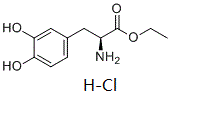
Etilevodopa HCl (TV-1203; Levodopa ethyl ester; L-Dopa ethyl ester; O-Ethyl-DOPA), the hydrochloride salt of Etilevodopa, is a dopaminergic agent used for the treatment for Parkinson's disease. It is an ethyl-ester prodrug of levodopa that has greater gastric solubility, passes quickly into the small intestine, is rapidly hydrolyzed to levodopa, and has a shortened time to maximum levodopa concentration.
Physicochemical Properties
| Molecular Formula | C11H16CLNO4 |
| Molecular Weight | 261.702 |
| Exact Mass | 261.077 |
| CAS # | 39740-30-2 |
| Related CAS # | Etilevodopa;37178-37-3 |
| PubChem CID | 12485237 |
| Appearance | Light yellow to yellow solid powder |
| LogP | 2.033 |
| Hydrogen Bond Donor Count | 4 |
| Hydrogen Bond Acceptor Count | 5 |
| Rotatable Bond Count | 5 |
| Heavy Atom Count | 17 |
| Complexity | 234 |
| Defined Atom Stereocenter Count | 1 |
| SMILES | CCOC(=O)[C@H](CC1=CC(=C(C=C1)O)O)N.Cl |
| InChi Key | CVQFXVIIFKVRCK-QRPNPIFTSA-N |
| InChi Code | InChI=1S/C11H15NO4.ClH/c1-2-16-11(15)8(12)5-7-3-4-9(13)10(14)6-7;/h3-4,6,8,13-14H,2,5,12H2,1H3;1H/t8-;/m0./s1 |
| Chemical Name | ethyl (2S)-2-amino-3-(3,4-dihydroxyphenyl)propanoate;hydrochloride |
| Synonyms | TV-1203 HClL-Dopa ethyl ester Levodopa ethyl ester TV1203 Etilevodopa |
| HS Tariff Code | 2934.99.9001 |
| Storage |
Powder-20°C 3 years 4°C 2 years In solvent -80°C 6 months -20°C 1 month Note: (1). This product requires protection from light (avoid light exposure) during transportation and storage.(2). Please store this product in a sealed and protected environment (e.g. under nitrogen), avoid exposure to moisture. |
| Shipping Condition | Room temperature (This product is stable at ambient temperature for a few days during ordinary shipping and time spent in Customs) |
Biological Activity
| ln Vitro | After traveling through the stomach unaltered, ativodopa (levodopa ethyl ester) hydrochloride enters the duodenum, where local esterase quickly hydrolyzes it into levodopa and ethanol, which is then quickly absorbed into the bloodstream as levodopa. Stream [1]. Azidovopa hydrochloride is more soluble in the stomach, enters the small intestine more quickly, and achieves the maximum levodopa concentration in less time when compared to regular levodopa [2]. |
| References |
[1]. Pharmacokinetics of etilevodopa compared to levodopa in patients with Parkinson's disease: an open-label, randomized, crossover study. Clin Neuropharmacol. 2003 Nov-Dec;26(6):322-6. [2]. A randomized controlled trial of etilevodopa in patients with Parkinson disease who have motor fluctuations. Arch Neurol. 2006 Feb;63(2):210-6. [3]. Dopamine and Levodopa Prodrugs for the Treatment of Parkinson's Disease. Molecules. 2017 Dec 25;23(1). pii: E40. |
Solubility Data
| Solubility (In Vitro) | H2O : ~125 mg/mL (~477.65 mM) |
| Solubility (In Vivo) |
Solubility in Formulation 1: 25 mg/mL (95.53 mM) in PBS (add these co-solvents sequentially from left to right, and one by one), clear solution; with sonication. (Please use freshly prepared in vivo formulations for optimal results.) |
| Preparing Stock Solutions | 1 mg | 5 mg | 10 mg | |
| 1 mM | 3.8212 mL | 19.1058 mL | 38.2117 mL | |
| 5 mM | 0.7642 mL | 3.8212 mL | 7.6423 mL | |
| 10 mM | 0.3821 mL | 1.9106 mL | 3.8212 mL |