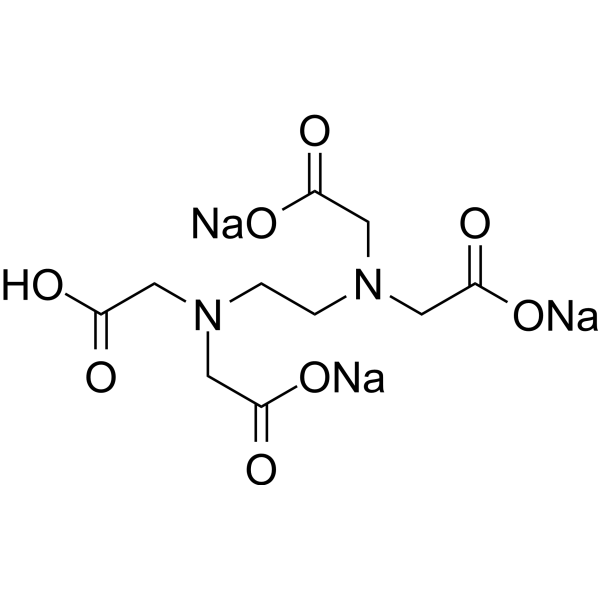
Physicochemical Properties
| Molecular Formula | C10H16N2O8.NA+ |
| Molecular Weight | 315.23244 |
| Exact Mass | 358.036 |
| CAS # | 150-38-9 |
| Related CAS # | EDTA dipotassium dihydrate;25102-12-9;Ethylenediaminetetraacetic acid;60-00-4 |
| PubChem CID | 9008 |
| Appearance | White to off-white solid powder |
| Boiling Point | 614.2ºC at 760 mmHg |
| Melting Point | 237 °C |
| Flash Point | 325.2ºC |
| Vapour Pressure | 1.15E-16mmHg at 25°C |
| Hydrogen Bond Donor Count | 1 |
| Hydrogen Bond Acceptor Count | 10 |
| Rotatable Bond Count | 8 |
| Heavy Atom Count | 23 |
| Complexity | 351 |
| Defined Atom Stereocenter Count | 0 |
| InChi Key | QZKRHPLGUJDVAR-UHFFFAOYSA-K |
| InChi Code | InChI=1S/C10H16N2O8.3Na/c13-7(14)3-11(4-8(15)16)1-2-12(5-9(17)18)6-10(19)20;;;/h1-6H2,(H,13,14)(H,15,16)(H,17,18)(H,19,20);;;/q;3*+1/p-3 |
| Chemical Name | trisodium;2-[2-[bis(carboxylatomethyl)amino]ethyl-(carboxymethyl)amino]acetate |
| HS Tariff Code | 2934.99.9001 |
| Storage |
Powder-20°C 3 years 4°C 2 years In solvent -80°C 6 months -20°C 1 month Note: Please store this product in a sealed and protected environment, avoid exposure to moisture. |
| Shipping Condition | Room temperature (This product is stable at ambient temperature for a few days during ordinary shipping and time spent in Customs) |
Biological Activity
| ln Vitro |
Ethylenediaminetetraacetic acid trisodium salt (EDTA) at high concentrations eluted from anion exchange columns can inhibit Mg²⁺-dependent polymerase chain reaction (PCR). When 2 µl of a fraction containing an enriched concentration of EDTA (22 mM, representing a 220-fold increase from the original 0.1 mM in the mobile phase) was added to a PCR reaction, it completely inhibited the amplification of the EGFP gene, unlike fractions without the EDTA peak. [1] EDTA present in protein purification buffers can interfere with anion exchange chromatography (AEC). When an AEC column (e.g., MonoQ) was equilibrated and samples were applied in buffers containing EDTA, the EDTA bound to the resin and co-eluted as a sharp peak during a salt gradient. This concentrated EDTA peak (eluting at ~240-275 mM NaCl depending on resin and pH) can mask protein peaks detected at 215 nm, displace weakly bound proteins (e.g., EGFP), and reduce the protein-binding capacity of the resin. Saturation of the resin with EDTA (e.g., by applying 5 mM EDTA) can prevent subsequent binding of proteins like EGFP, with only ~7% of the protein adsorbing under such conditions. Conversely, applying a high concentration of EDTA (5 mM) to a column with pre-bound EGFP can displace approximately 95% of the protein. [1] As an in vitro anticoagulant, Ethylenediaminetetraacetic acid trisodium salt (EDTA) prevents blood clotting by chelating calcium ions, which are necessary for the coagulation cascade. It is the recommended anticoagulant for hematological testing (complete blood count) as it optimally preserves cellular components and blood cell morphology. [2] EDTA demonstrates a stabilizing effect on labile molecules in blood samples. For example, EDTA plasma is recommended for the measurement of hormones like corticotropin (ACTH), parathyroid hormone (PTH), glucagon, C-peptide, and others, as it inhibits degradation. PTH is more stable in EDTA plasma than in serum. [2] EDTA can inhibit complement activation and stabilize certain proteins in immunoassays when added to the reaction buffer. [2] EDTA is the anticoagulant of choice for molecular biology applications (e.g., PCR, HIV-1 RNA quantification) as it stabilizes nucleic acids and, unlike heparin, does not inhibit DNA amplification. HCV-RNA concentrations in EDTA anticoagulated blood are stable for up to 5 days at room temperature. [2] EDTA can cause interference in specific diagnostic assays: It can lead to underestimation of Troponin T (TnT) by up to 18% in some immunoassays and can interfere with Troponin I (TnI) activity by chelating Ca²⁺ needed for the complex. EDTA is not recommended for their measurement. [2] EDTA may cause a variable degree of interference in some myoglobin immunoassays. [2] For natriuretic peptides (ANP, BNP), EDTA plasma (with or without antiproteolytic substances) is recommended for collection, and cold storage in EDTA tubes is indicated. However, NT-proBNP concentration in EDTA plasma can be up to 10% lower than in serum or heparin plasma. [2] EDTA is recommended for proteomics studies as its chelating action inhibits metal-dependent proteases, helping to stabilize the protein profile. [2] EDTA is recommended for measuring certain drugs like aminoglycosides and some antiepileptic drugs. It can serve as an alternative to heparin or serum for measuring several antiepileptic drugs, antiarrhythmic drugs, salicylate, acetaminophen, and theophylline. However, it should not be used for measuring 3,4-dihydroxyphenylalanine (DOPA), which undergoes rapid degradation triggered by EDTA. [2] In clinical chemistry, EDTA is traditionally unsuitable for general analyses due to its chelation of metal ions (e.g., Ca, Mg, Fe). However, it is the anticoagulant of choice for specific tests like ammonia, creatine kinase (CK) isoforms (where zinc chelation is crucial), and homocysteine assays. EDTA plasma can also be used for measuring total cholesterol, HDL-C, LDL-C, and apolipoproteins, though concentrations may be underestimated compared to serum depending on the analytical technique. [2] EDTA can induce several artifacts: It can cause time-dependent platelet shape change (discoidal to spherical), leading to an increase in Mean Platelet Volume (MPV) measured by impedance analyzers, necessitating measurement at a fixed time after blood draw. [2] EDTA can induce pseudothrombocytopenia, a phenomenon characterized by in vitro platelet clumping or adhesion to white blood cells, leading to spuriously low platelet counts. This is often mediated by IgM autoantibodies against platelet glycoproteins IIb/IIIa, whose conformation is altered by EDTA. The prevalence is nearly 0.1% in the general population. [2] EDTA has been associated with other rare phenomena such as leukocyte clumping, erythrocyte agglutination, and pseudoleukocytosis. [2] EDTA inhibits lipopolysaccharide (LPS)-induced cytokine production (e.g., TNF-α) in whole blood assays, making it unsuitable for measuring TNF-α in such contexts. [2] |
| References |
[1]. Artifact-inducing enrichment of ethylenediaminetetraacetic acid and ethyleneglycoltetraacetic acid on anion exchange resins. Anal Biochem. 2011 May 1;412(1):34-9. [2]. The role of ethylenediamine tetraacetic acid (EDTA) as in vitro anticoagulant for diagnostic purposes. Clin Chem Lab Med. 2007;45(5):565-76. [3]. Chelation therapy in the treatment of cardiovascular diseases. J Clin Lipidol. 2016 Jan-Feb;10(1):58-62. [4]. The effect of ethylenediaminetetra-acetic acid on the cell walls of some gram-negative bacteria. J Gen Microbiol. 1965 Jun;39(3):385-99. [5]. Ethylenediaminetetraacetic acid induces antioxidant and anti-inflammatory activities in experimental liver fibrosis. Redox Rep. 2011;16(2):62-70. [6]. Remediation of heavy metals contaminated silty clay loam soil by column extraction with ethylenediaminetetraacetic acid and nitrilo triacetic acid. Journal of Environmental Engineering, 2017, 143(8): 04017026. [7]. Ethylenediaminetetraacetic acid (EDTA) enhances cAMP production in human TDAG8-expressing cells. Biochem Biophys Res Commun. 2022 Oct 20;626:15-20. |
| Additional Infomation |
Ethylenediamine tetraacetic acid, trisodium salt is an odorless white crystalline powder. pH (1% aqueous solution) 9.3. pH (10% aqueous solution) about 8.3-8.7. (NTP, 1992) EDTA trisodium salt is the organic sodium salt of ethylenediaminetetraacetic acid (EDTA) in which three sodium cations are associated with one trianion of EDTA. It contains an EDTA(3-). Ethylenediaminetetraacetic acid trisodium salt (EDTA) is extensively used as an additive in protein purification buffers. Its functions include chelating divalent and trivalent cations to decrease metal ion-dependent protease activity, reduce metal ion-catalyzed oxidative damage to proteins, stabilize reducing agents like DTT, and decrease disulfide bond formation. [1] EDTA is a multivalent anion whose charge varies with pH (pKa values of its carboxylic acids are 2.0, 2.7, 6.2, and 10.3). It interacts strongly with anion exchange resins (both strong "Q" and weak "DEAE" types). EDTA can be adsorbed and concentrated on these resins during column equilibration and sample application when present in the mobile phase. It elutes as a distinct peak during salt gradient elution at NaCl concentrations of approximately 205-254 mM (depending on the resin) at pH 7.9. The on-column concentration effect can lead to EDTA levels in eluted fractions being 10- to 220-fold higher than its original concentration in the applied sample or buffer. [1] This enrichment can cause several artifacts in protein purification and downstream applications: it can decrease the binding capacity of the resin for proteins, displace weakly bound proteins, mask protein peaks when monitoring at 215 nm absorbance, cause an aberrant pH decrease upon Ca²⁺ addition, and inhibit metal-dependent assays (like PCR). Fractions co-eluting with the EDTA peak may contain a "mysterious inhibitor". [1] To mitigate these effects, the literature suggests: equilibrating the AEC column in mobile phase without EDTA and switching to EDTA-containing buffer just before sample application; using low concentrations of EDTA (0.1-0.5 mM) in the mobile phase; monitoring elution at both 280 nm and 215 nm; adding EDTA back to fractions that elute before the EDTA peak to the desired concentration; and performing control runs with buffer-only samples to identify the EDTA peak position and concentration. In final polishing steps, EDTA can be omitted from the mobile phase and added directly to collected fractions post-elution. [1] Ethylenediaminetetraacetic acid trisodium salt (EDTA) is a polyprotic acid containing four carboxylic acid groups and two amine groups that chelate metal ions. In diagnostic applications, it is primarily used as an in vitro anticoagulant. [2] Commonly used EDTA salts include Na₂EDTA, K₂EDTA, and K₃EDTA. The International Council for Standardization in Hematology (ICSH) recommends K₂EDTA as the anticoagulant of choice for hematological testing. K₂EDTA causes less cell shrinkage compared to K₃EDTA. The recommended concentration is 1.5 mg/mL of blood (alternatively 4.55 mmol/L). [2] EDTA tubes are traditionally color-coded with a lavender stopper. [2] EDTA plasma is not suitable for measuring electrolytes like calcium, magnesium, iron, sodium, or potassium (as it is used as a sodium or potassium salt). [2] Hematological parameters in EDTA-anticoagulated blood are generally stable: up to 48 hours for hemoglobin and 24 hours for red blood cell parameters at 4°C. Reticulocyte analysis is recommended within 24 hours. [2] To mitigate EDTA-induced pseudothrombocytopenia, alternative anticoagulants such as sodium citrate, heparin, or CTAD (citrate, theophylline, adenosine, dextrose) can be used for platelet counting. The addition of aminoglycosides (e.g., kanamycin) to EDTA samples can prevent and dissociate platelet clumping in vitro. [2] For cytokine measurement, EDTA is recommended for sample collection and stabilization until centrifugation, which should occur quickly. However, EDTA is not recommended for measuring soluble interleukin-2 receptor (sIL-2R), soluble transferrin receptor (sTfR), or TNF-α in LPS-stimulation assays. [2] The review discusses the potential of a "universal anticoagulant" to simplify laboratory workflows and mentions that EDTA has been considered for this role due to its stabilizing properties, even being usable for coagulation testing in patients on oral anticoagulants. However, alternatives like hirudin and synthetic thrombin inhibitors (e.g., argatroban, PPACK) are also explored. [2] A summary table in the review provides recommendations: EDTA is recommended for hemocytometry, proteins/peptides prone to enzymatic degradation, proteomics, molecular biology, virology, and specific clinical chemistry tests (ammonia, CK isoforms). It is not recommended for general clinical chemistry, troponin measurement, or analysis of metalloproteases. [2] |
Solubility Data
| Solubility (In Vitro) | H2O : ~50 mg/mL (~139.59 mM) |
| Solubility (In Vivo) |
Solubility in Formulation 1: 50 mg/mL (139.59 mM) in PBS (add these co-solvents sequentially from left to right, and one by one), clear solution; with sonication. (Please use freshly prepared in vivo formulations for optimal results.) |
| Preparing Stock Solutions | 1 mg | 5 mg | 10 mg | |
| 1 mM | 3.1723 mL | 15.8614 mL | 31.7229 mL | |
| 5 mM | 0.6345 mL | 3.1723 mL | 6.3446 mL | |
| 10 mM | 0.3172 mL | 1.5861 mL | 3.1723 mL |