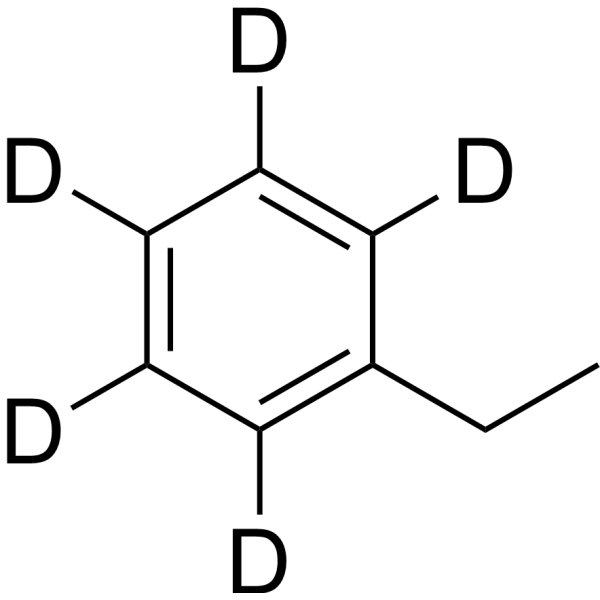
Physicochemical Properties
| Molecular Formula | C8H5D5 |
| Molecular Weight | 111.20 |
| Exact Mass | 111.109 |
| CAS # | 20302-26-5 |
| Related CAS # | 27536-89-6 |
| PubChem CID | 7500 |
| Appearance | Colorless liquid |
| Density | 0.9±0.1 g/cm3 |
| Boiling Point | 136.2±3.0 °C at 760 mmHg |
| Melting Point |
-139 °F (NTP, 1992) -94.95 °C -95 °C -139 °F -139 °F |
| Flash Point | 22.2±0.0 °C |
| Vapour Pressure | 9.2±0.1 mmHg at 25°C |
| Index of Refraction | 1.497 |
| LogP | 3.21 |
| Hydrogen Bond Donor Count | 0 |
| Hydrogen Bond Acceptor Count | 0 |
| Rotatable Bond Count | 1 |
| Heavy Atom Count | 8 |
| Complexity | 51.1 |
| Defined Atom Stereocenter Count | 0 |
| SMILES | C1=CC=C(C(C([2H])([2H])[2H])([2H])[2H])C=C1 |
| InChi Key | YNQLUTRBYVCPMQ-UHFFFAOYSA-N |
| InChi Code | InChI=1S/C8H10/c1-2-8-6-4-3-5-7-8/h3-7H,2H2,1H3 |
| Chemical Name | ethylbenzene |
| HS Tariff Code | 2934.99.9001 |
| Storage |
Powder-20°C 3 years 4°C 2 years In solvent -80°C 6 months -20°C 1 month |
| Shipping Condition | Room temperature (This product is stable at ambient temperature for a few days during ordinary shipping and time spent in Customs) |
Biological Activity
| ln Vitro | Drug compounds have included stable heavy isotopes of carbon, hydrogen, and other elements, mostly as quantitative tracers while the drugs were being developed. Because deuteration may have an effect on a drug's pharmacokinetics and metabolic properties, it is a cause for concern [1]. |
| ADME/Pharmacokinetics |
Absorption, Distribution and Excretion Human exposure to ethylbenzene occurs mainly by inhalation; 40-60% of inhaled ethylbenzene is retained in the lung. Three lab technicians exposed to 42 ppm & 1 to 34 ppm had avg steady state blood levels of 0.72 + or - 0.11 mg/L. 30 Min after exposure concn had dropped to approx 0.5% of original values. After exposure to 112-156 mg/l (aq) the skin absorption rate in humans (n= 14) was 0.11 to 0.21 mg/sq m/hr. When administered sc to 40 rats (2.5 ml, 1:1 v/v), ethylbenzene was detected in the blood within 2 hours, and the levels of ethylbenzene (10-15 ppm in blood) were maintained for at least 16 hours. For more Absorption, Distribution and Excretion (Complete) data for ETHYLBENZENE (6 total), please visit the HSDB record page. Metabolism / Metabolites Ethylbenzene is extensively metabolized, mainly to mandelic and phenylglyoxylic acids. These urinary metabolites can be used to monitor human exposures. Ethyl benzene in man is metabolized 64% to mandelic and 25% to phenylglyoxylic acid and excreted into urine. It is metabolized mainly in the liver through hydroxylation followed by conjugation and excretion of the metabolites in the urine. Major metabolites in rats are hippuric and benzoic acids (38%), 1-phenylethanol (25%), mandelic acid (15-23%), and phenylglyoxylic acid (10%). ... Major metabolites in humans are mandelic acid (65-70%) and phenylglyoxylic acid (20-25%). Female assistants using mixture of xylenes & ethylbenzene as solvent in histology lab were exam. Avg air concn of (m + p)-xylene & ethylbenzene was between 56-68 & 34-41 ppm. Approx 1.1 to 1.4% of retained ethylbenzene was metabolized to 2-ethyl-phenol. For more Metabolism/Metabolites (Complete) data for ETHYLBENZENE (11 total), please visit the HSDB record page. Ethylbenzene is metabolized mainly through hydroxylation and then through conjugation reactions from which numerous metabolites have been isolated. Hydroxylation of ethylbenzene to 1-phenylethanol is catalyzed by cytochrome P-450 isoforms CYP2E1 and CYP2B6. 1-Phenylethanol is conjugated to glucuronide, which then is either excreted or converted to subsequent metabolites. Oxidation of 1-phenylethanol yields acetophenone, which is both excreted in the urine as a minor metabolite and further transformed. Continued oxidation of the side chain leads to the sequential formation of 2-hydroxyacetophenone, 1-phenyl-1,2-ethanediol, mandelic acid, and phenylglyoxylic acid. Minor pathways (e.g., ring hydroxylation) include glucuronide and sulfate conjugation with hydroxylated derivatives to form glucuronides and sulfates that are excreted in the urine. In humans exposed via inhalation, the major metabolites of ethylbenzene in the urine are mandelic acid (70%) and phenylglyoxylic acid (25%). Following dermal exposure of humans, however, excretion of mandelic acid was shown to be only 4.6% of the absorbed dose, which may indicate differences in the metabolic fate between inhalation and dermal exposure routes. (L311) Biological Half-Life Whole body: biphasic with initial of 3.1 hours and slower phase of 25 hours; [TDR, p. 631] |
| Toxicity/Toxicokinetics |
Toxicity Summary IDENTIFICATION AND USE: Ethylbenzene is a colorless liquid with aromatic odor. It is used as an intermediate for the manufacture of the styrene monomer and as a resin solvent. It is also used as a component of automotive and aviation fuels. HUMAN EXPOSURE AND TOXICITY: Human exposure to ethylbenzene occurs mainly by inhalation. Ethylbenzene has low acute and chronic toxicity for humans. It is toxic to the central nervous system and is an irritant of mucous membranes and the eyes. Ethylbenzene vapor has a transient irritant effect on human eyes at 200 ppm in air. At 1000 ppm on the first exposure it is very irritating and causes tearing, but tolerance rapidly develops. At 2000 ppm eye irritation and lacrimation are immediate and severe; 5000 ppm causes intolerable irritation of the eyes and nose. Volunteers reported irritation and chest constriction after acute-duration exposures to 2,000 ppm ethylbenzene. These symptoms worsened as the concentration was increased to 5,000 ppm. Human exposures in the range of 2,000-5,000 ppm ethylbenzene were associated with dizziness and vertigo. Complete recovery occurs if exposure is not prolonged. Ethylbenzene exposure might be associated with hearing loss, neurobehavioral function impairment, and imbalance of neurotransmitters. Ethylbenzene is an inducer of liver microsomal enzymes. ANIMAL STUDIES: Drop application to rabbit eyes caused slight irritation and no corneal injury demonstrable by fluorescein staining. Standard testing on rabbit eyes gave an injury grade of 2 on a scale of 10. Eye irritation and lacrimation have been observed after acute-duration exposures in rats, mice, and guinea pigs exposed to >/= 1,000 ppm ethylbenzene. Lacrimation was observed in rats exposed to 382 ppm for 4 weeks. In contrast, no ocular effects were seen in rats or mice after a 13-week exposure to 975 ppm ethylbenzene. Mild irritation, reddening, exfoliation, and blistering have been reported in rabbits when ethylbenzene was applied directly on the skin. Slight irritation of the eye and corneal injuries were observed in rabbits when ethylbenzene was instilled onto the eyes. A 50% respiratory depression was observed in mice exposed to >/= 1,432 ppm for 5-30 minutes. Results of 4- and 13-week studies indicate that intermediate-duration oral exposure to ethylbenzene produces effects to the liver. Acute-duration and intermediate-duration studies in animals suggest that the auditory system is a sensitive target of ethylbenzene toxicity. Significant losses of outer hair cells in the organ of Corti have been observed in rats after acute-duration exposure >/= 400 ppm and intermediate-duration inhalation exposure to >/= 200 ppm ethylbenzene. Guinea pigs exposed to sublethal concentrations of ethylbenzene (Changes in the integrity of the cell membrane after partitioning of ethylbenzene into the lipid bilayer may subsequently affect the function of membrane, particularly as a barrier and in energy transduction, and in the formation of a matrix for proteins and enzymes. Ethybenzene inhibits the activity of the astrocytic membrane ATPases, which helps regulate adequate intercellular levels of ions, nutrients, metabolic intermediates and precursors in the central nervous system. Thus, this may disturb the ability of the cells to maintain homeostasis. (L311, A186) Toxicity Data LCLo (rat) = 4,000 ppm/4H LD50: 3.5 g/kg (Oral, Rat) (L324) LD50: 77.4 g/kg (Dermal, Rabbit)(L324) LC50: 17.2 g/m3 (4000 ppm) (Inhalation, Rat) (L324) Interactions Urinary biomarkers are widely used among biomonitoring studies because of their ease of collection and nonintrusiveness. Chloroform and TEX (i.e., toluene, ethylbenzene, and m-xylene) are chemicals that are often found together because of common use. Although interactions occurring among TEX are well-known, no information exists on possible kinetic interactions between these chemicals and chloroform at the level of parent compound or urinary biomarkers. The objective of this study was therefore to study the possible interactions between these compounds in human volunteers with special emphasis on the potential impact on urinary biomarkers. Five male volunteers were exposed by inhalation for 6 hr to single, binary, and quaternary mixtures that included chloroform. Exhaled air and blood samples were collected and analyzed for parent compound concentrations. Urinary biomarkers (o-cresol, mandelic, and m-methylhippuric acids) were quantified in urine samples. Published PBPK model for chloroform was used, and a Vmax of 3.4 mg/hr/kg was optimized to provide a better fit with blood data. Adapted PBPK models from our previous study were used for parent compounds and urinary biomarkers for TEX. Binary exposures with chloroform resulted in no significant interactions. Experimental data for quaternary mixture exposures were well predicted by PBPK models using published description of competitive inhibition among TEX components. However, no significant interactions were observed at levels used in this study. PBPK models for urinary biomarkers proved to be a good tool in quantifying exposure to VOC. In lab assistants using xylenes & ethylbenzene, 2,4-dimethylphenol, metab of m-xylene could not be detected. Competitive reaction between xylenes & ethylbenzene prevented m-xylene from oxidation. ... A study of workers exposed occupationally to solvent mixtures that include ethylbenzene (mean exposure level 1.8 ppm) showed a 58% incidence of hearing loss compared to 36% in the reference (unexposed) group. The role of ethylbenzene in the observed losses cannot be ascertained from this study given that ethylbenzene was only one of several solvents, most of which were present at mean concentrations 1.5- 3.5 times higher than ethylbenzene. Consistent with the outcome of occupational studies showing hearing loss, significant and persistent adverse auditory effects have been shown in animals after acute- and intermediate-duration inhalation exposures to ethylbenzene and after acute-duration oral exposures. Non-Human Toxicity Values LD50 Rat oral 5.46 g/kg. LD50 Rat oral 3500 mg/kg LD50 Mouse ip 2272 mg/kg LD50 Rabbit skin 17,800 mg/kg |
| References |
[1]. Impact of Deuterium Substitution on the Pharmacokinetics of Pharmaceuticals. Ann Pharmacother. 2019 Feb;53(2):211-216. |
| Additional Infomation |
Ethylbenzene is a colorless, flammable liquid that smells like gasoline. It is found in natural products such as coal tar and petroleum and is also found in manufactured products such as inks, insecticides, and paints. Ethylbenzene is used primarily to make another chemical, styrene. Other uses include as a solvent, in fuels, and to make other chemicals. Ethylbenzene can cause cancer according to The World Health Organization's International Agency for Research on Cancer (IARC). Ethylbenzene appears as a clear colorless liquid with an aromatic odor. Flash point 59 °F. Less dense than water (at 7.2 lb / gal) and insoluble in water. Hence floats on water. Vapors heavier than air. Used as a solvent and to make other chemicals. Polyethylbenzene appears as a clear colorless liquid with a petroleum-like odor. Less dense than water and insoluble in water. Hence floats on water. Vapors are heavier than air. Ethylbenzene is an alkylbenzene carrying an ethyl substituent. It is a constituent of coal tar and petroleum. Ethylbenzene is mainly used in the manufacture of styrene. Acute (short-term) exposure to ethylbenzene in humans results in respiratory effects, such as throat irritation and chest constriction, irritation of the eyes, and neurological effects such as dizziness. Chronic (long-term) exposure to ethylbenzene by inhalation in humans has shown conflicting results regarding its effects on the blood. Animal studies have reported effects on the blood, liver, and kidneys from chronic inhalation exposure to ethylbenzene. Limited information is available on the carcinogenic effects of ethylbenzene in humans. In a study by the National Toxicology Program (NTP), exposure to ethylbenzene by inhalation resulted in an increased incidence of kidney and testicular tumors in rats, and lung and liver tumors in mice. EPA has classified ethylbenzene as a Group D, not classifiable as to human carcinogenicity. Ethylbenzene has been reported in Basella alba, Oecophylla smaragdina, and other organisms with data available. Ethylbenzene is an aromatic hydrocarbon composed of a benzene ring linked to an ethyl group. Ethylbenzene is a constituent of petroleum and coal tar and is used as either a petroleum additive or a chemical intermediate in the production of polystyrene. High level exposure to airborne ethylbenzene is associated with eye and throat irritation. Ethylbenzene is an organic compound with the formula C6H5CH2CH3. This aromatic hydrocarbon is important in the petrochemical industry as an intermediate in the production of styrene, which in turn is used for making polystyrene, a commonly used plastic material. Although often present in small amounts in crude oil, ethylbenzene is produced in bulk quantities by combining benzene and ethylene in an acid-catalyzed chemical reaction. It is one ingredient of cigarette. The acute toxicity of ethylbenzene is low, with an LD50 of about 4 grams per kilogram of body weight. The longer term toxicity and carcinogenicity is ambiguous. Eye and throat sensitivity can occur when high level exposure to ethylbenzene in the air occurs. At higher level exposure, ethylbenzene can cause dizziness. See also: Benzene, toluene, ethylbenzene and xylene (component of); Aromatic hydrocarbons, C12-20 (annotation moved to); Benzene, ethyl-, benzylated (annotation moved to). |
Solubility Data
| Solubility (In Vitro) | May dissolve in DMSO (in most cases), if not, try other solvents such as H2O, Ethanol, or DMF with a minute amount of products to avoid loss of samples |
| Solubility (In Vivo) |
Note: Listed below are some common formulations that may be used to formulate products with low water solubility (e.g. < 1 mg/mL), you may test these formulations using a minute amount of products to avoid loss of samples. Injection Formulations (e.g. IP/IV/IM/SC) Injection Formulation 1: DMSO : Tween 80: Saline = 10 : 5 : 85 (i.e. 100 μL DMSO stock solution → 50 μL Tween 80 → 850 μL Saline) *Preparation of saline: Dissolve 0.9 g of sodium chloride in 100 mL ddH ₂ O to obtain a clear solution. Injection Formulation 2: DMSO : PEG300 :Tween 80 : Saline = 10 : 40 : 5 : 45 (i.e. 100 μL DMSO → 400 μLPEG300 → 50 μL Tween 80 → 450 μL Saline) Injection Formulation 3: DMSO : Corn oil = 10 : 90 (i.e. 100 μL DMSO → 900 μL Corn oil) Example: Take the Injection Formulation 3 (DMSO : Corn oil = 10 : 90) as an example, if 1 mL of 2.5 mg/mL working solution is to be prepared, you can take 100 μL 25 mg/mL DMSO stock solution and add to 900 μL corn oil, mix well to obtain a clear or suspension solution (2.5 mg/mL, ready for use in animals). Injection Formulation 4: DMSO : 20% SBE-β-CD in saline = 10 : 90 [i.e. 100 μL DMSO → 900 μL (20% SBE-β-CD in saline)] *Preparation of 20% SBE-β-CD in Saline (4°C,1 week): Dissolve 2 g SBE-β-CD in 10 mL saline to obtain a clear solution. Injection Formulation 5: 2-Hydroxypropyl-β-cyclodextrin : Saline = 50 : 50 (i.e. 500 μL 2-Hydroxypropyl-β-cyclodextrin → 500 μL Saline) Injection Formulation 6: DMSO : PEG300 : castor oil : Saline = 5 : 10 : 20 : 65 (i.e. 50 μL DMSO → 100 μLPEG300 → 200 μL castor oil → 650 μL Saline) Injection Formulation 7: Ethanol : Cremophor : Saline = 10: 10 : 80 (i.e. 100 μL Ethanol → 100 μL Cremophor → 800 μL Saline) Injection Formulation 8: Dissolve in Cremophor/Ethanol (50 : 50), then diluted by Saline Injection Formulation 9: EtOH : Corn oil = 10 : 90 (i.e. 100 μL EtOH → 900 μL Corn oil) Injection Formulation 10: EtOH : PEG300:Tween 80 : Saline = 10 : 40 : 5 : 45 (i.e. 100 μL EtOH → 400 μLPEG300 → 50 μL Tween 80 → 450 μL Saline) Oral Formulations Oral Formulation 1: Suspend in 0.5% CMC Na (carboxymethylcellulose sodium) Oral Formulation 2: Suspend in 0.5% Carboxymethyl cellulose Example: Take the Oral Formulation 1 (Suspend in 0.5% CMC Na) as an example, if 100 mL of 2.5 mg/mL working solution is to be prepared, you can first prepare 0.5% CMC Na solution by measuring 0.5 g CMC Na and dissolve it in 100 mL ddH2O to obtain a clear solution; then add 250 mg of the product to 100 mL 0.5% CMC Na solution, to make the suspension solution (2.5 mg/mL, ready for use in animals). Oral Formulation 3: Dissolved in PEG400 Oral Formulation 4: Suspend in 0.2% Carboxymethyl cellulose Oral Formulation 5: Dissolve in 0.25% Tween 80 and 0.5% Carboxymethyl cellulose Oral Formulation 6: Mixing with food powders Note: Please be aware that the above formulations are for reference only. InvivoChem strongly recommends customers to read literature methods/protocols carefully before determining which formulation you should use for in vivo studies, as different compounds have different solubility properties and have to be formulated differently. (Please use freshly prepared in vivo formulations for optimal results.) |
| Preparing Stock Solutions | 1 mg | 5 mg | 10 mg | |
| 1 mM | 8.9928 mL | 44.9640 mL | 89.9281 mL | |
| 5 mM | 1.7986 mL | 8.9928 mL | 17.9856 mL | |
| 10 mM | 0.8993 mL | 4.4964 mL | 8.9928 mL |