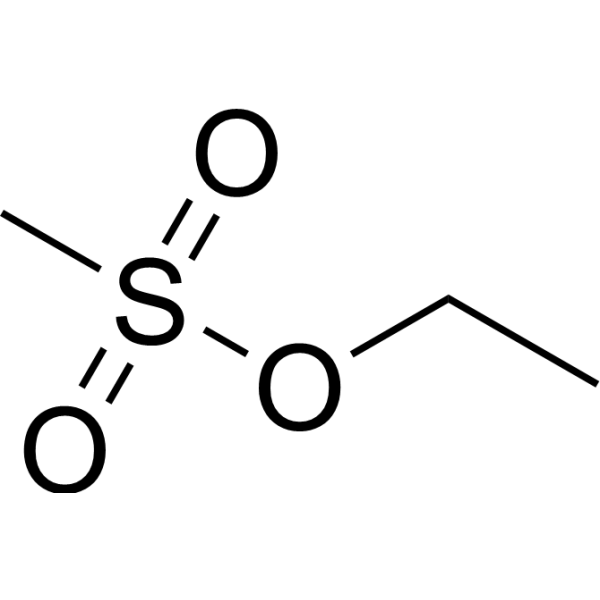
Physicochemical Properties
| Molecular Formula | C3H8O3S |
| Molecular Weight | 124.15 |
| Exact Mass | 124.019 |
| CAS # | 62-50-0 |
| Related CAS # | Ethyl methanesulfonate-d5;1219795-44-4 |
| PubChem CID | 6113 |
| Appearance | Colorless to light yellow liquid |
| Density | 1.2±0.1 g/cm3 |
| Boiling Point | 214.4±9.0 °C at 760 mmHg |
| Melting Point | < 25ºC |
| Flash Point | 100.0±0.0 °C |
| Vapour Pressure | 0.2±0.4 mmHg at 25°C |
| Index of Refraction | 1.416 |
| LogP | -0.03 |
| Hydrogen Bond Donor Count | 0 |
| Hydrogen Bond Acceptor Count | 3 |
| Rotatable Bond Count | 2 |
| Heavy Atom Count | 7 |
| Complexity | 118 |
| Defined Atom Stereocenter Count | 0 |
| SMILES | S(C([H])([H])[H])(=O)(=O)OC([H])([H])C([H])([H])[H] |
| InChi Key | PLUBXMRUUVWRLT-UHFFFAOYSA-N |
| InChi Code | InChI=1S/C3H8O3S/c1-3-6-7(2,4)5/h3H2,1-2H3 |
| Chemical Name | ethyl methanesulfonate |
| HS Tariff Code | 2934.99.9001 |
| Storage |
Powder-20°C 3 years 4°C 2 years In solvent -80°C 6 months -20°C 1 month |
| Shipping Condition | Room temperature (This product is stable at ambient temperature for a few days during ordinary shipping and time spent in Customs) |
Biological Activity
| ADME/Pharmacokinetics |
Absorption, Distribution and Excretion ... Is rapidly distributed in the mammalian system and increases the excretion of methylnicotinamide. Metabolism / Metabolites ... IS METAB ... BY REACTION WITH GLUTATHIONE TO GIVE ETHYLMERCAPTURIC ACID, & BY HYDROLYSIS TO ETHANOL ... . Biological Half-Life ... HALF-LIFE IN RAT BLOOD SERUM ... 6.5 HR. |
| Toxicity/Toxicokinetics |
Interactions The antimutagenic effects of vitamins C, E, and A, and derivatives of vitamin C on ethyl methanesulfonate induced 6TG resistant mutations in Chinese hamster V79 cells were examined. Vitamin C was most effective in inhibiting ethyl methanesulfonate cytotoxicity and 6TG resistant mutations. In the presence of vitamin C at a concentration of 100 micrograms/ml, ethyl methanesulfonate induced mutations were reduced to about one-third or one-forth of those in control cultures treated with ethyl methanesulfonate alone. Dehydro-vitamin C and iso-vitamin C also inhibited ethyl methanesulfonate induced mutations to about ... one-half or one-third of the control level. ... Vitamin C may react directly with ethyl methanesulfonate as a desmutagen and thus inactivate its mutation-inducing activity in Chinese hamster V79 cells. Vitamin E had an additive cytotoxic effect on EMS-induced cytotoxicity. This vitamin enhanced the frequencies of 6TG-resistant mutations induced by ethyl methanesulfonate. Pretreatment with vitamin E before treatment with ethyl methanesulfonate resulted in no detectable effect in modifying the ethyl methanesulfonate induced mutations. On the contrary, vitamin A markedly enhanced ethyl methanesulfonate induced mutation frequencies. The 1,4-dihydropyridine derivative 2,6-dimethyl-3,5-diethoxycarbonyl-4-(sodium carboxylate)-1,4-dihydropyridine was studied for antimutagenic effect in the dominant lethal test and in the sex-linked recessive lethal test of Drosophila melanogaster. ... 1,4-dihydropyridine reduces the frequency of ethyl methanesulfate induced genetic damage (point mutations and chromosome breakage). A reduction of the mutation rate induced by ethyl methanesulfate in adults could be observed independently of the developmental stages (larvae or imago) pretreated with 1,4-dihydropyridine. The protective effect of this ... antimutagen against the alkylating agent depended on both the 1,4-dihydropyridine dose and the level of the ethyl methanesulfonate induced mutation rate. The effect of 1,4-dihydropyridine was more pronounced than that of /cysteine and cysteamine/. Rat and canine hepatocyte suspensions were exposed to toxic concentrations of ethyl methanesulfonate (EMS) and ionophore A-23187 in the presence and absence of extracellular calcium (Ca2+) and alpha-tocopheryl succinate (alpha-TS). The exogenous administration of alpha-TS (25 microM) completely protected hepatocytes from chemically- induced toxicity when exposed to physiological free extracellular calcium concentrations (0.8-1.5 mM). ... Hepatocytes exposed to unesterified alpha- tocopherol (alpha-T, 25 microM) or alpha-tocopheryl acetate (alpha-TA, 25 microM), however, were not protected from the toxic effect of chemicals even though these treatments resulted in the marked accumulation of cellular alpha-T (2.65 nml/10(6) cells) and alpha-TA (2.3 nmol/10(6) cells), respectively. Finding suggest that the supplementation of endogenous stores of alpha-T or alpha-TA does not promote protection against chemical toxicity and that alpha-TS cytoprotection results not from the accumulation of alpha-T but rather from the cellular presence of the intact alpha-TS molecule. Thus alpha-TS appears to possess cytoprotective properties that differ from other vitamin E congeners. The combination of EMS and aureomycin was highly cytotoxic, but EMS alone inhibited the mitosis in Vicia fabia. For more Interactions (Complete) data for ETHYL METHANESULFONATE (7 total), please visit the HSDB record page. Non-Human Toxicity Values LD50 Mouse oral 470 mg/kg |
| Additional Infomation |
Ethyl Methanesulfonate can cause cancer according to an independent committee of scientific and health experts. Ethyl methanesulfonate is a clear colorless liquid. Denser than water. (NTP, 1992) Ethyl methanesulfonate is a methanesulfonate ester resulting from the formal condensation of methanesulfonic acid with ethanol. It has a role as an alkylating agent, an antineoplastic agent, a carcinogenic agent, a genotoxin, a mutagen and a teratogenic agent. Ethyl methanesulfonate has been reported in Arabidopsis thaliana with data available. Ethyl Methanesulfonate is a sulfonoxyalkane with carcinogenic and teratogenic properties. Ethyl methanesulfonate ethylates DNA, thereby damaging DNA and leading to genetic mutations, single-stranded breaks in DNA, and chromosomal aberrations. Ethyl methanesulfonate may be used experimentally in biomedical research. (NCI04) An antineoplastic agent with alkylating properties. It also acts as a mutagen by damaging DNA and is used experimentally for that effect. Mechanism of Action /GENOTOXICITY/ The relative importance of different sites of alkylation on DNA was determined by comparing two ethylating agents. 1-Ethyl-1-nitrosourea ethylates DNA with a higher proportion of total adducts on ring oxygens than ethyl methanesulfonate, which ethylates with a higher proportion of total adducts on the N-7 of guanine. ... To determine the importance in germ-line mutagenesis of the O6-G site relative to the N-7 of guanine, dose-response curves were constructed for both 1-ethyl-1-nitrosourea and ethyl methanesulfonate, where dose was measured as total adducts per deoxynucleotide and response as sex-linked recessive lethals induced in Drosophila melanogaster spermatozoa. For both mutagens the dose response curve was linear and extrapolated to the origin. ... 1-Ethyl-1-nitrosourea is 1.9 times more efficient per adduct in inducing sex-linked recessive lethals mutations than EMS. In vitro studies showed that 1-ethyl-1-nitrosourea induced 9.5% of its total adducts on O6-G while EMS induced 2.0% of its adducts on O6-G. If O6-G was the sole genotoxic site, then 1-ethyl-1-nitrosourea should be 4.8 times more efficient per adduct than ethyl methanesulfonate. ... While O6-G was the principal genotoxic site, N-7 G made a significant contribution to germ-line mutagenesis. |
Solubility Data
| Solubility (In Vitro) | DMSO: ≥ 100 mg/mL (805.48 mM) |
| Solubility (In Vivo) |
Solubility in Formulation 1: ≥ 2.5 mg/mL (20.14 mM) (saturation unknown) in 10% DMSO + 40% PEG300 + 5% Tween80 + 45% Saline (add these co-solvents sequentially from left to right, and one by one), clear solution. For example, if 1 mL of working solution is to be prepared, you can add 100 μL of 25.0 mg/mL clear DMSO stock solution to 400 μL PEG300 and mix evenly; then add 50 μL Tween-80 to the above solution and mix evenly; then add 450 μL normal saline to adjust the volume to 1 mL. Preparation of saline: Dissolve 0.9 g of sodium chloride in 100 mL ddH₂ O to obtain a clear solution. Solubility in Formulation 2: ≥ 2.5 mg/mL (20.14 mM) (saturation unknown) in 10% DMSO + 90% (20% SBE-β-CD in Saline) (add these co-solvents sequentially from left to right, and one by one), clear solution. For example, if 1 mL of working solution is to be prepared, you can add 100 μL of 25.0 mg/mL clear DMSO stock solution to 900 μL of 20% SBE-β-CD physiological saline solution and mix evenly. Preparation of 20% SBE-β-CD in Saline (4°C,1 week): Dissolve 2 g SBE-β-CD in 10 mL saline to obtain a clear solution. Solubility in Formulation 3: ≥ 2.5 mg/mL (20.14 mM) (saturation unknown) in 10% DMSO + 90% Corn Oil (add these co-solvents sequentially from left to right, and one by one), clear solution. For example, if 1 mL of working solution is to be prepared, you can add 100 μL of 25.0 mg/mL clear DMSO stock solution to 900 μL of corn oil and mix evenly. (Please use freshly prepared in vivo formulations for optimal results.) |
| Preparing Stock Solutions | 1 mg | 5 mg | 10 mg | |
| 1 mM | 8.0548 mL | 40.2739 mL | 80.5477 mL | |
| 5 mM | 1.6110 mL | 8.0548 mL | 16.1095 mL | |
| 10 mM | 0.8055 mL | 4.0274 mL | 8.0548 mL |