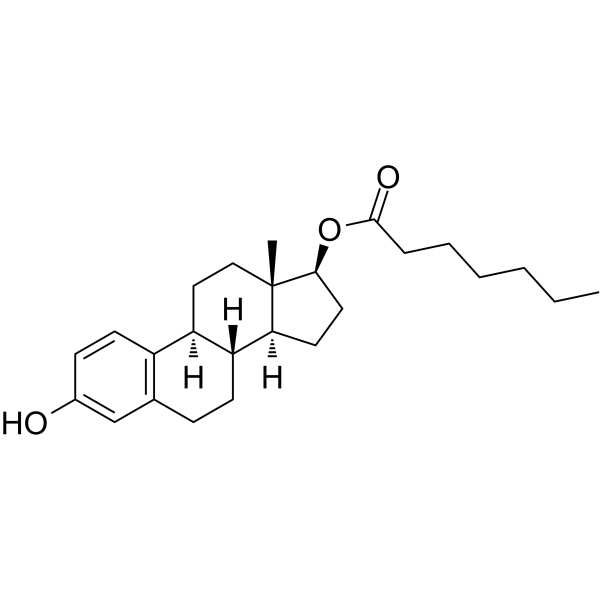
Physicochemical Properties
| Molecular Formula | C25H36O3 |
| Molecular Weight | 384.55 |
| Exact Mass | 384.266 |
| CAS # | 4956-37-0 |
| Related CAS # | Estradiol;50-28-2;Estradiol (cypionate);313-06-4;Estradiol benzoate;50-50-0 |
| PubChem CID | 21070 |
| Appearance | White to off-white solid powder |
| Density | 1.1±0.1 g/cm3 |
| Boiling Point | 509.5±50.0 °C at 760 mmHg |
| Melting Point | 94-96ºC |
| Flash Point | 197.1±22.9 °C |
| Vapour Pressure | 0.0±1.4 mmHg at 25°C |
| Index of Refraction | 1.560 |
| LogP | 7.68 |
| Hydrogen Bond Donor Count | 1 |
| Hydrogen Bond Acceptor Count | 3 |
| Rotatable Bond Count | 7 |
| Heavy Atom Count | 28 |
| Complexity | 546 |
| Defined Atom Stereocenter Count | 5 |
| SMILES | CCCCCCC(=O)O[C@H]1CC[C@@H]2[C@@]1(CC[C@H]3[C@H]2CCC4=C3C=CC(=C4)O)C |
| InChi Key | RFWTZQAOOLFXAY-BZDYCCQFSA-N |
| InChi Code | InChI=1S/C25H36O3/c1-3-4-5-6-7-24(27)28-23-13-12-22-21-10-8-17-16-18(26)9-11-19(17)20(21)14-15-25(22,23)2/h9,11,16,20-23,26H,3-8,10,12-15H2,1-2H3/t20-,21-,22+,23+,25+/m1/s1 |
| Chemical Name | [(8R,9S,13S,14S,17S)-3-hydroxy-13-methyl-6,7,8,9,11,12,14,15,16,17-decahydrocyclopenta[a]phenanthren-17-yl] heptanoate |
| Synonyms | ESTRADIOL ENANTHATE; 4956-37-0; Oestradiol 17-heptanoate; Estradiol Enantate; Estradiol 17-heptanoate; Estradiol enanthate [USAN]; SQ 16,150; PAP315WZIA; |
| HS Tariff Code | 2934.99.9001 |
| Storage |
Powder-20°C 3 years 4°C 2 years In solvent -80°C 6 months -20°C 1 month Note: Please store this product in a sealed and protected environment (e.g. under nitrogen), avoid exposure to moisture and light. |
| Shipping Condition | Room temperature (This product is stable at ambient temperature for a few days during ordinary shipping and time spent in Customs) |
Biological Activity
| Targets | ER |
| ln Vivo | Introduction: This study compared two regimens of a monthly injectable contraceptive containing dihydroxyprogesterone acetophenide 150 mg and estradiol enanthate 10 mg (Perlutan) over 12 cycles of use. Methods: Three hundred sixty-five adolescents were randomized into two groups. The patients in Group 1 received an initial injection of Perlutan on the 1st-5th day of their menstrual cycle and subsequent injections every 30 +/- 3 days, whereas those in Group 2 followed the traditional schedule of administration in which the first injection is administered between Days 7 and 10 of their menstrual cycle and subsequent injections 7-10 days after Day 1 of withdrawal bleeding. This schedule may result in an irregularity in the timing of injections. Results: No significant difference was found between the two groups regarding tolerability or pregnancy (two in Group 1 and three in Group 2). Conclusion: Monthly administration limits the annual number of injections to a maximum of 12, thus frequently reducing the total annual dose while maintaining efficacy and tolerability similar to those obtained with the traditional regimen.[1] |
| Animal Protocol | Monthly injectable steroid contraceptives which contained the long-acting progestogen dihydroxyprogesterone acetofenide plus a shorter-acting estrogen (usually estradiol enanthate) were used by women in two of the countries (Chile and Mexico) from which data were collected. In preliminary analyses of data from Chile (1979-1983), a strong association was observed between use of these products and invasive cervical cancer. Therefore, three additional data sets from these two countries were analyzed in further detail for this report. Analyses of additional data from Chile on invasive cervical cancer (1983-1985) and cervical carcinoma in situ (1979-1986) and of data on invasive cervical cancer from Mexico (1979-1986) failed to confirm the initially observed association. The original finding was probably due to chance, but a causal interpretation cannot be confidently ruled out, and additional studies are warranted.[2] |
| References |
[1]. Comparison of two regimens of a monthly injectable contraceptive containing dihydroxyprogesterone acetophenide and estradiol enanthate. Contraception. 2006;73(3):249-252. [2]. Monthly injectable steroid contraceptives and cervical carcinoma. Am J Epidemiol. 1989;130(2):237-247. |
| Additional Infomation | Estradiol enanthate is a steroid ester. |
Solubility Data
| Solubility (In Vitro) | DMSO: 125 mg/mL (325.06 mM) |
| Solubility (In Vivo) |
Note: Listed below are some common formulations that may be used to formulate products with low water solubility (e.g. < 1 mg/mL), you may test these formulations using a minute amount of products to avoid loss of samples. Injection Formulations (e.g. IP/IV/IM/SC) Injection Formulation 1: DMSO : Tween 80: Saline = 10 : 5 : 85 (i.e. 100 μL DMSO stock solution → 50 μL Tween 80 → 850 μL Saline) *Preparation of saline: Dissolve 0.9 g of sodium chloride in 100 mL ddH ₂ O to obtain a clear solution. Injection Formulation 2: DMSO : PEG300 :Tween 80 : Saline = 10 : 40 : 5 : 45 (i.e. 100 μL DMSO → 400 μLPEG300 → 50 μL Tween 80 → 450 μL Saline) Injection Formulation 3: DMSO : Corn oil = 10 : 90 (i.e. 100 μL DMSO → 900 μL Corn oil) Example: Take the Injection Formulation 3 (DMSO : Corn oil = 10 : 90) as an example, if 1 mL of 2.5 mg/mL working solution is to be prepared, you can take 100 μL 25 mg/mL DMSO stock solution and add to 900 μL corn oil, mix well to obtain a clear or suspension solution (2.5 mg/mL, ready for use in animals). Injection Formulation 4: DMSO : 20% SBE-β-CD in saline = 10 : 90 [i.e. 100 μL DMSO → 900 μL (20% SBE-β-CD in saline)] *Preparation of 20% SBE-β-CD in Saline (4°C,1 week): Dissolve 2 g SBE-β-CD in 10 mL saline to obtain a clear solution. Injection Formulation 5: 2-Hydroxypropyl-β-cyclodextrin : Saline = 50 : 50 (i.e. 500 μL 2-Hydroxypropyl-β-cyclodextrin → 500 μL Saline) Injection Formulation 6: DMSO : PEG300 : castor oil : Saline = 5 : 10 : 20 : 65 (i.e. 50 μL DMSO → 100 μLPEG300 → 200 μL castor oil → 650 μL Saline) Injection Formulation 7: Ethanol : Cremophor : Saline = 10: 10 : 80 (i.e. 100 μL Ethanol → 100 μL Cremophor → 800 μL Saline) Injection Formulation 8: Dissolve in Cremophor/Ethanol (50 : 50), then diluted by Saline Injection Formulation 9: EtOH : Corn oil = 10 : 90 (i.e. 100 μL EtOH → 900 μL Corn oil) Injection Formulation 10: EtOH : PEG300:Tween 80 : Saline = 10 : 40 : 5 : 45 (i.e. 100 μL EtOH → 400 μLPEG300 → 50 μL Tween 80 → 450 μL Saline) Oral Formulations Oral Formulation 1: Suspend in 0.5% CMC Na (carboxymethylcellulose sodium) Oral Formulation 2: Suspend in 0.5% Carboxymethyl cellulose Example: Take the Oral Formulation 1 (Suspend in 0.5% CMC Na) as an example, if 100 mL of 2.5 mg/mL working solution is to be prepared, you can first prepare 0.5% CMC Na solution by measuring 0.5 g CMC Na and dissolve it in 100 mL ddH2O to obtain a clear solution; then add 250 mg of the product to 100 mL 0.5% CMC Na solution, to make the suspension solution (2.5 mg/mL, ready for use in animals). Oral Formulation 3: Dissolved in PEG400 Oral Formulation 4: Suspend in 0.2% Carboxymethyl cellulose Oral Formulation 5: Dissolve in 0.25% Tween 80 and 0.5% Carboxymethyl cellulose Oral Formulation 6: Mixing with food powders Note: Please be aware that the above formulations are for reference only. InvivoChem strongly recommends customers to read literature methods/protocols carefully before determining which formulation you should use for in vivo studies, as different compounds have different solubility properties and have to be formulated differently. (Please use freshly prepared in vivo formulations for optimal results.) |
| Preparing Stock Solutions | 1 mg | 5 mg | 10 mg | |
| 1 mM | 2.6004 mL | 13.0022 mL | 26.0044 mL | |
| 5 mM | 0.5201 mL | 2.6004 mL | 5.2009 mL | |
| 10 mM | 0.2600 mL | 1.3002 mL | 2.6004 mL |