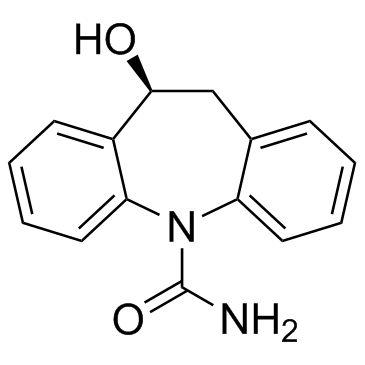
Eslicarbazepine (BIA 2-194; BIA-2194; Aptiom; Zebinix) is a dual inhibitor of voltage-gated sodium channel blocker and β-Secretase approved for use as an antiepileptic drug for partial-onset seizures.
Physicochemical Properties
| Molecular Formula | C15H14N2O2 |
| Molecular Weight | 254.289 |
| Exact Mass | 254.105 |
| CAS # | 104746-04-5 |
| PubChem CID | 9881504 |
| Appearance | White to off-white solid powder |
| Density | 1.3±0.1 g/cm3 |
| Boiling Point | 431.3±55.0 °C at 760 mmHg |
| Melting Point | 188-190°C |
| Flash Point | 214.6±31.5 °C |
| Vapour Pressure | 0.0±1.1 mmHg at 25°C |
| Index of Refraction | 1.677 |
| LogP | 0.93 |
| Hydrogen Bond Donor Count | 2 |
| Hydrogen Bond Acceptor Count | 2 |
| Rotatable Bond Count | 0 |
| Heavy Atom Count | 19 |
| Complexity | 347 |
| Defined Atom Stereocenter Count | 1 |
| SMILES | C1[C@@H](C2=CC=CC=C2N(C3=CC=CC=C31)C(=O)N)O |
| InChi Key | BMPDWHIDQYTSHX-AWEZNQCLSA-N |
| InChi Code | InChI=1S/C15H14N2O2/c16-15(19)17-12-7-3-1-5-10(12)9-14(18)11-6-2-4-8-13(11)17/h1-8,14,18H,9H2,(H2,16,19)/t14-/m0/s1 |
| Chemical Name | (5S)-5-hydroxy-5,6-dihydrobenzo[b][1]benzazepine-11-carboxamide |
| Synonyms | Erelib EC 810-248-9 BIA 2-194BIA2-194BIA-2194Aptiom Zebinix |
| HS Tariff Code | 2934.99.9001 |
| Storage |
Powder-20°C 3 years 4°C 2 years In solvent -80°C 6 months -20°C 1 month |
| Shipping Condition | Room temperature (This product is stable at ambient temperature for a few days during ordinary shipping and time spent in Customs) |
Biological Activity
| ln Vivo | Chemically similar to carbamazepine, escicarbazepine is an anti-epileptic medication with a better safety record. Eslicarbazepine acetate serves as a prodrug for eslicarbazepine (S-licarbazepine), a voltage-gated sodium channel and β-secretase dual inhibitor [1][2]. |
| Toxicity/Toxicokinetics |
Hepatotoxicity In prelicensure clinical trials, addition of eslicarbazepine to standard anticonvulsant therapy was reported to be associated with ALT elevations above 3 times the upper limit of normal (ULN) in a small proportion of patients ( Likelihood score: D (possible rare cause of clinically apparent liver injury). Effects During Pregnancy and Lactation ◉ Summary of Use during Lactation No information is available on the use of eslicarbazepine during breastfeeding. However, eslicarbazepine is the active metabolite of oxcarbazepine. Limited information indicates that oxcarbazepine would not be expected to cause any adverse effects in breastfed infants, especially if the infant is older than 2 months. Monitor the infant for drowsiness, adequate weight gain, and developmental milestones, especially in younger, exclusively breastfed infants and when using combinations of anticonvulsants. ◉ Effects in Breastfed Infants No specific information is available in mothers taking eslicarbazepine. See the LactMed record on oxcarbazepine for relevant information. ◉ Effects on Lactation and Breastmilk Relevant published information was not found as of the revision date. |
| References |
[1]. Patch testing in a case of eslicarbazepine and carbamazepine induced cutaneous reaction. Eur Ann Allergy Clin Immunol. 2018 Sep;50(5):229-231. [2]. Aptiom (Eslicarbazepine Acetate) as a Dual Inhibitor of β-Secretase and Voltage-Gated Sodium Channel: Advancement in Alzheimer's Disease-Epilepsy Linkage via an Enzoinformatics Study. CNS & Neurological Disorders Drug Targets Volume 13 , Issue 7 , 2014. |
| Additional Infomation |
(S)-MHD is a dibenzooxazepine. Eslicarbazepine is an anti-epileptic medication available commercially as [eslicarbazepine acetate]. The mechanism of action of eslicarbazepine is as a Cytochrome P450 3A4 Inducer, and Cytochrome P450 2C19 Inhibitor. The physiologic effect of eslicarbazepine is by means of Decreased Central Nervous System Disorganized Electrical Activity. Eslicarbazepine is an aromatic anticonvulsant similar to oxcarbazepine that is used in combination with other antiepileptic agents as therapy of partial onset seizures. Eslicarbazepine is associated with a low rate of transient serum enzyme elevations during therapy and has been implicated in rare instances of clinically apparent liver injury. See also: Eslicarbazepine Acetate (active moiety of). Mechanism of Action The precise mechanism(s) by which eslicarbazepine exerts anticonvulsant activity is unknown but is thought to involve inhibition of voltage-gated sodium channels. |
Solubility Data
| Solubility (In Vitro) | DMSO : ~250 mg/mL (~983.17 mM) |
| Solubility (In Vivo) |
Solubility in Formulation 1: ≥ 2.08 mg/mL (8.18 mM) (saturation unknown) in 10% DMSO + 40% PEG300 + 5% Tween80 + 45% Saline (add these co-solvents sequentially from left to right, and one by one), clear solution. For example, if 1 mL of working solution is to be prepared, you can add 100 μL of 20.8 mg/mL clear DMSO stock solution to 400 μL PEG300 and mix evenly; then add 50 μL Tween-80 to the above solution and mix evenly; then add 450 μL normal saline to adjust the volume to 1 mL. Preparation of saline: Dissolve 0.9 g of sodium chloride in 100 mL ddH₂ O to obtain a clear solution. Solubility in Formulation 2: ≥ 2.08 mg/mL (8.18 mM) (saturation unknown) in 10% DMSO + 90% (20% SBE-β-CD in Saline) (add these co-solvents sequentially from left to right, and one by one), clear solution. For example, if 1 mL of working solution is to be prepared, you can add 100 μL of 20.8 mg/mL clear DMSO stock solution to 900 μL of 20% SBE-β-CD physiological saline solution and mix evenly. Preparation of 20% SBE-β-CD in Saline (4°C,1 week): Dissolve 2 g SBE-β-CD in 10 mL saline to obtain a clear solution. Solubility in Formulation 3: ≥ 2.08 mg/mL (8.18 mM) (saturation unknown) in 10% DMSO + 90% Corn Oil (add these co-solvents sequentially from left to right, and one by one), clear solution. For example, if 1 mL of working solution is to be prepared, you can add 100 μL of 20.8 mg/mL clear DMSO stock solution to 900 μL of corn oil and mix evenly. (Please use freshly prepared in vivo formulations for optimal results.) |
| Preparing Stock Solutions | 1 mg | 5 mg | 10 mg | |
| 1 mM | 3.9325 mL | 19.6626 mL | 39.3252 mL | |
| 5 mM | 0.7865 mL | 3.9325 mL | 7.8650 mL | |
| 10 mM | 0.3933 mL | 1.9663 mL | 3.9325 mL |