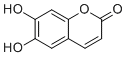
Esculetin is a naturally occuring β-catenin inhibitor found mainly in chicory and other plant sources with antioxidant, antiinflammatory, and antitumor activities. It demonstrates a wide range of activities, such as inhibiting MPTP-induced neurotoxicity and neuronal apoptosis, lowering body weight, triglyceride levels, total cholesterol, and glucose in animals fed a high-fat diet, and repressing colon cancer cell proliferation.
Physicochemical Properties
| Molecular Formula | C9H6O4 |
| Molecular Weight | 178.14154 |
| Exact Mass | 178.026 |
| Elemental Analysis | C, 60.68; H, 3.40; O, 35.92 |
| CAS # | 305-01-1 |
| Related CAS # | 305-01-1 |
| PubChem CID | 5281416 |
| Appearance | Yellow to brown solid powder |
| Density | 1.6±0.1 g/cm3 |
| Boiling Point | 469.7±45.0 °C at 760 mmHg |
| Melting Point | 271-273 °C(lit.) |
| Flash Point | 201.5±22.2 °C |
| Vapour Pressure | 0.0±1.2 mmHg at 25°C |
| Index of Refraction | 1.689 |
| LogP | 0.98 |
| Hydrogen Bond Donor Count | 2 |
| Hydrogen Bond Acceptor Count | 4 |
| Rotatable Bond Count | 0 |
| Heavy Atom Count | 13 |
| Complexity | 248 |
| Defined Atom Stereocenter Count | 0 |
| SMILES | O=C1C=CC2=C(O1)C=C(O)C(O)=C2 |
| InChi Key | ILEDWLMCKZNDJK-UHFFFAOYSA-N |
| InChi Code | InChI=1S/C9H6O4/c10-6-3-5-1-2-9(12)13-8(5)4-7(6)11/h1-4,10-11H |
| Chemical Name | 6,7-dihydroxychromen-2-one |
| Synonyms | CCRIS 7065; CCRIS-7065; CCRIS7065; Cichorigenin; NSC 26428; Asculetine; NSC-26428; NSC26428 |
| HS Tariff Code | 2934.99.9001 |
| Storage |
Powder-20°C 3 years 4°C 2 years In solvent -80°C 6 months -20°C 1 month |
| Shipping Condition | Room temperature (This product is stable at ambient temperature for a few days during ordinary shipping and time spent in Customs) |
Biological Activity
| Targets | PI3K |
| ln Vitro | Esculetin decreases cell proliferation by inducing G1 phase cell cycle arrest, which is associated with the down-regulation of cyclin D1/CDK4 and cyclin E/CDK2 complexes by the activation of p27KIP[2]. Esculetin significantly reduces HCC cell proliferation, with an IC50 value of 2.24 mM, in a concentration- and time-dependent manner. In SMMC-7721 cells, it blocks the cell cycle at the S phase and induces apoptosis with a notable increase in caspase-3 and caspase-9 activity, but it has no effect on caspase-8 activity. Esculetin treatment causes the mitochondrial membrane potential to collapse both in vitro and in vivo, along with an uptick in the transcriptional gene Bax and a decrease in the translational gene Bcl-2 expression. Esculetin inhibits the growth of hepatocellular carcinoma cells both in vitro and in vivo, and its mechanisms involve the start of a mitochondrial-mediated, caspase-dependent apoptosis pathway[3]. |
| ln Vivo | Esculetin significantly decreases tumor growth in mice bearing Hepa1-6 cells. With increasing doses of esculetin, tumor weight is decreased by 20.33, 40.37, and 55.42%. It's important to note that this animal study found no evidence of esculetin's toxicity[3]. At a dose of 5 mg/kg, esculetin exhibits intestinal anti-inflammatory activity in a rat experimental model of inflammatory bowel disease brought on by trinitrobenzenesulfonic acid[4]. |
| Cell Assay | Tests are performed in 96-well plates. For mature adipocytes, cells are seeded (5000 cells/well), grown to confluency, induced to differentiate, and grown to maturation. Preadipocytes are cultured overnight before treatment at a seeding density of 2500 cells per well. For 6, 12, 24, or 48 hours, cells are either incubated with DMSO or esculetin at progressively higher concentrations. The seeding density for the post-confluent preadipocytes is 2500 cells/well, and the cells are grown to confluency prior to treatment. For Days 0 to 2, 2 to 4, and 4 to 6 of adipogenesis, esculletin (100 or 200 M) is added to the induction medium in a carrier containing 0.01% DMSO. Every two days, medium is changed. Cells are treated with 20 μL of the MTS assay solution per well before being washed three times with DMEM/10% FBS before the assay for cell viability. 100 μL of DMEM/10% FBS medium is then added to each well. 25 μL of 10% sodium dodecyl sulfate is then added to each well after cells have been incubated at 37 °C for one hour. To calculate the formazan concentration, which is inversely proportional to the number of live cells, a plate reader is used to measure the absorbance at 490 nm. |
| Animal Protocol |
C57BL/6J mice implanted with Hepa1-6 cells 200, 400, or 700 mg/kg/day i.p |
| References |
[1]. NObesity (Silver Spring) . 2006 Oct;14(10):1691-9. [2]. Oncol Rep . 2011 Jan;25(1):223-30. [3]. Braz J Med Biol Res . 2015 Mar;48(3):245-53. |
| Additional Infomation |
Esculetin is a hydroxycoumarin that is umbelliferone in which the hydrogen at position 6 is substituted by a hydroxy group. It is used in filters for absorption of ultraviolet light. It has a role as an antioxidant, an ultraviolet filter and a plant metabolite. Esculetin has been reported in Caragana frutex, Sonchus fruticosus, and other organisms with data available. |
Solubility Data
| Solubility (In Vitro) | DMSO: 35~125 mg/mL (196.5~701.7 mM) |
| Solubility (In Vivo) |
Solubility in Formulation 1: ≥ 2.08 mg/mL (11.68 mM) (saturation unknown) in 10% DMSO + 40% PEG300 + 5% Tween80 + 45% Saline (add these co-solvents sequentially from left to right, and one by one), clear solution. For example, if 1 mL of working solution is to be prepared, you can add 100 μL of 20.8 mg/mL clear DMSO stock solution to 400 μL PEG300 and mix evenly; then add 50 μL Tween-80 to the above solution and mix evenly; then add 450 μL normal saline to adjust the volume to 1 mL. Preparation of saline: Dissolve 0.9 g of sodium chloride in 100 mL ddH₂ O to obtain a clear solution. Solubility in Formulation 2: ≥ 2.08 mg/mL (11.68 mM) (saturation unknown) in 10% DMSO + 90% (20% SBE-β-CD in Saline) (add these co-solvents sequentially from left to right, and one by one), clear solution. For example, if 1 mL of working solution is to be prepared, you can add 100 μL of 20.8 mg/mL clear DMSO stock solution to 900 μL of 20% SBE-β-CD physiological saline solution and mix evenly. Preparation of 20% SBE-β-CD in Saline (4°C,1 week): Dissolve 2 g SBE-β-CD in 10 mL saline to obtain a clear solution. Solubility in Formulation 3: ≥ 2.08 mg/mL (11.68 mM) (saturation unknown) in 10% DMSO + 90% Corn Oil (add these co-solvents sequentially from left to right, and one by one), clear solution. For example, if 1 mL of working solution is to be prepared, you can add 100 μL of 20.8 mg/mL clear DMSO stock solution to 900 μL of corn oil and mix evenly. (Please use freshly prepared in vivo formulations for optimal results.) |
| Preparing Stock Solutions | 1 mg | 5 mg | 10 mg | |
| 1 mM | 5.6136 mL | 28.0678 mL | 56.1356 mL | |
| 5 mM | 1.1227 mL | 5.6136 mL | 11.2271 mL | |
| 10 mM | 0.5614 mL | 2.8068 mL | 5.6136 mL |