Physicochemical Properties
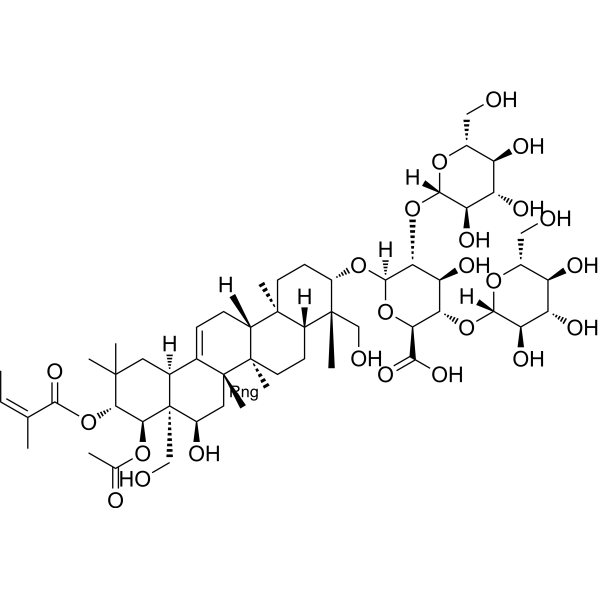
| Molecular Formula | C55H86O24 |
| Molecular Weight | 1131.2570 |
| Exact Mass | 1130.55 |
| CAS # | 26339-90-2 |
| PubChem CID | 6476031 |
| Appearance | White to off-white solid powder |
| Density | 1.5±0.1 g/cm3 |
| Boiling Point | 1140.6±65.0 °C at 760 mmHg |
| Flash Point | 311.8±27.8 °C |
| Vapour Pressure | 0.0±0.6 mmHg at 25°C |
| Index of Refraction | 1.628 |
| LogP | 1.88 |
| Hydrogen Bond Donor Count | 13 |
| Hydrogen Bond Acceptor Count | 24 |
| Rotatable Bond Count | 16 |
| Heavy Atom Count | 79 |
| Complexity | 2300 |
| Defined Atom Stereocenter Count | 27 |
| SMILES | C/C=C(/C)\C(=O)O[C@H]1[C@@H]([C@@]2([C@@H](C[C@@]3(C(=CC[C@H]4[C@]3(CC[C@@H]5[C@@]4(CC[C@@H]([C@]5(C)CO)O[C@H]6[C@@H]([C@H]([C@@H]([C@H](O6)C(=O)O)O[C@H]7[C@@H]([C@H]([C@@H]([C@H](O7)CO)O)O)O)O)O[C@H]8[C@@H]([C@H]([C@@H]([C@H](O8)CO)O)O)O)C)C)[C@@H]2CC1(C)C)C)O)CO)OC(=O)C |
| InChi Key | AXNVHPCVMSNXNP-OXPBSUTMSA-N |
| InChi Code | InChI=1S/C55H86O24/c1-10-23(2)46(71)79-43-44(72-24(3)60)55(22-59)26(17-50(43,4)5)25-11-12-30-51(6)15-14-32(52(7,21-58)29(51)13-16-53(30,8)54(25,9)18-31(55)61)75-49-41(77-48-38(67)36(65)34(63)28(20-57)74-48)39(68)40(42(78-49)45(69)70)76-47-37(66)35(64)33(62)27(19-56)73-47/h10-11,26-44,47-49,56-59,61-68H,12-22H2,1-9H3,(H,69,70)/b23-10-/t26-,27+,28+,29+,30+,31+,32-,33+,34+,35-,36-,37+,38+,39-,40-,41+,42-,43-,44-,47-,48-,49+,51-,52+,53+,54+,55-/m0/s1 |
| Chemical Name | (2S,3S,4S,5R,6R)-6-[[(3S,4S,4aR,6aR,6bS,8R,8aR,9R,10R,12aS,14aR,14bR)-9-acetyloxy-8-hydroxy-4,8a-bis(hydroxymethyl)-4,6a,6b,11,11,14b-hexamethyl-10-[(Z)-2-methylbut-2-enoyl]oxy-1,2,3,4a,5,6,7,8,9,10,12,12a,14,14a-tetradecahydropicen-3-yl]oxy]-4-hydroxy-3,5-bis[[(2S,3R,4S,5S,6R)-3,4,5-trihydroxy-6-(hydroxymethyl)oxan-2-yl]oxy]oxane-2-carboxylic acid |
| HS Tariff Code | 2934.99.9001 |
| Storage |
Powder-20°C 3 years 4°C 2 years In solvent -80°C 6 months -20°C 1 month Note: This product requires protection from light (avoid light exposure) during transportation and storage. |
| Shipping Condition | Room temperature (This product is stable at ambient temperature for a few days during ordinary shipping and time spent in Customs) |
Biological Activity
| References |
[1]. Determination of Four Major Saponins in Skin and Endosperm of Seeds of Horse Chestnut (Aesculus Hippocastanum L.) Using High Performance Liquid Chromatography with Positive Confirmation by Thin Layer Chromatography. Adv Pharm Bull. 2015 Nov;5(4):587-91. [2]. Anti-obesity effects of escins extracted from the seeds of Aesculus turbinata BLUME (Hippocastanaceae). Chem Pharm Bull (Tokyo). 2008 Jan;56(1):12-6. |
| Additional Infomation |
Aescin is a triterpenoid saponin. escin Ib has been reported in Aesculus chinensis, Aesculus turbinata, and other organisms with data available. See also: Horse Chestnut (part of). Escin IB is one of the four major saponins isolated from the seeds of Aesculus hippocastanum L. (horse chestnut) [1] In the seeds of Aesculus hippocastanum L., the content of Escin IB is higher in the endosperm (2.12 ± 0.08 mg/g dry weight) than in the seed skin (0.85 ± 0.03 mg/g dry weight) [1] High Performance Liquid Chromatography (HPLC) was used for quantitative determination of Escin IB: The chromatographic column was operated at 30°C, with a mobile phase consisting of acetonitrile and water (gradient elution), flow rate of 1.0 mL/min, and detection wavelength at 220 nm; the injection volume was 20 μL, and the calibration curve was linear within a specific concentration range, with good precision and recovery [1] Thin Layer Chromatography (TLC) was used for positive confirmation of Escin IB: The sample was spotted on a TLC plate, developed with a mixed solvent system of chloroform-methanol-water, sprayed with a specific coloring reagent, and heated at 105°C for visualization; the Rf value of Escin IB was consistent with the reference standard [1] |
Solubility Data
| Solubility (In Vitro) | DMSO : ~100 mg/mL (~88.40 mM) |
| Solubility (In Vivo) |
Solubility in Formulation 1: ≥ 2.5 mg/mL (2.21 mM) (saturation unknown) in 10% DMSO + 40% PEG300 + 5% Tween80 + 45% Saline (add these co-solvents sequentially from left to right, and one by one), clear solution. For example, if 1 mL of working solution is to be prepared, you can add 100 μL of 25.0 mg/mL clear DMSO stock solution to 400 μL PEG300 and mix evenly; then add 50 μL Tween-80 to the above solution and mix evenly; then add 450 μL normal saline to adjust the volume to 1 mL. Preparation of saline: Dissolve 0.9 g of sodium chloride in 100 mL ddH₂ O to obtain a clear solution. Solubility in Formulation 2: 2.5 mg/mL (2.21 mM) in 10% DMSO + 90% (20% SBE-β-CD in Saline) (add these co-solvents sequentially from left to right, and one by one), suspension solution; with ultrasonication. For example, if 1 mL of working solution is to be prepared, you can add 100 μL of 25.0 mg/mL clear DMSO stock solution to 900 μL of 20% SBE-β-CD physiological saline solution and mix evenly. Preparation of 20% SBE-β-CD in Saline (4°C,1 week): Dissolve 2 g SBE-β-CD in 10 mL saline to obtain a clear solution. Solubility in Formulation 3: ≥ 2.5 mg/mL (2.21 mM) (saturation unknown) in 10% DMSO + 90% Corn Oil (add these co-solvents sequentially from left to right, and one by one), clear solution. For example, if 1 mL of working solution is to be prepared, you can add 100 μL of 25.0 mg/mL clear DMSO stock solution to 900 μL of corn oil and mix evenly. (Please use freshly prepared in vivo formulations for optimal results.) |
| Preparing Stock Solutions | 1 mg | 5 mg | 10 mg | |
| 1 mM | 0.8840 mL | 4.4199 mL | 8.8397 mL | |
| 5 mM | 0.1768 mL | 0.8840 mL | 1.7679 mL | |
| 10 mM | 0.0884 mL | 0.4420 mL | 0.8840 mL |