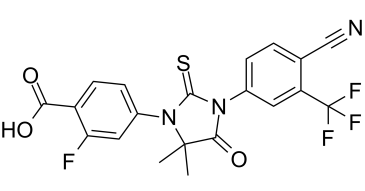
Enzalutamide carboxylic acid (also called MDV-3100 carboxylic acid) is a major inactive metabolite of Enzalutamide (MDV3100; Xtandi) which is a non-steroidal androgen-receptor (AR) antagonist approved for use as an anticancer drug.
Physicochemical Properties
| Molecular Formula | C₂₀H₁₃F₄N₃O₃S |
| Molecular Weight | 451.39 |
| Exact Mass | 451.061 |
| CAS # | 1242137-15-0 |
| Related CAS # | Enzalutamide;915087-33-1;N-desmethyl Enzalutamide;1242137-16-1;Enzalutamide carboxylic acid-d6 |
| PubChem CID | 46898522 |
| Appearance | White to off-white solid powder |
| LogP | 4.461 |
| Hydrogen Bond Donor Count | 1 |
| Hydrogen Bond Acceptor Count | 9 |
| Rotatable Bond Count | 3 |
| Heavy Atom Count | 31 |
| Complexity | 824 |
| Defined Atom Stereocenter Count | 0 |
| InChi Key | MECDPCCFIDQBBP-UHFFFAOYSA-N |
| InChi Code | InChI=1S/C20H13F4N3O3S/c1-19(2)17(30)26(11-4-3-10(9-25)14(7-11)20(22,23)24)18(31)27(19)12-5-6-13(16(28)29)15(21)8-12/h3-8H,1-2H3,(H,28,29) |
| Chemical Name | 4-[3-[4-cyano-3-(trifluoromethyl)phenyl]-5,5-dimethyl-4-oxo-2-sulfanylideneimidazolidin-1-yl]-2-fluorobenzoic acid |
| Synonyms | Enzalutamide carboxylic acid; MDV3100 carboxylic acid; 1242137-15-0; Enzalutamide Carboxylic Acid; 4-(3-(4-cyano-3-(trifluoromethyl)phenyl)-5,5-dimethyl-4-oxo-2-thioxoimidazolidin-1-yl)-2-fluorobenzoic acid; Enzalutamide Carboxylic Acid Metabolite (M1); YF8MAL2HDY; Enzalutamide metabolite M1; 4-[3-[4-cyano-3-(trifluoromethyl)phenyl]-5,5-dimethyl-4-oxo-2-sulfanylideneimidazolidin-1-yl]-2-fluorobenzoic acid; 4-[3-[4-Cyano-3-(trifluoromethyl)phenyl]-5,5-dimethyl-4-oxo-2-thioxo-1-imidazolidinyl]-2-fluoro-benzoic Acid; MDV-3100 carboxylic acid |
| HS Tariff Code | 2934.99.9001 |
| Storage |
Powder-20°C 3 years 4°C 2 years In solvent -80°C 6 months -20°C 1 month |
| Shipping Condition | Room temperature (This product is stable at ambient temperature for a few days during ordinary shipping and time spent in Customs) |
Biological Activity
| Targets | Inactive metabolite of Enzalutamide (AR antagonist) |
| ln Vitro | By means of cytochrome P450 (CYP) 3A4/5 and CYP2C8, enzalutamide is transformed into its principal metabolites, N-desmethylenzalutamide and enzalutamide carboxylate, respectively. While enzalutamide carboxylate is inactive, N-desmethylenzalutamide exhibits clinically significant antiandrogenic activity that is comparable to enzalutamide [1]. |
| References |
[1]. Exposure-Response Assessment of Enzalutamide and Its Major Metabolites in a Real-World Cohort of Patients with Metastatic Castration-Resistant Prostate Cancer. Pharmacotherapy. 2019 Dec;39(12):1137-1145. |
| Additional Infomation | Study objective: Enzalutamide is an oral agent for the treatment of metastatic castration-resistant prostate cancer (mCRPC); N-desmethyl enzalutamide is its active metabolite, which has clinically relevant anti-androgen capacities similar to enzalutamide, and carboxylic acid enzalutamide is an inactive metabolite. The aim of our study was to investigate the relationship between enzalutamide and N-desmethyl enzalutamide exposure and treatment response in a real-world cohort of patients with mCRPC. Design: Retrospective, observational, pharmacokinetic study. Setting: Outpatient clinic at a tertiary cancer center in Amsterdam, the Netherlands. Patients: Sixty-five patients with mCRPC who were treated with enzalutamide 160 mg daily and had at least one steady-state enzalutamide plasma concentration between May 2015 and June 2018; of these patients, 38 were prostate-specific antigen (PSA) responders and 27 were nonresponders. Measurements and main results: Plasma concentrations, determined by using liquid chromatography with tandem mass spectrometry (LC-MS/MS), were compared between PSA responders and nonresponders. Three clinical end points were evaluated separately in this study: PSA-independent progression-free survival (PFS), time to PSA progression (TTPP), and rate of PSA response (defined as ≥ 50% decrease in PSA level from baseline). Enzalutamide toxicity was defined as discontinuation due to adverse events, dose reductions due to adverse events, or temporary treatment interruption. For these analyses, plasma concentrations of enzalutamide and N-desmethyl enzalutamide were divided into quartiles. Mean ± SD plasma concentrations in the 65 patients were as follows: enzalutamide 11.2 ± 2.8 μg/ml, N-desmethyl enzalutamide 9.9 ± 2.9 μg/ml, and carboxylic acid enzalutamide 6.1 ± 4.3 μg/ml. Plasma concentrations were not significantly different in the PSA responder versus nonresponder groups for enzalutamide (11.5 vs 10.6 μg/ml, p=0.20), N-desmethyl enzalutamide (10.1 vs 9.6 μg/ml, p=0.48), and carboxylic acid enzalutamide (6.5 vs 5.5 μg/ml, p=0.34). Univariate and multivariate analyses did not show a relationship between plasma concentrations and PSA-independent PFS, TTPP, or toxicity. Conclusion: This study confirmed that enzalutamide plasma concentrations were not related to PSA-independent PFS, TTPP, or toxicity in patients with mCRPC, and demonstrated that plasma concentrations of its major metabolites were also not associated with treatment response. Based on these findings, there is no role for therapeutic drug monitoring of enzalutamide in patients with mCRPC in daily practice. [1] |
Solubility Data
| Solubility (In Vitro) | DMSO : ~125 mg/mL (~276.92 mM) |
| Solubility (In Vivo) |
Solubility in Formulation 1: ≥ 2.08 mg/mL (4.61 mM) (saturation unknown) in 10% DMSO + 40% PEG300 + 5% Tween80 + 45% Saline (add these co-solvents sequentially from left to right, and one by one), clear solution. For example, if 1 mL of working solution is to be prepared, you can add 100 μL of 20.8 mg/mL clear DMSO stock solution to 400 μL PEG300 and mix evenly; then add 50 μL Tween-80 to the above solution and mix evenly; then add 450 μL normal saline to adjust the volume to 1 mL. Preparation of saline: Dissolve 0.9 g of sodium chloride in 100 mL ddH₂ O to obtain a clear solution. Solubility in Formulation 2: ≥ 2.08 mg/mL (4.61 mM) (saturation unknown) in 10% DMSO + 90% (20% SBE-β-CD in Saline) (add these co-solvents sequentially from left to right, and one by one), clear solution. For example, if 1 mL of working solution is to be prepared, you can add 100 μL of 20.8 mg/mL clear DMSO stock solution to 900 μL of 20% SBE-β-CD physiological saline solution and mix evenly. Preparation of 20% SBE-β-CD in Saline (4°C,1 week): Dissolve 2 g SBE-β-CD in 10 mL saline to obtain a clear solution. Solubility in Formulation 3: ≥ 2.08 mg/mL (4.61 mM) (saturation unknown) in 10% DMSO + 90% Corn Oil (add these co-solvents sequentially from left to right, and one by one), clear solution. For example, if 1 mL of working solution is to be prepared, you can add 100 μL of 20.8 mg/mL clear DMSO stock solution to 900 μL of corn oil and mix evenly. (Please use freshly prepared in vivo formulations for optimal results.) |
| Preparing Stock Solutions | 1 mg | 5 mg | 10 mg | |
| 1 mM | 2.2154 mL | 11.0769 mL | 22.1538 mL | |
| 5 mM | 0.4431 mL | 2.2154 mL | 4.4308 mL | |
| 10 mM | 0.2215 mL | 1.1077 mL | 2.2154 mL |