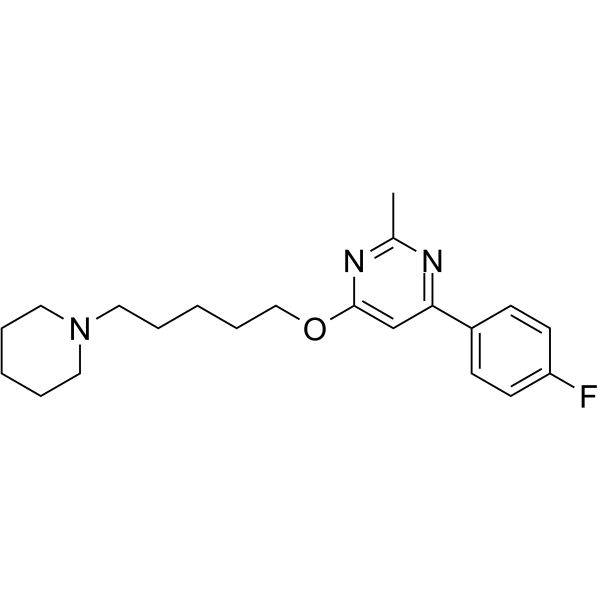
Physicochemical Properties
| Molecular Formula | C₂₁H₂₈FN₃O |
| Molecular Weight | 357.46 |
| Exact Mass | 357.221 |
| CAS # | 259525-01-4 |
| Related CAS # | 259525-01-4;178429-67-9 (HCl); |
| PubChem CID | 6433114 |
| Appearance | Light yellow to yellow solid powder |
| Density | 1.099g/cm3 |
| Boiling Point | 487.7ºC at 760mmHg |
| Flash Point | 248.8ºC |
| Vapour Pressure | 1.16E-09mmHg at 25°C |
| Index of Refraction | 1.537 |
| LogP | 0.003 |
| Hydrogen Bond Donor Count | 0 |
| Hydrogen Bond Acceptor Count | 5 |
| Rotatable Bond Count | 8 |
| Heavy Atom Count | 26 |
| Complexity | 384 |
| Defined Atom Stereocenter Count | 0 |
| SMILES | CC1=NC(OCCCCCN2CCCCC2)=CC(C3=CC=C(F)C=C3)=N1 |
| InChi Key | SZSHJTJCJOWMHM-UHFFFAOYSA-N |
| InChi Code | InChI=1S/C21H28FN3O/c1-17-23-20(18-8-10-19(22)11-9-18)16-21(24-17)26-15-7-3-6-14-25-12-4-2-5-13-25/h8-11,16H,2-7,12-15H2,1H3 |
| Chemical Name | 4-(4-fluorophenyl)-2-methyl-6-(5-piperidin-1-ylpentoxy)pyrimidine |
| HS Tariff Code | 2934.99.9001 |
| Storage |
Powder-20°C 3 years 4°C 2 years In solvent -80°C 6 months -20°C 1 month |
| Shipping Condition | Room temperature (This product is stable at ambient temperature for a few days during ordinary shipping and time spent in Customs) |
Biological Activity
| Targets |
Enecadin targets endothelin B (ETB) receptor (exhibits agonist activity) [1] |
| ln Vitro | Enecadin is a neuroprotective drug that can be used to treat stroke or other cerebrovascular events [1]. |
| ln Vivo |
In rat middle cerebral artery occlusion (MCAO)-induced ischemic stroke models, Enecadin administration resulted in a significant reduction in cerebral infarct volume compared to vehicle-treated controls [1] It improved neurological deficits in stroke-induced rats, as evaluated by standardized neurological scoring systems assessing locomotor function, balance, reflex responses, and sensorimotor integration [1] The neuroprotective effect of Enecadin was associated with increased cerebral blood flow in the ischemic penumbra, mitigating hypoxic damage to neuronal and glial cells [1] The compound demonstrated therapeutic efficacy when administered pre-ischemia (30 minutes prior to MCAO) or post-ischemia (within 1–4 hours after reperfusion), supporting its potential for acute stroke management [1] |
| Animal Protocol |
Rats (strain not specified) were randomly assigned to vehicle control, Enecadin treatment (multiple dose groups), and optional positive control groups [1] Ischemic stroke was induced via MCAO: the middle cerebral artery was occluded for 60–90 minutes using an intraluminal suture method, followed by reperfusion [1] Enecadin was formulated in a physiologically compatible vehicle (specific composition not detailed) and administered via intravenous injection or intraperitoneal injection at doses ranging from 0.01 mg/kg to 10 mg/kg [1] Administration timings included: pre-ischemia (30 minutes before MCAO occlusion), acute post-reperfusion (1–4 hours after suture removal), and subacute post-stroke (24 hours after stroke onset) [1] Neurological function was assessed at 6, 24, 48, and 72 hours post-stroke using validated scoring criteria [1] At the study endpoint (24–72 hours post-stroke), rats were euthanized; brains were harvested, sectioned, and stained with 2,3,5-triphenyltetrazolium chloride (TTC) to quantify infarct volume [1] |
| References | [1]. Anil Gulati. Methods for treatment of stroke or cerebrovascular accidents using an ETB receptor agonist. US 8623823 B2. |
| Additional Infomation |
Enecadin has been investigated for the treatment of Stroke. Enecadin is a synthetic small-molecule ETB receptor agonist developed for the treatment of stroke and cerebrovascular accidents [1] Its mechanism of action involves specific activation of ETB receptors expressed on vascular endothelial cells, leading to vasodilation, improved cerebral microcirculation, and reduced ischemic neuronal death [1] It exhibits selectivity for ETB receptors over endothelin A (ETA) receptors, minimizing ETA-mediated adverse effects such as vasoconstriction or pro-inflammatory responses [1] The compound is the subject of US Patent 8623823 B2, which claims methods for its use in treating stroke by administering effective doses to reduce infarct size and improve neurological outcomes [1] |
Solubility Data
| Solubility (In Vitro) | DMSO : ≥ 50 mg/mL (~139.88 mM) |
| Solubility (In Vivo) |
Solubility in Formulation 1: ≥ 2.08 mg/mL (5.82 mM) (saturation unknown) in 10% DMSO + 40% PEG300 + 5% Tween80 + 45% Saline (add these co-solvents sequentially from left to right, and one by one), clear solution. For example, if 1 mL of working solution is to be prepared, you can add 100 μL of 20.8 mg/mL clear DMSO stock solution to 400 μL PEG300 and mix evenly; then add 50 μL Tween-80 to the above solution and mix evenly; then add 450 μL normal saline to adjust the volume to 1 mL. Preparation of saline: Dissolve 0.9 g of sodium chloride in 100 mL ddH₂ O to obtain a clear solution. Solubility in Formulation 2: ≥ 2.08 mg/mL (5.82 mM) (saturation unknown) in 10% DMSO + 90% Corn Oil (add these co-solvents sequentially from left to right, and one by one), clear solution. For example, if 1 mL of working solution is to be prepared, you can add 100 μL of 20.8 mg/mL clear DMSO stock solution to 900 μL of corn oil and mix evenly. (Please use freshly prepared in vivo formulations for optimal results.) |
| Preparing Stock Solutions | 1 mg | 5 mg | 10 mg | |
| 1 mM | 2.7975 mL | 13.9876 mL | 27.9752 mL | |
| 5 mM | 0.5595 mL | 2.7975 mL | 5.5950 mL | |
| 10 mM | 0.2798 mL | 1.3988 mL | 2.7975 mL |