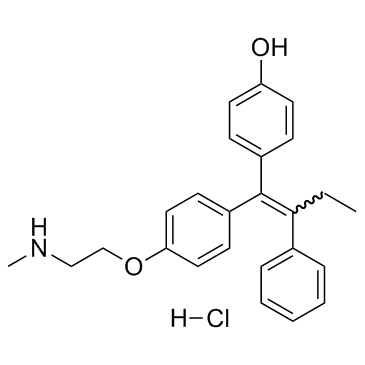
Endoxifen hydrochloride (N-desmethyl-4-hydroxytamoxifen) is an active metabolite of Tamoxifen which is a potent SERM/antiestrogen. It is also being evaluated as an antipsychotic for treatment of mania and other psychotic disorders. Endoxifen is a nonsteroidal selective estrogen receptor modulator (SERM) of the triphenylethylene group.
Physicochemical Properties
| Molecular Formula | C₂₅H₂₈CLNO₂ |
| Molecular Weight | 409.95 |
| Exact Mass | 409.18 |
| CAS # | 1197194-41-4 |
| Related CAS # | Endoxifen (Z-isomer);112093-28-4;Endoxifen Z-isomer hydrochloride;1032008-74-4;Endoxifen (E-isomer);114828-90-9;Endoxifen;110025-28-0;Endoxifen E-isomer hydrochloride;1197194-61-8 |
| PubChem CID | 54613017 |
| Appearance | Light brown to brown solid powder |
| Hydrogen Bond Donor Count | 3 |
| Hydrogen Bond Acceptor Count | 3 |
| Rotatable Bond Count | 8 |
| Heavy Atom Count | 29 |
| Complexity | 467 |
| Defined Atom Stereocenter Count | 0 |
| SMILES | Cl[H].O(C([H])([H])C([H])([H])N([H])C([H])([H])[H])C1C([H])=C([H])C(=C([H])C=1[H])/C(/C1C([H])=C([H])C(=C([H])C=1[H])O[H])=C(\C1C([H])=C([H])C([H])=C([H])C=1[H])/C([H])([H])C([H])([H])[H] |
| InChi Key | RPFIMPDXTABYCN-BJFQDICYSA-N |
| InChi Code | InChI=1S/C25H27NO2.ClH/c1-3-24(19-7-5-4-6-8-19)25(20-9-13-22(27)14-10-20)21-11-15-23(16-12-21)28-18-17-26-2;/h4-16,26-27H,3,17-18H2,1-2H3;1H/b25-24-; |
| Chemical Name | 4-[(Z)-1-[4-[2-(methylamino)ethoxy]phenyl]-2-phenylbut-1-enyl]phenol;hydrochloride |
| HS Tariff Code | 2934.99.9001 |
| Storage |
Powder-20°C 3 years 4°C 2 years In solvent -80°C 6 months -20°C 1 month Note: Please store this product in a sealed and protected environment, avoid exposure to moisture. |
| Shipping Condition | Room temperature (This product is stable at ambient temperature for a few days during ordinary shipping and time spent in Customs) |
Biological Activity
| Targets | Endoxifen hydrochloride targets Estrogen Receptor α (ERα) for degradation via the proteasome pathway [2]. |
| ln Vitro |
Endoxifen, a metabolite of hydroxylated tamoxifen, has an ER antagonistic potency that is around 100 times greater than tamoxifen's. In addition to its impact on transcription within the ER, it also implies that endoxifen, but not 4-hydroxytamoxifen, causes ER-alpha degradation[1]. A strong antiestrogen called endoxifen causes breast cancer cells' estrogen receptor α to break down. Endoxifen has also been demonstrated to decrease estrogen-induced breast cancer cell proliferation and block ERA transcriptional activity, even in the presence of tamoxifen, N-desmethyl-tamoxifen, and 4-hydroxytamoxifen[2]. With the exception of MDAMB-468, which shows modest inhibition at 10 μM, doxifen significantly inhibits the development of all breast cancer cell lines. For MCF7, HS 578T, and BT-549 cells, cytotoxic effects are highly noticeable at 10 μM concentration. All studied cells showed lethality at 100 μM Endoxifen concentration, but the inhibitory effects at lower doses (0.01-1 μM) are not as strong as those at 10 μM[2]. Endoxifen hydrochloride induces ERα protein degradation in MCF7, T47D, Hs578T-ERα, and U2OS-ERα cells in a concentration-dependent manner, with effects observed between 10 and 1000 nmol/L but not at ≤1 nmol/L [2]. Significant reduction in ERα protein levels is observed within 6 hours of treatment with 100 nmol/L endoxifen [2]. Proteasome inhibitor MG132 blocks endoxifen-induced ERα degradation, confirming proteasome-mediated degradation [2]. Endoxifen inhibits estrogen response element (ERE)-driven luciferase reporter activity in transfected Hs578T cells, and this inhibition is maintained even in the presence of tamoxifen, 4-hydroxy-tamoxifen (4HT), and N-desmethyl-tamoxifen (NDT) [2]. Endoxifen suppresses estrogen-induced expression of endogenous ERα target genes amphiregulin and c-Myc in MCF7 cells, with high concentrations (100–1000 nmol/L) showing complete or near-complete suppression [2]. Endoxifen inhibits estrogen-induced proliferation of MCF7 cells in a dose-dependent manner, with high concentrations (100–1000 nmol/L) showing strong suppression even in the presence of tamoxifen, 4HT, and NDT [2]. In Ishikawa endometrial carcinoma cells, endoxifen does not induce ERα degradation and has minimal effect on cell proliferation under the experimental conditions used [2]. |
| ln Vivo | In female rats, oral administration of Endoxifen results in fast absorption and systemic availability. When compared to Tamoxifen, the rats administered with Endoxifen exhibit 1,500% greater concentration (Cmax) and 787% higher exposure (AUC0–∞) levels of Endoxifen. Endoxifen given orally once daily for 28 days in a succession at doses of 2, 4, and 8 mg/kg has been shown to be safe and to gradually reduce the growth of human mammary tumor xenografts in female mice[2]. |
| Cell Assay |
For Western blot analysis of ERα protein levels, cells were plated in 12-well plates and treated with various concentrations of endoxifen or other ER ligands for 24 hours. Cell extracts were prepared using Laemmli buffer, and proteins were resolved by SDS-PAGE, transferred to membranes, and probed with anti-ERα and anti-tubulin antibodies [2]. For time-course experiments, MCF7 cells were treated with 100 nmol/L endoxifen for various time points up to 24 hours, followed by protein extraction and Western blotting [2]. For proteasome inhibition studies, cells were pretreated with 25 μmol/L MG132 or vehicle for 1 hour, followed by treatment with endoxifen or other ligands for 8 hours in the continued presence of MG132 [2]. For reporter gene assays, parental Hs578T cells were transiently transfected with an ERα expression vector and an ERE-luciferase reporter construct. After transfection, cells were treated with ligands for 24 hours, lysed, and luciferase activity was measured [2]. For real-time RT-PCR, MCF7 cells were treated with ligands for 24 hours, total RNA was isolated, reverse transcribed, and quantitative PCR was performed using gene-specific primers for amphiregulin and c-Myc, with TATA-binding protein as a control [2]. For cell proliferation assays, MCF7 and Ishikawa cells were seeded in 96-well plates and treated with ligands every 48 hours for 8 days. Cell viability was measured using a luminescent cell viability assay kit [2]. |
| ADME/Pharmacokinetics |
In patients taking tamoxifen (20 mg/day), plasma endoxifen concentrations vary with CYP2D6 phenotype: extensive metabolizers (EM) average ~90 nmol/L (±40 nmol/L), intermediate metabolizers (IM) range 40–60 nmol/L, and poor metabolizers (PM) have concentrations <30 nmol/L [2]. In the same patients, average steady-state concentrations of tamoxifen, 4HT, and NDT are approximately 335, 7.4, and 695 nmol/L, respectively [2]. |
| References |
[1]. Goetz MP, et al. Tamoxifen, endoxifen, and CYP2D6: the rules for evaluating a predictive factor. Oncology (Williston Park). 2009 Dec;23(14):1233-4, 1236. [2]. Wu X, et al. The tamoxifen metabolite, Endoxifen, is a potent antiestrogen that targets estrogen receptor alpha fordegradation in breast cancer cells. Cancer Res. 2009 Mar 1;69(5):1722-7 |
| Additional Infomation |
Endoxifen Hydrochloride is the hydrochloride salt and the z (cis-) stereoisomer of endoxifen with potential antineoplastic activity. Endoxifen, the active metabolite of tamoxifen, competitively inhibits the binding of estradiol to estrogen receptors, thereby preventing the receptor from binding to the estrogen-response element on DNA and thus reducing DNA synthesis. Unlike tamoxifen, however, which relies on CYP2D6 activity for its conversion to the active metabolite endoxifen, the direct administration of endoxifen bypasses the CYP2D6 route. As CYP2D6 activity can vary widely among individuals due to genetic CYP2D6 polymorphisms, endoxifen is therefore theoretically more potent and more uniform in its bioavailability across patient populations. Endoxifen hydrochloride (also referred to as 4-hydroxy-N-desmethyl-tamoxifen) is an active metabolite of tamoxifen formed primarily via CYP2D6-mediated oxidation of N-desmethyl-tamoxifen [2]. It functions as a potent antiestrogen by targeting ERα for proteasomal degradation, a mechanism distinct from that of 4-hydroxy-tamoxifen, which stabilizes ERα [2]. Its potency in degrading ERα and inhibiting ERα-mediated transcription and cell proliferation is concentration-dependent and correlates with CYP2D6 metabolic status [2]. The study suggests that endoxifen is a key mediator of tamoxifen’s therapeutic efficacy in ER-positive breast cancer and provides a mechanistic basis for CYP2D6 genotyping to predict treatment response [2]. |
Solubility Data
| Solubility (In Vitro) |
DMSO : ≥ 35 mg/mL (~85.38 mM) H2O : ~1 mg/mL (~2.44 mM) |
| Solubility (In Vivo) |
Solubility in Formulation 1: ≥ 2.5 mg/mL (6.10 mM) (saturation unknown) in 10% DMSO + 40% PEG300 + 5% Tween80 + 45% Saline (add these co-solvents sequentially from left to right, and one by one), clear solution. For example, if 1 mL of working solution is to be prepared, you can add 100 μL of 25.0 mg/mL clear DMSO stock solution to 400 μL PEG300 and mix evenly; then add 50 μL Tween-80 to the above solution and mix evenly; then add 450 μL normal saline to adjust the volume to 1 mL. Preparation of saline: Dissolve 0.9 g of sodium chloride in 100 mL ddH₂ O to obtain a clear solution. Solubility in Formulation 2: ≥ 2.5 mg/mL (6.10 mM) (saturation unknown) in 10% DMSO + 90% (20% SBE-β-CD in Saline) (add these co-solvents sequentially from left to right, and one by one), clear solution. For example, if 1 mL of working solution is to be prepared, you can add 100 μL of 25.0 mg/mL clear DMSO stock solution to 900 μL of 20% SBE-β-CD physiological saline solution and mix evenly. Preparation of 20% SBE-β-CD in Saline (4°C,1 week): Dissolve 2 g SBE-β-CD in 10 mL saline to obtain a clear solution. (Please use freshly prepared in vivo formulations for optimal results.) |
| Preparing Stock Solutions | 1 mg | 5 mg | 10 mg | |
| 1 mM | 2.4393 mL | 12.1966 mL | 24.3932 mL | |
| 5 mM | 0.4879 mL | 2.4393 mL | 4.8786 mL | |
| 10 mM | 0.2439 mL | 1.2197 mL | 2.4393 mL |